Stablecoins: What is USDT?

Last updated: July 2026
Table of Contents
- What Are Stablecoins?
- What Is Tether (USDT)?
- Who Created Tether and Who Runs It?
- How USDT Stays at $1
- What Backs USDT: Reserves and Attestations
- USDT by the Numbers in 2026
- How USDT Is Regulated
- USDT Controversies
- USDT, Tether Gold and Tokenized Assets
- Frequently Asked Questions
- Final Thoughts
Every crypto trader touches USDT sooner or later. It is the quote currency on thousands of trading pairs, the digital dollar of choice in emerging markets and the largest stablecoin in existence. It is also run by one of the most scrutinized companies in the industry.
This guide explains what USDT is, who stands behind it, what actually backs it and where the open questions remain.
What Are Stablecoins?
Stablecoins are cryptocurrencies designed to hold a steady value, most commonly one US dollar per token, by being backed with reserves such as cash, short-term government debt or other assets. They give traders and businesses a way to move dollar value across blockchains without the volatility of assets like Bitcoin. Our guide to the purpose of stablecoins covers the category in more depth.
What Is Tether (USDT)?
USDT is a dollar-pegged stablecoin issued by Tether. Each token is intended to be redeemable for one US dollar, backed by a reserve portfolio the company reports in quarterly attestations. USDT does not run its own blockchain: it exists as a token on other networks, with the majority of supply circulating on Tron and Ethereum.
The name describes the idea: the token is “tethered” to the dollar. Traders use it to park value between positions, exchanges use it as their main quote asset, and in countries with weak local currencies it functions as an accessible digital dollar.
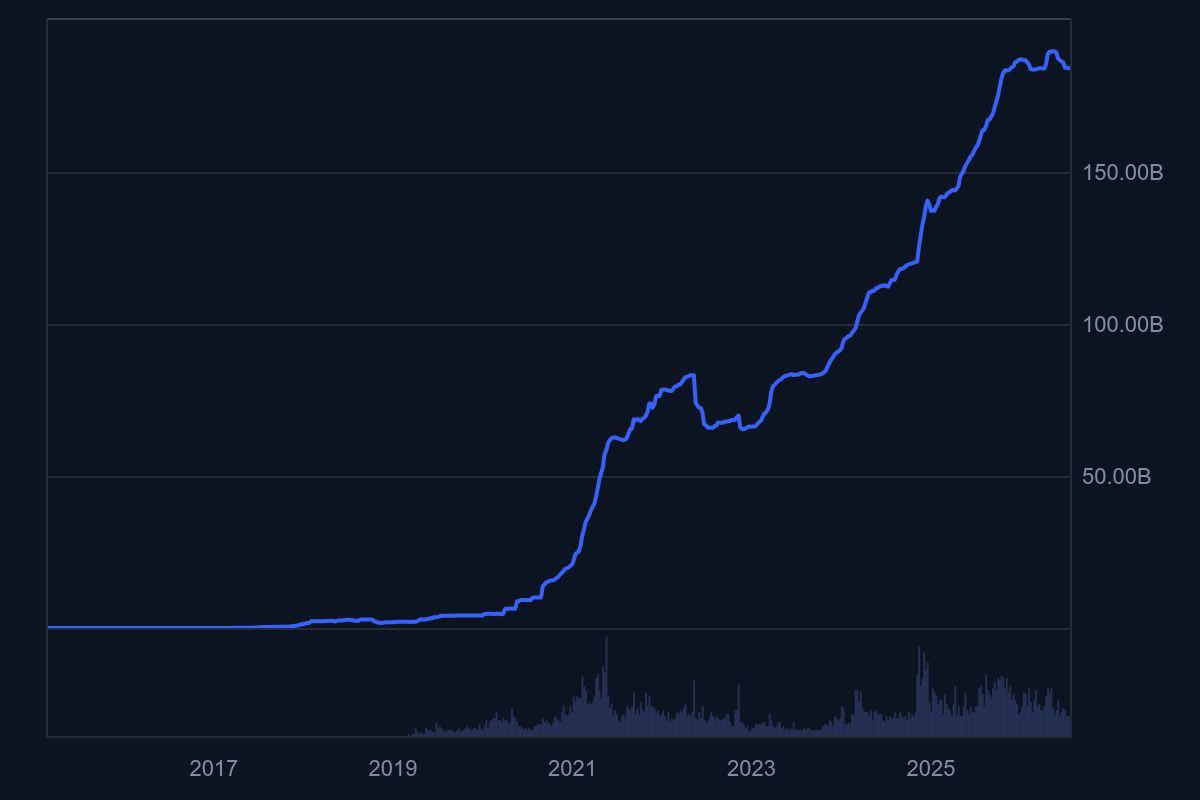
As of July 21, 2026, USDT’s market capitalization stands around $184 billion at the time of writing, according to CoinMarketCap. On June 26, 2026, USDT briefly overtook Ethereum to become the second-largest crypto asset by market value, ending ETH’s hold on that position for the first time in over seven years. USDT has held the top spot by daily trading volume for years.
Who Created Tether and Who Runs It?
The project launched in July 2014 as RealCoin, founded by Brock Pierce, Reeve Collins and Craig Sellars, and was rebranded to Tether in November 2014. Trading began in early 2015.
The issuer was long incorporated in the British Virgin Islands and shares historical ownership ties with the crypto exchange Bitfinex through the parent group iFinex. Following El Salvador’s digital-asset licensing regime, Tether relocated its headquarters there, and USDT is today issued by Tether International, S.A. de C.V., its Salvadoran entity. The company is led by CEO Paolo Ardoino.
Tether has expanded well beyond the stablecoin, with divisions covering payments infrastructure, Bitcoin mining, AI and education, funded by reserve income that made it one of the most profitable companies per employee in the world.
How USDT Stays at $1
The peg is maintained through issuance and redemption. Verified customers can send dollars to Tether and receive newly minted USDT, or redeem USDT with the company for dollars, which removes those tokens from circulation. If the market price drifts from $1, arbitrage traders profit by minting or redeeming until the price returns to the peg.
Direct redemption, however, is not retail-facing. Under Tether’s published fee schedule, redemption requires a verified account, a minimum transaction of $100,000 and a fee of 0.1% or $1,000, whichever is greater. Ordinary holders exit USDT by selling it on an exchange, which means the peg most people experience is enforced by arbitrage desks, not by their own claim on Tether.
The mechanism has held through repeated market shocks, although the price has deviated historically, trading as low as roughly $0.57 in its early, less liquid years and wobbling to about $0.95 during the May 2022 market collapse before recovering within hours. Brief deviations of fractions of a cent still occur during volatile sessions.
USDT is issued across multiple blockchains. As of 2026, more than 60% of supply lives on Tron, which dominates payment and remittance use, with Ethereum second and smaller amounts on other networks, per Tether’s transparency data. Older transport layers such as Bitcoin’s Omni protocol have been phased out.
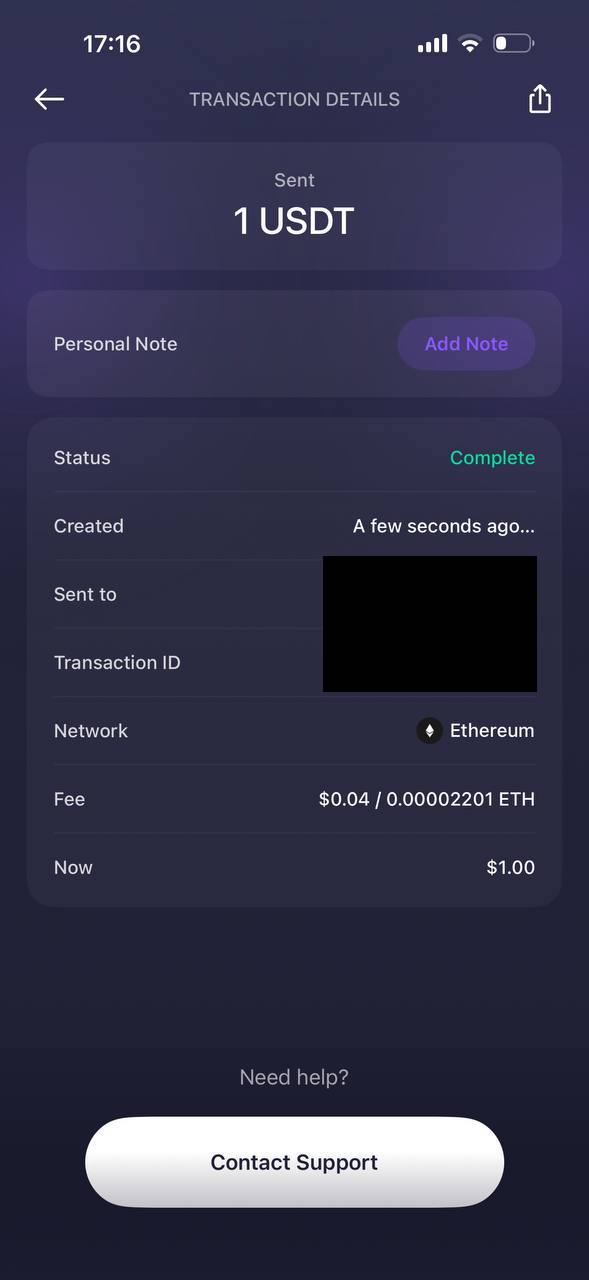
- Tested in practice: On 21 July 2026, while updating this guide, we sent 1 USDT between two self-custody wallets on Ethereum.
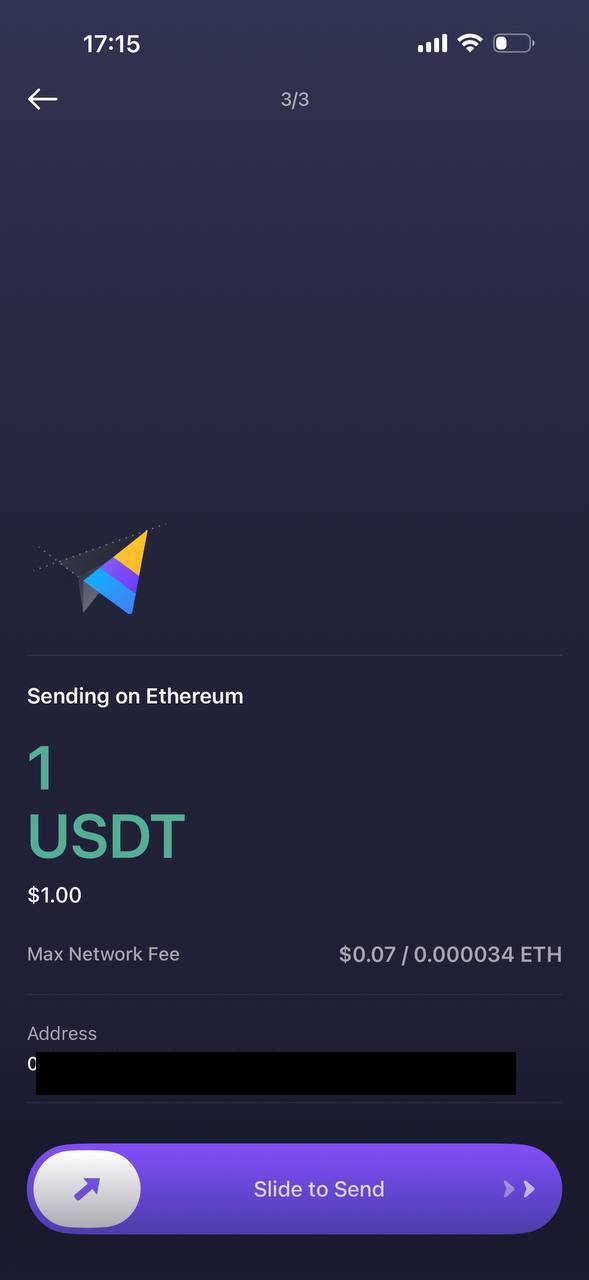
The wallet quoted a maximum network fee of $0.07; the transfer confirmed in roughly nine seconds and the final cost came to $0.04 (0.00002201 ETH). At today’s fee levels, moving USDT on Ethereum costs cents and settles in seconds, a sharp contrast with earlier years, when gas spikes could push a small transfer above the value being sent.
What Backs USDT: Reserves and Attestations
Tether publishes quarterly attestations prepared by the accounting firm BDO on its transparency page. The report covering the first quarter of 2026 showed total assets of $191.7 billion against token-related liabilities of about $183.5 billion, leaving record excess reserves of roughly $8.23 billion, alongside quarterly profit of about $1.04 billion.
| Reserve component | Value (March 31, 2026) | Approx. share of assets |
|---|---|---|
| Cash, cash equivalents & short-term deposits ($117.0B direct US T-bills plus $24.1B in Treasury-collateralized reverse repos) | $141.2 billion | ~74% |
| Physical gold (LBMA bars) | $19.8 billion | ~10% |
| Secured loans (overcollateralized) | $15.8 billion | ~8% |
| Bitcoin (roughly 97,000 BTC) | $6.6 billion | ~3.5% |
| Other investments | $4.8 billion | ~2.5% |
| Public equities (indirect gold, bitcoin and other exposure) | $3.4 billion | ~2% |
Source: Tether Q1 2026 attestation announcement (BDO). Figures as of March 31, 2026; shares are approximate and calculated against total reported assets.
The Treasury position makes Tether roughly the 17th-largest holder of US government debt globally, and the interest it generates is the engine behind the company’s profits.
An important distinction: attestations are point-in-time snapshots verified by an accountant, not a full financial audit. Tether has engaged a Big Four firm to work toward its first complete independent audit, something critics have requested for years, but as of July 2026 no full audit has been published. Readers should check the transparency page for the current status.
USDT by the Numbers in 2026
Company figures put USDT’s user base above 500 million. In a July 2026 update reported by Bitcoin.com News, CEO Paolo Ardoino said the stablecoin is adding more than 30 million wallets per quarter, concentrated in developing countries, and that half or more of USDT activity now relates to cross-border trade and payments rather than crypto trading. These are the company’s own characterizations of its user data.
Annual transfer volume runs in the trillions of dollars, and USDT remains the most traded crypto asset by daily volume, ahead of Bitcoin itself.
How USDT Is Regulated
Regulation now shapes where and how USDT can be used, and the answer differs by region.
In the European Union, the MiCA framework requires stablecoin issuers to be authorized as e-money issuers. Tether has not sought that authorization, so regulated European exchanges have delisted USDT trading pairs for retail users. Our guide on how European users can convert USDT to USDC explains the practical consequences.
In the United States, the GENIUS Act created a federal framework for payment stablecoins. Rather than restructuring USDT itself, Tether launched a separate, US-compliant stablecoin, USAT, for the American market, while USDT continues to serve its global base.
Elsewhere, treatment ranges from licensed acceptance to restriction, and users should always check local rules. Regulatory approval, where it exists, applies to how a product is offered, and is not a guarantee of its reserves or value.
USDT Controversies
Tether’s history includes episodes that still define how critics view it, and an honest guide has to include them.
In 2021, the US Commodity Futures Trading Commission fined Tether $41 million for misstating, in earlier years, that USDT was fully backed by fiat at all times. The same year, the New York Attorney General reached an $18.5 million settlement with Tether and Bitfinex over commingled funds and reserve disclosures, barring them from operating in New York. During that dispute, the company’s lawyers acknowledged that at one point only about 74% of USDT was backed by cash and equivalents.
Tether’s reserve composition and transparency have improved substantially since then, but the absence of a completed full audit keeps the question open, and the company’s scale means any reserve failure would be systemic for the entire crypto market.
A separate structural point: USDT is centrally issued, and Tether can freeze tokens at specific addresses. It has done so extensively at the request of law enforcement, targeting funds tied to scams, sanctions and theft. Depending on the observer, this is either responsible compliance or proof that USDT is nothing like censorship-resistant money. Both readings are accurate descriptions of the same capability.
USDT, Tether Gold and Tokenized Assets
Stablecoins were the first tokenized real-world asset to reach mass adoption: a claim on dollars, represented as a blockchain token. The model USDT proved now extends to tokenized Treasuries, funds, stocks and commodities, a market our guide to RWA tokenization platforms covers in detail.
Tether itself participates beyond the dollar with Tether Gold (XAUT), a token backed by physical gold held in Switzerland. As with any tokenized asset, what matters is the legal claim behind the token: who issues it, what backs it, and how it can be redeemed.
Frequently Asked Questions
Is USDT the same as the US dollar?
No. USDT is a private company’s token designed to track the dollar and be redeemable for it. It is not legal tender, not a bank deposit and not government-insured.
Can USDT lose its peg?
It can and briefly has, most notably a dip to about $0.95 in May 2022 that recovered within hours. The peg depends on Tether’s reserves and redemption process continuing to function.
Is USDT safe to hold?
USDT carries issuer risk (Tether’s reserves and solvency), regulatory risk (as the EU delistings show) and the usual custody risks of any crypto asset. It removes price volatility, not risk in general.
Why can’t European users trade USDT on regulated exchanges?
Because Tether has not sought e-money authorization under MiCA, regulated EEA platforms have removed retail USDT trading pairs. Holding and withdrawing USDT generally remains possible.
What is the difference between USDT and USDC?
Both aim to track the dollar. USDC is issued by Circle, which holds e-money authorization in the EU and follows a US-regulated reserve model; USDT is larger, more liquid globally and dominant in emerging markets, but sits outside the EU framework. For more details on the difference you can read our report on USDT vs. USDC.
Conclusion
USDT is the one of the successful products crypto has shipped so far: a digital dollar used by hundreds of millions of people, most of whom will never trade a volatile cryptocurrency. It is also a bet on a single private company’s balance sheet, one that regulators, critics and the market continue to test.
Understanding both halves of that sentence is what it means to understand Tether. For unfamiliar terms encountered along the way, our crypto terms guide can help.
Source review: Updated in July 2026 using Tether’s transparency page and Q1 2026 BDO attestation, CFTC and New York Attorney General enforcement publications, ESMA’s MiCA materials, US Congress records and market data from CoinGecko current as of publication.
This article is provided for informational purposes only and does not constitute financial, investment, legal or tax advice.



Alexander Zdravkov is a market analyst and crypto journalist with interests in economics, broader financial markets and digital assets. His journey into crypto began more than four years ago, driven by a fascination with the rapid evolution of blockchain technology and the transformative potential of decentralized finance. He began analyzing market cycles and identifying emerging trends before they reach the mainstream. He holds a degree in International Relations - a background that helped shape his broader perspective on global economics, geopolitics, and the interconnected nature of modern financial markets. Whether covering the latest developments in the crypto sector or exploring broader macroeconomic themes, Alexander focuses on giving readers context rather than simply repeating headlines. During his career, he has authored more than 5,000 articles covering cryptocurrencies, traditional finance, and global market developments. His work spans everything from Bitcoin and altcoins to macroeconomic trends influencing risk assets worldwide.