What Is Solana (SOL) and How Does Its Blockchain Work?

Solana is a public blockchain built to process transactions at a pace and cost that suit trading, stablecoins and consumer applications. It combines proof of stake, Proof of History and an account model that can process unrelated transactions together.
- Last reviewed: August 29, 2026. Software, network parameters and governance decisions can change. Live documentation is linked where it matters.
Table of Contents
What Solana is and why it was built
Solana is a public network where independent validators maintain a shared ledger and run applications. Its native token, SOL, pays transaction fees and can be delegated to validators through staking.
That makes SOL part of the network’s operating system, not a share in the companies, foundations, exchanges or payment applications connected with the network. Owning SOL does not give an investor a contractual claim on an application’s revenue, profits or assets.
It was designed for a recurring blockchain problem: heavy demand can turn a public network slow and expensive when every transaction waits for the one before it. Trading, payments and consumer applications often involve many small, frequent actions, so delays and high fees can quickly make an app impractical.
The project addresses that pressure by reducing the coordination work needed to order transactions and by executing independent actions at the same time. That approach can improve responsiveness, while also increasing the importance of validator hardware, network operations and software reliability.
How Solana works
The network is best-known feature is Proof of History, but it is only one part of the system. Proof of stake determines how validators participate in consensus, while Proof of History gives the network a way to verify the ordering and passage of time between recorded events.
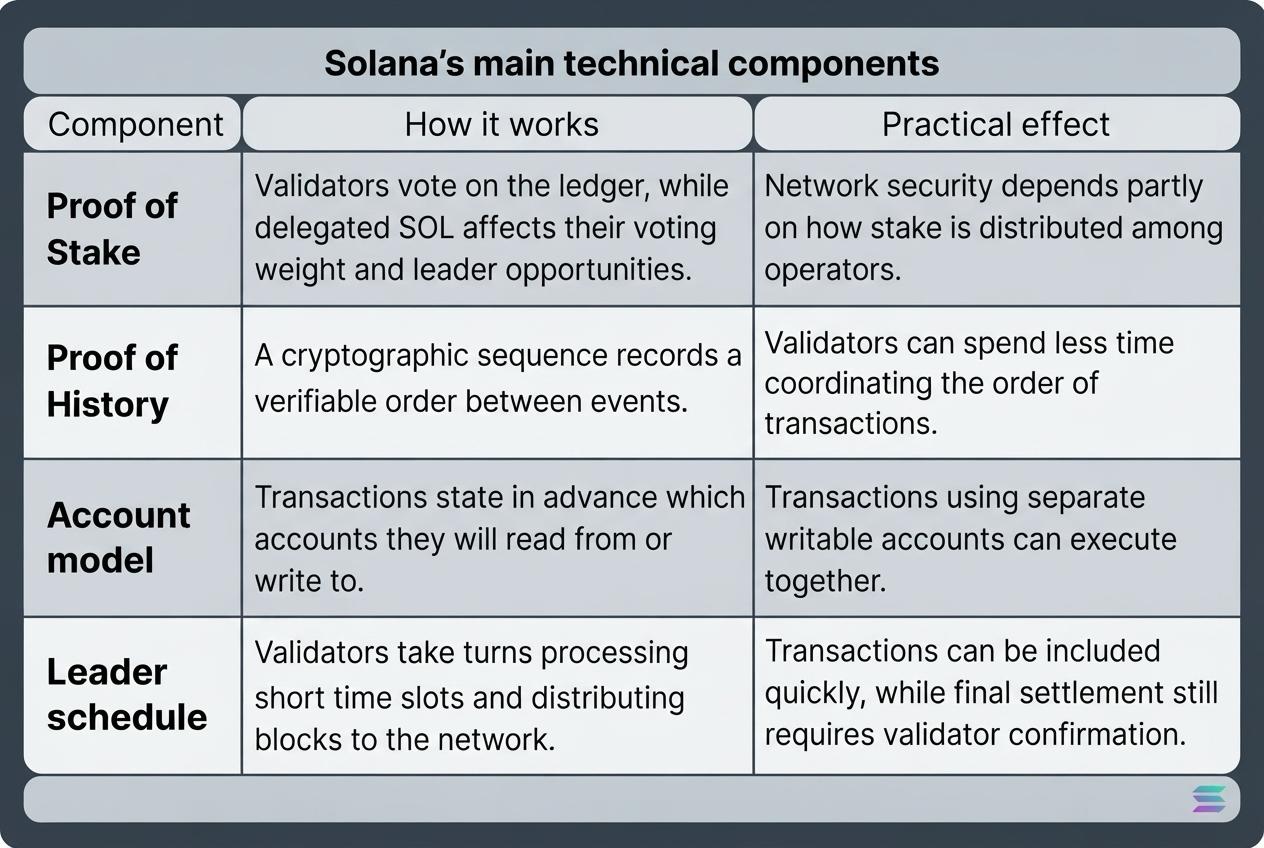
- Proof of History is a cryptographic ordering system rather than a consensus mechanism. The original whitepaper proposed it as a way to establish the order and duration between events before validators reach consensus. Solana’s official documentation describes it as a sequence of proofs showing that data existed before a later proof was created.
Solana applications store data in accounts, while their executable logic is generally called a program. Before a transaction runs, it identifies the accounts it will use. A validator can process two transactions in parallel when they write to different accounts. When both transactions attempt to modify the same account, the network must order them.
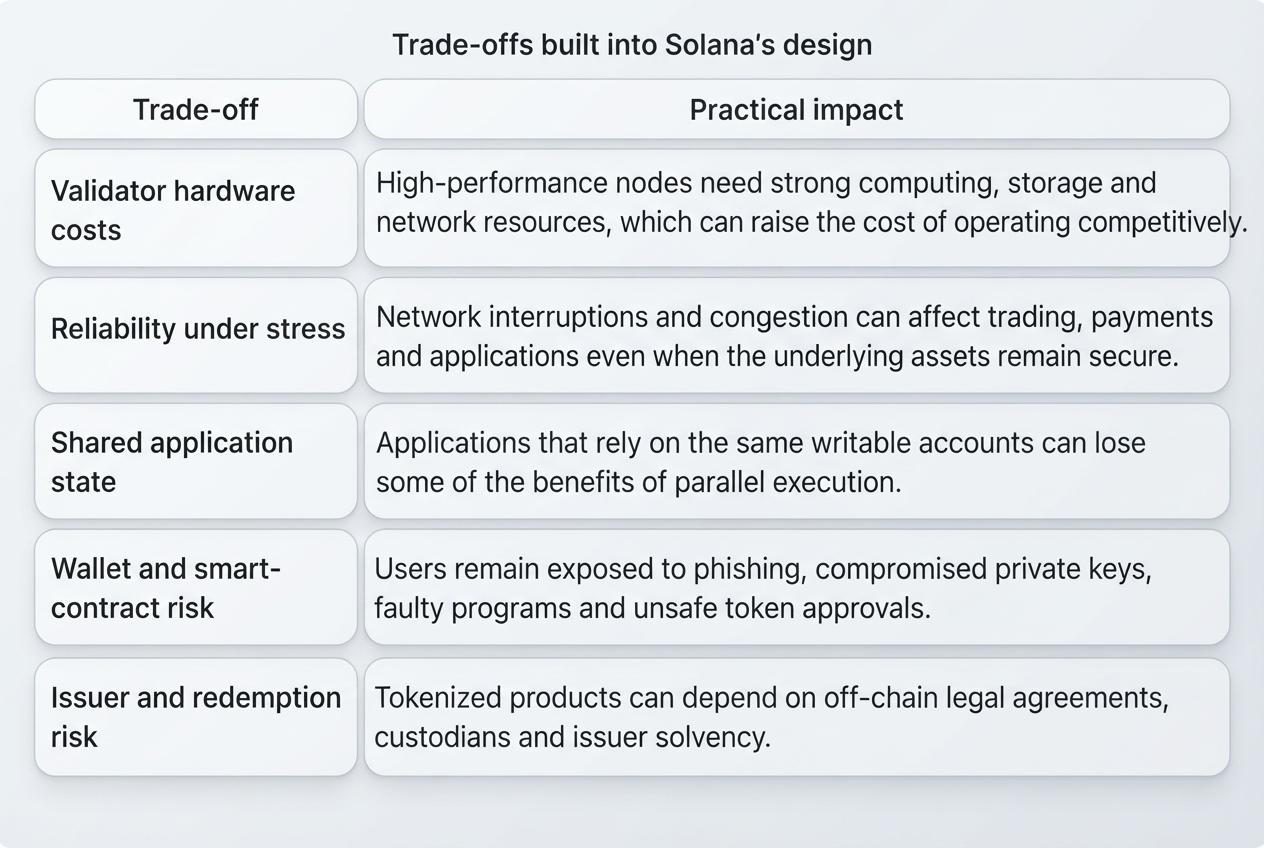
This gives developers a useful advantage, but also a design constraint. Applications built around heavily shared writable accounts can lose some of the parallelism that Solana offers. The rules behind account metadata and execution are explained in Solana’s instruction documentation.
What happens when you send a Solana transaction?
- Your wallet creates and signs instructions, including the accounts the transaction needs to access.
- An RPC provider forwards the transaction into the network and toward the validator processing the relevant slot.
- The leader executes it, alongside other transactions that do not conflict over writable accounts.
- Other validators replay the result and vote on the ledger. Wallets and applications then show confirmation or finalization according to their chosen commitment level.
During busy periods, users may add a priority fee to compete for faster inclusion. A transaction can also fail because of insufficient funds, incorrect instructions, changing market conditions or a conflict with the application’s state.
What SOL is used for
SOL performs several operational roles inside the network. Each role affects how Solana functions, but none turns SOL into ownership of the businesses building on top of it.
The fee system includes a base fee and an optional priority fee. The allocation and calculation rules are protocol details that can change, so current figures should always be checked in Solana’s official fee documentation.
Direct staking uses a separate stake account with its own authorities and activation rules. Users who want to delegate SOL should understand validator commissions, custody of the withdrawal authority and the time needed for a stake to activate or deactivate. Solana explains those mechanics in its stake-account documentation.
SOL supply changes over time
Token issuance is part of network’s security model because staking rewards help fund validators. The rate of issuance, the amount staked and the share of income coming from fees can all affect the network’s long-term economics.
Current governance note August 2026: Solana stakeholders approved a faster-disinflation proposal intended to reduce projected future SOL issuance. The vote did not immediately change circulating supply; implementation and activation remain separate steps. Read our coverage of the vote on lower SOL issuance for the latest details.
A brief history of Solana
- 2017: Anatoly Yakovenko published the original Proof of History paper that became the basis for Solana’s architecture.
- 2018–2019: The early team developed validator software, test networks and the infrastructure needed for a public launch.
- March 2020: Solana launched Mainnet Beta. The project’s official 2020 update records March 16 as the launch date.
- 2021: NFT projects, DeFi applications and retail trading brought rapid growth and significantly heavier demand for block space.
- 2022–2024: Congestion and outage episodes exposed weaknesses in the network’s software and operational resilience.
- Today: Development is focused on application infrastructure, validator economics, congestion management and stronger client diversity.
Solana’s early reliability problems are part of its public record. They show why a high-throughput design must be assessed on sustained operation during stress, not only on peak performance claims. Readers can review reported network events through the official Solana Status history.
Where Solana is used
Stablecoins and payments
Stablecoins can use Solana for transfers, trading collateral and settlement between crypto applications. They are often more practical for payments than volatile assets because their value is designed to track a reference currency or asset.
Payment integrations still rely on issuers, wallets, banks, local regulations and access to local currency. Our report on MoneyGram’s Solana integration shows how a crypto application can connect to existing fiat-access infrastructure rather than replace it outright.
DeFi and on-chain trading
Decentralized exchanges, lending protocols, perpetual-futures platforms and liquidity tools account for a large share of Solana’s visible activity. Quick execution can be valuable where market makers, traders and automated strategies must update positions frequently.
For investors, the useful distinction is between activity and value capture. Trading volume measures how much changes hands. Fees measure what users paid for block space or application services. Revenue shows what remains after a protocol’s own incentives and costs. Those figures can move in different directions.
Tokenized assets
The project also hosts tokenized stocks, funds, credit products and other real-world asset structures. Blockchain infrastructure can record transfers and ownership claims, but the holder’s rights are defined by the issuer, custody arrangement, redemption terms and applicable regulations.
Two tokens that appear similar on a wallet screen can provide very different legal and economic exposure. One may be freely transferable; another may be restricted to certain jurisdictions or investors. Recently, we made analysis of tokenized-stock trading and Solana’s network revenue, which shows why growth in one category should be evaluated alongside the wider financial picture.
The same distinction applies to tokenized investment products. A blockchain-based representation of a fund can still involve regulated intermediaries, transfer restrictions and limited redemption options. Our team also examined those mechanics in its report on Bitwise’s proposed tokenized Solana ETF structure.
Consumer apps and DePIN
Games, loyalty products, social applications and decentralized physical infrastructure networks can create many small on-chain actions. A mapping device recording data, a user claiming a digital item or a game updating ownership may need a network that can process frequent actions without turning each one into an expensive event.
That is where Solana’s lower-cost execution can be useful. The test for any consumer or DePIN application is concrete: does the blockchain provide necessary settlement, ownership or coordination, or is it being used only as a branding layer?
Solana’s trade-offs and risks
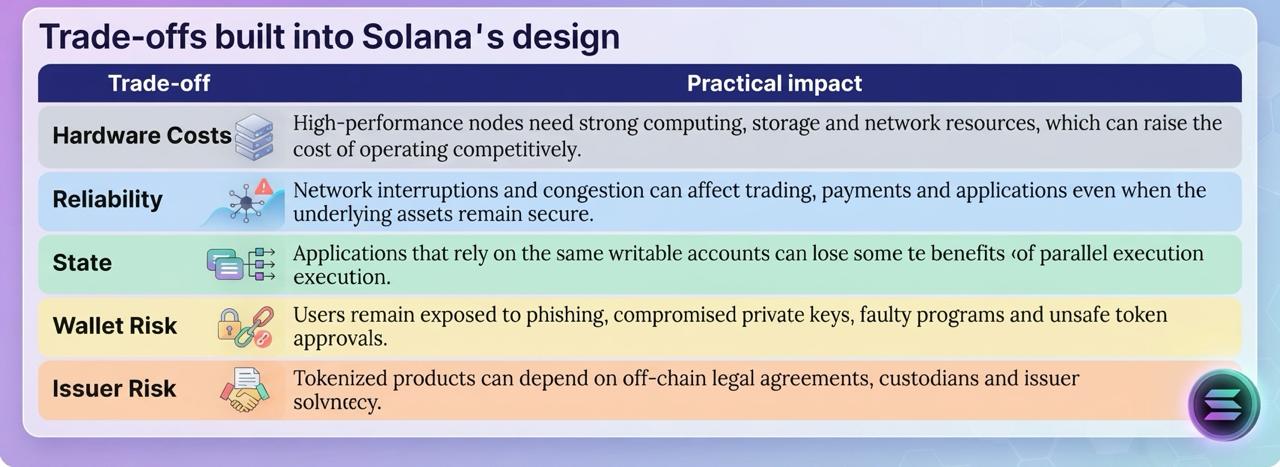
Validator hardware requirements are not a verdict on decentralization by themselves, but they influence who can operate infrastructure and how much it costs to remain competitive. Solana’s current Agave validator requirements should be read as operational guidance rather than a permanent specification.
Client diversity is another area to watch. If too much of a network depends on one software implementation, a shared bug can create a wider failure point. Firedancer is an important alternative validator effort, but its own documentation describes the current software as beta. Its Frankendancer configuration also retains Agave components while the full client is developed. Firedancer’s documentation provides the current status.
How to evaluate Solana and SOL
A useful Solana assessment separates the network from the token price and separates headline activity from durable economic use.
- Measure the quality of activity. Review stablecoin balances, recurring users, fees, application revenue and the type of transactions taking place. These help show whether demand comes from payments, trading, incentives or automated activity.
- Track validator resilience. Look at stake concentration, major validator operators, client adoption and reported incidents. A broad set of independent operators is more important than a single headline throughput figure.
- Follow SOL’s economics. Monitor issuance, the percentage of SOL staked, validator commissions, fee income and the role of governance changes in future supply.
- Assess each application separately. Before using a protocol or buying a tokenized product, check its smart-contract risk, administrator powers, issuer, custody model and redemption rights.
Users can inspect addresses and transactions through Solana Explorer. For live network, stablecoin and DeFi figures, consult Solana Data and compare major claims with independent datasets where possible.
Solana offers a specific combination of proof-of-stake coordination, verifiable ordering and parallel execution. That combination can support fast, frequent on-chain activity. Its long-term relevance will be determined by the persistence of useful demand, the resilience of its validator network and whether its security economics remain sustainable as the protocol evolves.



Kosta has reported on cryptocurrency markets and blockchain infrastructure since 2020, bringing over six years of hands-on experience in the crypto industry built through daily tracking of markets, trends, and emerging blockchain developments. Specializing in Bitcoin on-chain analysis, institutional ETF flows, and digital asset price action, his work at Coindoo has been cited by other news agencies and consistently covers market developments with a focus on data-driven reporting across Bitcoin, Ethereum, Solana, and XRP. Over the years, Kosta has contributed to multiple crypto media outlets in different regions, authoring over 6,000 articles across the sector. His reporting spans cryptocurrency markets and the broader fintech industry, tracking not only price action but also the technological and regulatory forces shaping the ecosystem. To support his analysis, Kosta actively leverages on-chain data and metrics from leading platforms such as Santiment, Glassnode, and CryptoQuant, enabling deeper, evidence-based market insights. He believes in the power of transparency and the data that underpins the blockchain ecosystem. His academic background in Marketing Management from Denmark further complements his analytical approach, adding a strong understanding of communication strategy and content positioning to his work.