15 Best DeFi Crypto Projects and Their Tokenomics
Table of contents
The DeFi sector has forever changed the cryptocurrency industry, as the best DeFi projects have encouraged investors to move their funds around the market. Yet, many investors struggle to navigate this niche due to the many options available, which can be overwhelming.
Not only do hodlers manage to keep their funds intact, but through the power of yield farming, collateralized tokens, and decentralized exchanges, they manage to use top DeFi projects to drive the whole crypto market to new limits. Thus, without a robust strategy, investors risk missing out on high returns or losing their hard-earned assets.
But fear not, as in this guide, we’ll review the best DeFi projects making the headlines. So, let’s jump in!
What Is DeFi?
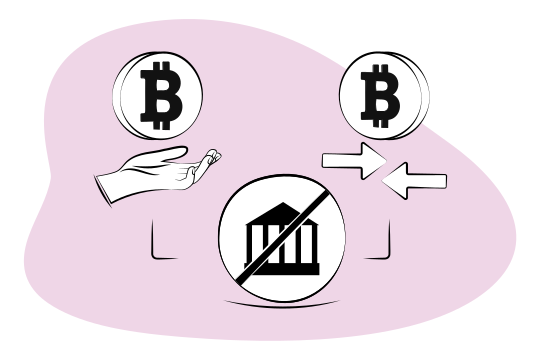
DeFi, short for Decentralized Finance, refers to a crypto sector that works to bring most of traditional finance’s capabilities inside the cryptocurrency space. It does that by disassembling the various financial services and decentralizing them.
Specifically, the decentralized finance sector brings the power of smart contracts to currency services such as lending, borrowing, earning interest, and trading assets. That’s why it is often stated that DeFi assets works like traditional banking to some extent.
DeFi projects usually denominate dApps and infrastructures such as asset management tools, decentralized exchanges (DEX), DeFi infrastructure & Dev Tooling, and many others.
Although they are risky to invest in and use, the more time passes, the more decentralized finance projects optimize and come out with better tokenomics and more secure infrastructures.
15 Best DeFi Crypto Projects – Updated on July 20, 2026
DAI (DAI)
DAI is an Ethereum-based stablecoin launched and governed through the Maker Platform and MakerDAO.
The main difference between DAI and the other popular stablecoins is that DAI is fully decentralized and is integrated by hundreds of dApps and is one of the best DeFi investments.
While most decentralized coins did not perform well, DAI has grown in popularity and use by keeping a steady price close to 1 USD. Also, the Decentralized Autonomous Organization keeps the stablecoin overcollateralized to ensure the pegging remains stable.
The minting process is not managed by a centralized organization, as anyone storing collateral can mint DAI tokens.
Supply
- Max Supply: no max supply;
- Total and Circulating Supply: 4,644,979,965.33 DAI.
Market Cap
The DAI token has a market cap of around $4.63 billion at the time of writing this article.
Allocation & Distribution
DAI tokens are minted by users that store in the collateral. That causes the supply and allocation to be dynamic.
Vesting & Inflation
The DAI token doesn’t have any type of scheduled vesting or inflation. The price is always close to 1 USD, and they are minted and burned as the market evolves.
Utility
The DAI token’s use cases are:
- Interact with Ethereum dApps and the top DeFi projects;
- Providing liquidity to various protocols;
- Collateral in DeFi ecosystems.
CHAINLINK (LINK)
Many dApps in the crypto space need oracles to interact with different kinds of data. And the current leader in oracles is Chainlink.
Chainlink offers a decentralized data set through a series of oracles and smart contracts, providing a middle ground between real-world data and blockchain applications.
Since 2019, Chainlink has grown exponentially, providing over 75 price feeds to 300 smart contracts and decentralized applications.
It’s important to notice that Chainlink as a project was developed and evolved to the point that it’s giving grants to crypto initiatives deemed helpful to the ecosystem.
In the DeFi space, Chainlink makes a significant impact by facilitating other projects with oracles to ensure their functionality. So, we consider that Chainlink deserves its place among our top DeFi crypto projects.
Early examples of projects using Chainlink oracles include Synthetix, Aave and KyberSwap, but the network has since expanded well beyond DeFi. On March 3, 2026, Chainlink announced an official partnership with ADI Foundation, whose ADI Predictstreet platform was named the official prediction market partner of the FIFA World Cup 2026 on April 2, 2026.
Chainlink has also moved into mainstream payments and institutional data. On June 24, 2025, it partnered with Mastercard to support onchain crypto purchases, while on March 25, 2026, Coinbase adopted Chainlink’s DataLink infrastructure to publish exchange market data onchain.
Chainlink has also participated in central-bank-led experiments: on November 5, 2024, it joined Singapore’s Project Guardian with Swift and UBS to test tokenized fund settlements through existing fiat-payment systems, while in 2025 its infrastructure connected the Central Bank of Brazil’s Drex pilot with the Hong Kong Monetary Authority for cross-border trade settlement.
Supply
- Max Supply: 1,000,000,000 LINK;
- Total Supply: 1,000,000,000 LINK;
- Circulating Supply as of July 20, 2026: 748,099,970.
Market Cap
The LINK token has a market cap of around $6.3 billion at the time of writing.
Allocation & Distribution
LINK tokens are preminted. Therefore, the Max Supply is the same as the total supply.
According to CoinMarketCap, the total supply of LINK is distributed as follows:
- 30% handled towards the company for continued development;
- 35% public token sale;
- 35% allocated to node operators and the ecosystem.
Vesting & Inflation
It appears there is no vesting or lock-up schedule for LINK.
Yet by checking the historical data on CoinMarketCap with WayBackMachine, it seems that Chainlink increases the circulating supply by 4-5% yearly.
Utility
The LINK token has quite a few use cases, such as:
- In smart contracts;
- Fees network;
- Staking.
AVALANCHE (AVAX)
Avalanche is an interoperable smart contracts platform for launching decentralized finance applications, financial assets, and other services. The platform supports the Ethereum virtual machine as well as application-specific sharding, network-level programmability, and NFTs.
Avalanche uses a proof-of-stake consensus protocol to offer a network where decentralized assets are traded and launched by users with sub-second transaction confirmations.
- Max Supply: 715,748,719 AVAX;
- Total Supply: 463,441,061 AVAX;
- Circulating Supply: 431,771,961 AVAX.
Market Cap
The AVAX token has a market cap of around $2.85 billion at the time of writing.
Allocation & Distribution
The 720M token supply is distributed as follows:
- 50% Staking Rewards;
- 9.26% Foundation;
- 10% Public Sale;
- 3.46% Private Sale;
- 2.5% Seed Sale;
- 7% Community & Developer Endowment;
- 5% Strategic Partners;
- 10% Team;
- 2.5% Airdrop;
- 0.27% Testnet Incentive Program.
Vesting & Inflation
Initially, AVAX had a vesting period of 1 year for the Seed Sale and Private Sale and Public Sale tokens. But nowadays, the tokens are being released at a yearly minting rate of 7-12% as staking rewards.
And to balance the supply coming into the market, AVAX employs a burning mechanism that takes out the fees paid on the network.
Utility
The AVAX token’s use cases are:
- The incentive for securing the network;
- Paying Fees;
- Staking;
- The base unit of account between multiple blockchains deployed on Avalanche.
Recent Hyundai Card pilot showed that utility in practice: a $20,000 intercompany transfer between its U.S. and Mexican affiliates settled in about seven minutes using USDT on Avalanche, with AVAX used to pay the network fees rather than as the transferred asset
UNISWAP (UNI)
Uniswap is mainly known as the current leader in the cryptocurrency DEX space. It is a decentralized exchange built on the Ethereum network, founded in 2017 by Hayden Adams.

The trading protocol was built to be an on-chain automated market maker (AMM) that can determine the price of a cryptocurrency based on the ratio of two cryptocurrencies within a pool.
Uniswap allows for the exchange and trade of various DeFi tokens, as well as Liquidity Provider tokens. And even if you don’t find an ERC20 token in the list, you can still create a pair and swap it for another crypto if you find the smart contract’s address.
And besides swapping, users can also provide liquidity in existing pools or create new pools to provide for.
Supply
- Max Supply: 1,000,000,000 UNI;
- Total Supply: 892,486,420 UNI;
- Circulating Supply: 625,351,561 UNI.
Market Cap
The UNI token has a market cap of around $2.18 billion at the time of writing.
Allocation & Distribution
The UNI tokens had been preminted at genesis as ERC20 tokens. And according to Uniswap, the token is allocated as follows:
- 60% to the Uniswap community;
- 21.266% to team members and future employees;
- 18.044% to investors;
- 0.69% to advisors.
Vesting & Inflation
Until 2024, UNI had a vesting period of 4 years for the 40% allocated to the team, employees, investors, and advisors. After that, UNI will function with a perpetual inflation rate of 2%.
Utility
The UNI token’s main use cases are:
- On-chain governance;
- Delegating voting power to another community representative;
- Rewarding liquidity providers in selected incentive programs.
For example, UNI holders can vote directly or delegate their voting power on proposals involving protocol fees, treasury spending and the deployment of Uniswap on additional networks. Liquidity providers in selected Uniswap v4 pools can also earn UNI incentives, although these rewards are separate from the trading fees generated by their positions.
Around June 18, 2026, a long-term forecast from Standard Chartered attracted renewed attention after the bank projected that UNI could reach $100 by the end of 2030, citing Uniswap’s potential role in the growth of tokenized assets and decentralized finance. The figure is an analyst forecast rather than a guaranteed valuation or an additional use case for the token.
AAVE (AAVE)
AAVE is a decentralized lending and borrowing protocol where lenders can earn interest by depositing crypto into specially created liquidity pools, which borrowers can use to take out a loan by giving their digital assets as collateral. The lending and borrowing take place through smart contracts.
The AAVE token is based on the ERC20 standard and is designed in a deflationary way as a core securing element of the Aave Protocol.
Supply
- Max Supply: 16,000,000 AAVE
- Total Supply: 16,000,000 AAVE
- Circulating Supply: 15,416,415 AAVE
Market Cap
The AAVE token has a market cap of $1.39 billion at the time of writing.
Allocation & Distribution
The AAVE token is preminted, but the 13 million tokens put in circulation were redeemed by exchanging LAND to AAVE at a rate of 100:1. The distribution goes as follows:
- 13 million AAVE allocated to the community;
- 3 million AAVE in reserve.
Vesting & Inflation
The AAVE token is deflationary, and circulation is linked to the total value locked on Aave, as tokens are burned whenever the protocol gathers fees.
Utility
The AAVE token has the following utility:
- Lending & borrowing;
- Fees discounts;
- Governance;
- Staking to support the safety module.
LIDO DAO (LDO)
Lido is a liquid staking protocol that allows users to stake ETH without operating their own validator or committing the 32 ETH normally required for solo staking. Users deposit ETH through Lido and receive stETH, a transferable token representing their share of the pooled stake and the rewards or penalties generated by participating validators.
Unlike a conventional staking position, stETH can remain usable across supported decentralized finance applications. Its balance is adjusted through regular rebases, while wrapped stETH, or wstETH, maintains a fixed token balance and reflects accumulated rewards through an increase in value per token.
More information about the staking process is available in Lido’s official protocol documentation, while the differences between the two liquid staking tokens are explained in its stETH and wstETH guide.
The protocol is governed by the Lido DAO. LDO holders vote on upgrades, protocol parameters, fees, node-operator participation, oracle sets and the use of assets held in the DAO treasury.
Supply
- Max Supply: 1,000,000,000 LDO;
- Total Supply: 1,000,000,000 LDO;
- Circulating Supply: approximately 836 million LDO as of July 20, 2026.
Current information about the token’s supply, price and trading activity can be found on the Lido DAO page on CoinGecko.
Market Cap
The LDO token has a market capitalization of approximately $295 million as of July 20, 2026. This figure changes constantly depending on the token’s market price and circulating supply.
Allocation & Distribution
All 1 billion LDO tokens were minted when the Lido DAO launched in December 2020. According to Lido’s original LDO announcement, the initial distribution was structured as follows:
- 36.32% allocated to the DAO treasury;
- 22.18% allocated to investors;
- 20% allocated to the initial Lido developers;
- 15% allocated to founders and future employees;
- 6.5% allocated to validators and signature holders.
Part of the treasury supply has subsequently been used for grants, liquidity incentives, integrations and other initiatives approved through Lido governance.
Vesting & Inflation
LDO has a fixed maximum supply, meaning the protocol does not continuously create new tokens as staking rewards. Changes in the circulating supply instead occur when previously locked tokens or tokens controlled by the DAO treasury enter circulation.
Tokens allocated to investors, developers, founders, employees and validators were initially locked until December 17, 2021, after which they vested linearly for one year. That original vesting period ended in December 2022.
Treasury tokens do not have a fixed release schedule. They can be distributed only through decisions approved by Lido DAO governance.
Utility
The LDO token has the following utility:
- Voting on protocol upgrades and parameters;
- Selecting and managing node and oracle operators;
- Approving changes to protocol fees;
- Governing the Lido DAO treasury;
- Delegating voting power to another governance participant.
For example, LDO holders can vote on whether to add a new node operator, change the protocol’s fee structure or allocate treasury funds to development and security initiatives. Voting power is generally proportional to the amount of LDO held or delegated by the participant.
LDO should not be confused with stETH. Users stake ETH, not LDO, to receive stETH and Ethereum staking rewards. LDO primarily provides governance rights and does not automatically entitle holders to staking rewards or a share of protocol revenue.
ETHER.FI (ETHFI)
Ether.fi is a non-custodial Ethereum staking and restaking protocol. Users can deposit ETH and receive eETH, a liquid token representing their share of the protocol’s pooled stake and accumulated rewards.
The protocol also offers weETH, a wrapped, non-rebasing version of eETH designed for use across supported decentralized finance applications. Instead of increasing the number of tokens in a wallet through rebasing, weETH reflects accumulated rewards through changes in its exchange value relative to eETH.
Ether.fi restakes pooled ETH through EigenLayer, allowing the deposited capital to support additional decentralized services while continuing to earn Ethereum staking rewards. Restaking may generate additional rewards, but it can also expose depositors to risks connected to validator performance, smart contracts and potential slashing.
ETHFI is separate from eETH and weETH. It is the protocol’s governance and ecosystem token rather than a direct representation of staked ETH.
Supply
- Max Supply: 1,000,000,000 ETHFI;
- Total Supply: approximately 998.54 million ETHFI;
- Circulating Supply: approximately 972 million ETHFI as of time of writing.
The full ETHFI allocation was minted at launch, and the protocol’s official documentation states that no additional tokens will be issued. Current information about ETHFI’s price, supply and trading activity is available on the Ether.fi page on CoinGecko.
Market Cap
ETHFI has a market capitalization of approximately $433 million as of July 20, 2026. This figure changes with the token’s market price and the amount of ETHFI classified as circulating.
Allocation & Distribution
Ether.fi launched ETHFI on March 18, 2024, with a fixed allocation of 1 billion tokens. According to the latest allocation published in the protocol’s governance documentation, the distribution is structured as follows:
- 33.74% allocated to investors;
- 21.62% allocated to the DAO treasury;
- 21.47% allocated to core contributors;
- 19.27% allocated to user airdrops;
- 3.90% allocated to partnerships and liquidity.
The treasury allocation is intended to fund development and adoption across the ether.fi and wider Ethereum ecosystems. The user allocation has been distributed through several airdrop seasons based on activities such as staking, holding eETH or weETH and participating in supported applications.
The partnerships and liquidity allocation supports integrations and ecosystem development. It also includes a commitment equal to 1% of the total ETHFI supply for the Protocol Guild.
Vesting & Inflation
ETHFI has a fixed maximum supply and no continuing token inflation. Changes in circulating supply therefore come from the release or distribution of existing tokens rather than the creation of new ETHFI.
The investor allocation follows a two-year vesting schedule, while tokens assigned to core contributors vest over three years. A one-year cliff applied to both groups before their scheduled releases began.
Treasury and ecosystem tokens can enter circulation through governance-approved spending, grants, incentives, partnerships and other protocol initiatives. This means the circulating supply can still increase even though the maximum supply remains fixed.
Utility
ETHFI has the following use cases:
- Voting on protocol upgrades and economic parameters;
- Governing the ether.fi DAO treasury;
- Approving node operators and contributor permissions;
- Influencing where protocol ETH is restaked;
- Delegating governance power to community representatives;
- Staking ETHFI to receive sETHFI and protocol rewards;
- Unlocking benefits within ether.fi’s membership system.
For example, ETHFI holders can vote on changes to protocol fees, treasury spending, software upgrades and the selection of operators that run Ethereum validators for the protocol. They may also delegate their voting power to another participant instead of voting on every proposal directly.
Users can also stake ETHFI to receive sETHFI. Rewards accrue in additional ETHFI and compound automatically, although the annual return is variable and not guaranteed.
Ether.fi operates a governance-approved token buyback program. ETHFI purchased with withdrawal-fee revenue and a portion of revenue from the protocol’s wider product range is distributed to sETHFI holders. These purchases redistribute existing tokens and do not increase ETHFI’s fixed supply.
ETHFI should not be confused with eETH or weETH. Holding ETHFI does not represent ownership of deposited ETH or automatically provide Ethereum validator rewards. Those rewards are associated with the protocol’s liquid staking tokens, while ETHFI is primarily used for governance, staking and participation in the wider ether.fi ecosystem.
CURVE DAO (CRV)
Curve Finance is a decentralized exchange and liquidity protocol originally designed for efficient swaps between assets expected to trade at similar prices, such as stablecoins, wrapped Bitcoin and liquid staking tokens.
Its automated market maker is designed to reduce slippage on these closely priced assets. Curve has since expanded beyond stablecoin trading through volatile-asset pools, the crvUSD stablecoin and the LlamaLend borrowing and lending platform.
CRV is the protocol’s governance and incentive token. Liquidity providers can earn CRV from eligible pools, while holders can lock the token to receive vote-escrowed CRV, known as veCRV.
Most of CRV’s functionality is accessed through veCRV rather than by simply holding the unlocked token. veCRV cannot be transferred and its voting power gradually declines as the chosen lock approaches its expiry date.
Supply
- Max Supply: approximately 3.03 billion CRV;
- Total Supply: approximately 2.40 billion CRV;
- Circulating Supply: approximately 1.54 billion CRV as of July 20, 2026.
CRV has a declining emission schedule rather than a fixed amount that entered circulation at launch. Current information about the token’s price, supply and trading activity is available on the Curve DAO page on CoinGecko.
Market Cap
CRV had a market capitalization of approximately $331 million as of July 20, 2026. The figure changes with both the token’s market price and its circulating supply.
Allocation & Distribution
CRV launched on August 12, 2020, with a theoretical maximum supply of approximately 3.03 billion tokens. Its original allocation was structured as follows:
- 57% allocated to community liquidity incentives;
- 26% allocated to the core team;
- 5% allocated to liquidity providers active before CRV launched;
- 5% allocated to the community reserve;
- 4% allocated to investors;
- 3% allocated to employees.
The largest allocation was not released immediately. It is distributed gradually through emissions to eligible Curve liquidity pools, with the share received by each pool influenced by gauge-weight votes.
The early liquidity-provider allocation vested over one year, while team, investor and employee allocations followed longer schedules. Curve’s official update states that all original vesting allocations had been fully distributed by August 2025.
Vesting & Inflation
New CRV continues to enter circulation through a hardcoded emission schedule. The schedule is divided into one-year epochs, with the issuance rate falling by approximately 15.9% at the beginning of each new epoch.
Between August 2025 and August 2026, the scheduled issuance rate is approximately 115.5 million CRV per year, or about 2.22 million CRV per week. The next programmed reduction is expected around August 2026.
According to Curve’s explanation of the emission schedule, the reductions were written into the CRV contract at launch and cannot be changed by a multisignature wallet or administrator.
Since the original team, investor and early-user vesting schedules have ended, newly circulating CRV now comes primarily from gauge-weighted liquidity incentives.
Utility
The CRV token has the following use cases:
- Locking CRV to receive veCRV;
- Voting on Curve DAO governance proposals;
- Directing CRV emissions through gauge-weight votes;
- Boosting CRV rewards for eligible liquidity positions;
- Receiving a share of eligible protocol revenue;
- Influencing treasury spending and protocol parameters.
For example, a holder can lock 1,000 CRV for four years to receive approximately 1,000 veCRV at the beginning of the lock. Locking the same amount for two years initially provides approximately 500 veCRV. Voting power then declines as the remaining lock period becomes shorter.
veCRV holders can vote on which eligible pools should receive a larger share of future CRV emissions. This gives projects an incentive to attract veCRV votes when they want to increase rewards and liquidity for their pools.
Liquidity providers who hold enough veCRV may also increase their CRV rewards by as much as 2.5 times. The amount required depends on the size of the liquidity position, the pool and the user’s share of total veCRV voting power.
Locking CRV can also provide access to distributions generated from parts of Curve’s trading and lending revenue. The amount is variable and can change according to protocol activity and DAO decisions about how revenue is divided.
CRV should not be confused with veCRV. Holding unlocked CRV alone does not provide the complete set of governance, fee-sharing and reward-boosting benefits. Those functions require the token to be locked, and the lock normally cannot be ended before its selected expiry date.
Some users instead deposit CRV through third-party liquid-locking protocols such as Convex, Yearn or Stake DAO. These services can provide transferable derivative tokens and pooled reward boosts, but users surrender some direct control and accept additional smart-contract and liquidity risks.
ONDO FINANCE (ONDO)
Ondo Finance develops blockchain-based products that provide access to traditional financial assets, including US Treasury funds, yield-bearing dollar instruments, stocks and exchange-traded funds.

Its main products include OUSG, which provides eligible investors with tokenized exposure to short-term US government securities, and USDY, a yield-bearing token backed by assets such as short-term US Treasuries and bank deposits. The wider platform also includes tokenized stocks and ETFs that can be transferred through public blockchain networks.
ONDO is the governance token of the Ondo DAO. It should not be confused with OUSG, USDY or Ondo’s tokenized securities. Holding ONDO does not represent ownership of the assets backing those products and does not automatically provide their investment yield.
Two developments in July 2026 expanded Ondo’s connection with traditional financial markets. On July 15, 2026, Ondo introduced tokenized stocks backed by DTC Tokenized Entitlements to securities held at the Depository Trust Company, which is part of DTCC’s market infrastructure. On July 16, 2026, Ondo and Japan’s SBI Group announced a strategic partnership to bring Japanese assets onchain, distribute Ondo products through the SBI ecosystem and explore SBI’s JPYSC stablecoin for settlement and collateral.
These developments may expand the use of Ondo’s platform, but they do not provide ONDO holders with direct ownership of the tokenized assets or an automatic claim on partnership revenue.
The token was issued by the Ondo Foundation, an independent Cayman Islands nonprofit established to support the growth of tokenized real-world assets and related onchain financial infrastructure.
Supply
- Max Supply: 10,000,000,000 ONDO;
- Total Supply: 10,000,000,000 ONDO;
- Circulating Supply: approximately 4.87 billion ONDO.
ONDO has a fixed maximum supply. New tokens are not continuously minted, although the circulating supply increases when previously locked allocations are released or ecosystem tokens are distributed.
Current information about the token’s price, supply and trading activity is available on the Ondo page on CoinGecko.
Market Cap
ONDO had a market capitalization of approximately $1.69 billion. Its fully diluted valuation was approximately $3.47 billion, based on the assumption that all 10 billion tokens were circulating at the current market price.
The difference between the two figures is significant because more than half of the maximum supply had not yet been classified as circulating. Future unlocks can increase the number of tokens available to the market even when the maximum supply remains unchanged.
Allocation & Distribution
According to the official ONDO distribution proposal, the 10 billion tokens were allocated across four main categories:
- 52.11% allocated to ecosystem growth;
- 33% allocated to protocol development;
- 12.90% allocated to private sales;
- 1.99% allocated to the Community Access Sale.
The ecosystem-growth allocation contains approximately 5.21 billion ONDO. It is intended to support activities such as incentives, airdrops, grants and contributions from developers, educators, researchers and strategic partners.
Approximately 3.3 billion tokens were allocated to protocol development. This category covers core contributors working on infrastructure, products and services within the Ondo ecosystem.
The private-sale allocation contains approximately 1.29 billion ONDO linked to two historical financing rounds. A further 198.88 million tokens were sold to more than 18,000 participants through CoinList’s Community Access Sale in May 2022.
Vesting & Inflation
ONDO does not have an inflationary emission schedule beyond its fixed supply of 10 billion tokens. Supply growth comes from scheduled unlocks rather than the creation of additional tokens.
The token became transferable on January 18, 2024, following an Ondo DAO vote to release the global lock-up. Approximately 1.43 billion ONDO, or 14.3% of the maximum supply, was initially classified as circulating.
Most tokens bought through the Community Access Sale became transferable at the public launch. A smaller portion remained subject to the original CoinList release schedule and entered circulation during the following 12 months.
Tokens allocated to private investors and core contributors were locked for at least one year after the public launch. Their releases were scheduled across annual unlocks occurring 12, 24, 36, 48 and 60 months after January 18, 2024.
Under that structure, the final scheduled releases are expected in January 2029. Ecosystem tokens can also enter circulation through approved incentives, grants and other growth programs.
Large annual unlocks can affect the token’s available supply, but an unlock does not necessarily mean that every released token will immediately be sold. Some tokens may remain in foundation, contributor or investor wallets after they become transferable.
Utility
The ONDO token has the following use cases:
- Voting on Ondo DAO governance proposals;
- Delegating voting power to another community representative;
- Managing assets held in the DAO treasury;
- Controlling incentives for DAO-governed protocols;
- Approving administrative and technical changes;
- Governing selected parameters within Flux Finance.
For example, ONDO holders can vote on whether Flux Finance should support a new lending market. Governance can also pause an existing market, change its interest-rate model, update its oracle address or withdraw accumulated reserves.
Token holders do not have to vote on every proposal directly. They can delegate their voting power to another participant through the Ondo DAO governance portal while retaining ownership of their ONDO tokens.
The DAO also has broader authority to manage its treasury, appoint administrators and control ONDO emissions used to encourage participation in DAO-governed products. Voting influence generally depends on the number of tokens held or delegated.
ONDO does not currently provide a native staking return simply for locking or holding the token. It also does not automatically give holders a share of Ondo Finance’s revenue, interest generated by US Treasuries or the assets supporting OUSG and USDY.
This distinction is important because the Ondo ecosystem contains several different token types. OUSG and USDY represent financial products with their own eligibility rules and underlying assets, while ONDO primarily provides governance rights within the Ondo DAO.
STELLAR (XLM)
Stellar is a blockchain network designed for payments, asset issuance and the movement of tokenized value. It supports stablecoins, tokenized financial assets and smart contracts through its Soroban platform.
XLM, also called the lumen, is Stellar’s native asset. It is used to pay network fees, maintain account reserves and transfer value between assets issued on the network.
Supply
- Max Supply: No fixed protocol-enforced maximum;
- Total Supply: approximately 50.002 billion XLM;
- Circulating Supply: approximately 34.16 billion XLM as of July 20, 2026.
No routine issuance of new XLM is currently active. Current information about the token’s price, supply and trading activity is available on the Stellar page on CoinGecko.
Market Cap
XLM had a market capitalization of approximately $6.4 billion. The figure changes with the token’s price and circulating supply.
Allocation & Distribution
Stellar launched in 2014 with an initial supply of 100 billion XLM. The original distribution plan allocated:
- 50% to a direct user distribution program;
- 25% to partnerships;
- 20% to Bitcoin holders;
- 5% to support the Stellar Development Foundation’s operations.
This original plan no longer represents the current supply. On November 4, 2019, the Stellar Development Foundation permanently removed approximately 55.44 billion XLM from circulation.
The Foundation continues to distribute part of its remaining holdings through its public mandate, which funds network development, ecosystem growth, products and liquidity programs.
Vesting & Inflation
Stellar originally increased the XLM supply by 1% annually. Validators voted to end that inflation mechanism on October 28, 2019, after it had created approximately 5.44 billion additional XLM.
XLM does not follow a conventional investor vesting schedule. Circulating supply can still grow when the Stellar Development Foundation spends or distributes tokens held under its mandate.
Validators do not receive XLM staking rewards, and transaction fees are collected in a network fee pool rather than paid to validators.
Utility
XLM has the following use cases:
- Paying transaction and smart-contract fees;
- Meeting minimum account-balance requirements;
- Paying rent for smart-contract data;
- Transferring value across the Stellar network;
- Acting as a bridge between otherwise illiquid assets.
For example, a standard Stellar operation has a minimum base fee of 0.00001 XLM, while a basic account generally requires a minimum balance of 1 XLM. These requirements help discourage spam without making ordinary transactions expensive.
XLM is not used for proof-of-stake rewards or direct onchain governance. Holding it also does not provide ownership of the Stellar Development Foundation or an automatic share of network revenue.
HYPERLIQUID (HYPE)
Hyperliquid is a Layer-1 blockchain built primarily for onchain trading. Its flagship exchange supports perpetual futures and spot markets through a transparent order book where orders, trades, funding and liquidations are recorded onchain.
The network consists of HyperCore, which handles trading and staking, and HyperEVM, which allows developers to deploy Ethereum-compatible smart contracts. HYPE is the native token used for network security, gas fees, staking and trading benefits.
Supply
- Max Supply: 1,000,000,000 HYPE;
- Total Supply: approximately 955.31 million HYPE;
- Circulating Supply: approximately 222.45 million HYPE as of July 20, 2026.
The total supply is lower than the maximum because HYPE accumulated by the protocol’s Assistance Fund is permanently burned. Current price, supply and trading information is available on the Hyperliquid page on CoinGecko.
Market Cap
HYPE had a market capitalization of approximately $13.6 billion as of July 20, 2026. The figure changes with the token’s price and the amount classified as circulating.
Allocation & Distribution
HYPE launched through the Hyper Foundation’s Genesis Event on November 29, 2024. The maximum supply was allocated as follows:
- 38.888% allocated to future emissions and community rewards;
- 31% distributed to early users through the Genesis airdrop;
- 23.8% allocated to current and future core contributors;
- 6% allocated to the Hyper Foundation budget;
- 0.3% allocated to community grants;
- 0.012% allocated to the HIP-2 liquidity program.
No separate allocation was reserved for private investors, centralized exchanges or external market makers. The 31% Genesis distribution was provided to eligible users based on their previous activity on Hyperliquid.
Vesting & Inflation
Hyperliquid also operates a programmatic buyback-and-burn mechanism. A portion of trading fees is directed to the Assistance Fund, which automatically converts those fees into HYPE through the protocol and permanently burns the purchased tokens. This reduces both the circulating and total supply, partly offsetting new HYPE entering the market through staking rewards and community incentives.
Most contributor vesting schedules are expected to finish between 2027 and 2028, although some allocations may remain locked for longer.
HYPE has a fixed maximum supply, but tokens from the future-emissions reserve enter circulation through staking rewards and other community incentives.
This issuance is partly offset by token burns. Hyperliquid’s Assistance Fund automatically converts part of the platform’s trading fees into HYPE and permanently removes the purchased tokens from supply.
Utility
HYPE has the following use cases:
- Staking and delegating to network validators;
- Benefiting from a fee-funded buyback-and-burn mechanism
- Securing Hyperliquid through delegated proof of stake;
- Earning staking rewards from future emissions;
- Paying gas fees on HyperEVM;
- Receiving discounts on spot and perpetual trading fees;
- Paying deployment costs for native Hyperliquid tokens.
For example, a holder can delegate HYPE to a validator and earn rewards for helping secure the network. A trader staking more than 1,000 HYPE can also qualify for a 15% trading-fee discount, while larger staking balances unlock higher discount tiers, making many participants to ask themselves if HYPE will be the next smart play.
According to the official fee documentation, the highest tier provides a 40% discount to accounts attributed more than 500,000 staked HYPE.
HYPE does not represent shares in Hyperliquid Labs or give holders an automatic legal claim on the platform’s revenue. Its benefits come from its role in network security, transaction processing, fee reductions and the wider Hyperliquid ecosystem.
TEZOS (XTZ)
Launched in 2017, Tezos is a cutting-edge blockchain platform that powers smart contracts and decentralized applications (dApps). It runs on its own unique blockchain and uses “tezzies” (XTZ) to motivate those who support the network by “baking”. Tezos is one of the most successful ICOs to date.
In distinction from other blockchains, Tezos sets itself apart with its self-amending capabilities. This means that the Tezos protocol can continually improve and adopt innovations without the fear of splitting the network into two separate versions.
Supply
- Max Supply: no max supply;
- Total Supply: 1,111,075,138 XTZ;
- Circulating Supply: 1,091,089,483 XTZ.
Market Cap
The XTZ token has a market cap of $241 million at the time of writing this article.
Allocation & Distribution
XTZ token was distributed as follows:
- 79.59% ICO Participants;
- 0.41% Early Backers and Contractors;
- 10% Tezos Foundation;
- 10% Dynamic Ledger Solutions.
Vesting & Inflation
To support the long-term stability of the network, the Tezos Foundation and DLS allocations have a vesting period of four years.
XTZ is an asset with a controlled rate of inflation. The rate is capped at a maximum of 5.51% per year, but it may fluctuate. The newly minted XTZ, which contributes to the inflation, is given as a reward to the network’s supporters called “bakers” and “endorsers.”
Utility
Some of the XTZ token’s use cases are:
- On-Chain Governance;
- Staking;
- Self-Amendment.
PANCAKESWAP (CAKE)

PancakeSwap is an Automated Market Maker, and Decentralized Exchange made on the Binance Smart Chain that requires no KYC. The project received funding from Binance as a part of the company’s DeFi acceleration program on the Binance Smart Chain.
In essence, PancakeSwap is a clone of UniSwap but also comes with a few new features:
- Two built-in yield farming tools in which you can stake liquidity provider tokens and earn cake or stake cake to earn more cake or other BEP20 tokens;
- Lottery tickets;
- An auction market for various NFTs;
- An initial farm offering;
- Gamification through the use of community teams, leader boards, various tasks, and achievements.
Supply
- Max Supply: 750,000,000 CAKE;
- Total Supply: 348,1876,829 CAKE;
- Circulating Supply: 322,55M CAKE.
Market Cap
The CAKE token has a market cap of almost $450 million at the time of writing this article.
Allocation & Distribution
The BEP20 CAKE token is preminted, and according to BscScan, the distribution goes as follows:
- 33.55% locked in the main staking contract;
- 58.89% wallet used for burning tokens;
- 17.87% allocated to various smart contracts and holders
Vesting & Inflation
In the past, CAKE had no max supply cap, but today it has a hard cap of 750M. However, regarding tokenomics, CAKE may seem to have disastrous inflation. The team behind the project is constantly looking for ways to reduce inflation in order to make deflation higher than emissions. Since the first reduction in block emissions, this team managed to reduce the number of CAKE entering circulation from 40 CAKE per block to 11.16.
The newly emitted tokens are distributed to Yield farmers and Syrup Pools.
Utility
The primary use of the CAKE token is staking. In addition, the token is also used for the following:
- Crowd pooling;
- NFTs Auctions;
- Participation in various features of the PANCAKESWAP environment.
ASTER (ASTER)
Aster is a decentralized exchange for spot and perpetual trading across crypto, stocks and commodities. The platform offers private order execution, multiple trading modes and its own Layer-1 network, Aster Chain.
ASTER became transferable on September 17, 2025, replacing APX as the ecosystem’s main token. APX holders were allowed to exchange their tokens for ASTER through a conversion program with a gradually declining exchange rate.
Supply
- Max Supply: 8,000,000,000 ASTER;
- Total Supply: approximately 7.82 billion ASTER;
- Circulating Supply: approximately 2.7 billion ASTER as of July 20, 2026.
Current information about the token’s price, supply and trading activity is available on the Aster page on CoinGecko.
Market Cap
ASTER had a market capitalization of approximately $1.66 billion as of July 20, 2026. This figure changes with the token’s price and circulating supply.
Allocation & Distribution
According to Aster’s official tokenomics, the maximum supply is allocated as follows:
- 53.5% for airdrops and community rewards;
- 30% for the ecosystem, APX migration and partnerships;
- 7% for the treasury;
- 5% for the team and advisors;
- 4.5% for liquidity and exchange listings.
A comparison published on May 29, 2026 estimated that 67.8% of ASTER’s supply was directed to community rewards and airdrops, the highest share among the perpetual DEX tokens included in the analysis. That figure uses a narrower classification than Aster’s official tokenomics, which assigns 53.5% to airdrops and another 30% to a broader ecosystem category covering APX migration, grants, partnerships, marketing and initial liquidity.
Vesting & Inflation
ASTER has a fixed maximum supply, but locked tokens continue to enter circulation. Most of the remaining community allocation is scheduled for distribution over approximately 80 months, while team tokens have a one-year cliff followed by 40 months of linear vesting.
Utility
ASTER has the following use cases:
- Staking and delegation to Aster Chain validators;
- Earning staking and loyalty rewards;
- Participating in protocol governance;
- Paying spot and perpetual trading fees;
- Qualifying for trading-fee discounts and VIP tiers.
For example, traders who pay their spot or perpetual fees with ASTER receive a 5% discount. Holders can also stake ASTER with an Aster Chain validator, with rewards influenced by validator performance and the selected lock period.
Aster also directs a portion of protocol revenue toward ASTER buybacks. The purchased tokens may be used for market stabilization and governance rewards, but the official documentation does not state that every repurchased token is permanently burned.
DECIMAL (DEL)
Decimal is an EVM-compatible blockchain for creating tokens, NFTs, smart contracts and decentralized applications. It uses delegated proof of stake, with validators processing transactions and securing the network.
DEL is the network’s native coin. It is used for transaction fees, staking and as the reserve asset supporting custom coins created on Decimal.
Supply
- Max Supply: 92.07B according to CoinMarketCap at the time of writing
- Total Issued Supply: approximately 11,121,003,895 DEL;
- Circulating Supply: 11,121,003,895 DEL.
On July 9, 2026, Decimal completed a 1,000:1 rebase. Every 1,000 old DEL became one new DEL, reducing token balances and supply figures by three zeros without changing each holder’s proportional ownership.
Market Cap
CoinMarketCap displayed a market capitalization of approximately $9.06 billion on July 20, 2026. However, this figure appears to combine DEL’s post-rebase price with its pre-rebase circulating supply.
Decimal completed a 1,000:1 rebase on July 9, 2026, removing three zeros from token balances and supply figures. Until market trackers fully update their data, the displayed $9.06 billion valuation should not be treated as a reliable measure of Decimal’s actual market capitalization.
Allocation & Distribution
Decimal launched on August 1, 2020, with 200 million old DEL created in the genesis block. After adjusting for the rebase, this is equivalent to 200,000 current DEL.
- 80% was allocated to the four starting validators;
- 20% was sold to early project investors.
The rest of the maximum supply was reserved for gradual issuance through validator and delegator rewards rather than being distributed at launch.
Vesting & Inflation
Decimal does not have a conventional token-unlock schedule. New DEL enters circulation through block rewards paid to validators and delegators.
A tokenomics update approved in 2024 extended the planned issuance period and introduced declining staking returns. Users can also choose longer delegation periods to qualify for additional rewards, while the standard withdrawal period was reduced to approximately 15 days.
The network offsets part of this issuance by automatically burning 50% of transaction fees. DEL removed through burning cannot return to circulation.
Utility
DEL has the following use cases:
- Paying transaction and smart-contract fees;
- Staking and delegating to validators;
- Securing the network through delegated proof of stake;
- Serving as the reserve for custom Decimal coins;
- Creating tokens, NFTs and smart contracts;
- Transferring value within the Decimal ecosystem.
For example, a user creating a custom coin can place DEL in its reserve. The new coin can then be converted through DEL into other reserve-backed assets available on the network.
DEL holders can also delegate their coins to a validator and receive part of the block rewards. The validator does not take custody of the delegated coins, but poor validator performance can reduce rewards or expose the stake to network penalties.
DEL is not the same as DDAO, Decimal’s separate DAO token. DEL is primarily used for fees, reserves and network security, while DDAO was created for participation in the wider Decimal DAO.
Final Thoughts
In 2026, we still see dozens decentralized finance of projects with amazing tokenomics and capabilities that push the crypto space further.
We’ve chosen these DeFi projects as the 15 Best DeFi Crypto Projects to showcase the capabilities that are coming into the market and not as financial advice, so invest in defi projects cautiously.
Therefore, keep your eyes open for the best opportunities, and never forget to do your own research. Because it seems we have not seen the last of what cryptocurrency and blockchain can bring to the financial world.



Alexander Zdravkov is a market analyst and crypto journalist with interests in economics, broader financial markets and digital assets. His journey into crypto began more than four years ago, driven by a fascination with the rapid evolution of blockchain technology and the transformative potential of decentralized finance. He began analyzing market cycles and identifying emerging trends before they reach the mainstream. He holds a degree in International Relations - a background that helped shape his broader perspective on global economics, geopolitics, and the interconnected nature of modern financial markets. Whether covering the latest developments in the crypto sector or exploring broader macroeconomic themes, Alexander focuses on giving readers context rather than simply repeating headlines. During his career, he has authored more than 5,000 articles covering cryptocurrencies, traditional finance, and global market developments. His work spans everything from Bitcoin and altcoins to macroeconomic trends influencing risk assets worldwide.