Can You Inherit Cryptocurrency?

Cryptocurrency can form part of an estate, but a will alone does not make it transferable. The executor must find every holding, prove authority to the right institution and, for self-custody, follow a recovery process that does not expose the assets to the wrong person.
Key takeaways
- An inheritance plan has two parts: the legal transfer of the estate and a safe route to each holding.
- Custody determines the practical work. An exchange account, a seed-phrase wallet and a multisig wallet cannot be handled in the same way.
- Keep a usable record. Heirs need a map of the assets, providers and recovery procedure.
Table of Contents
- Can You Inherit Cryptocurrency?
- Where the Crypto Is Held Changes Everything
- What an Executor Needs to Find
- Europe: Succession Law and National Tax
- United States: Probate, Digital Accounts and Tax
- United Kingdom: Estate Discovery and Valuation
- Canada, Australia and Singapore
- Assets an Executor Can Easily Miss
- How to Document a Crypto Valuation
- When More Than One Country Is Involved
- Build a Crypto Estate Access Plan
- FAQ
Can You Inherit Cryptocurrency?
Usually, yes. Crypto can pass under a will, trust or intestacy rules, subject to the succession law that applies to the estate. But it has a feature that shares and bank deposits normally do not: the person legally entitled to the asset may still be unable to move it.
That happens when assets sit in self-custody and no one can locate the recovery information, or when an exchange requires estate documents before it will disclose or transfer an account. Estate documents establish authority; custody records show where that authority must be used.
Where the Crypto Is Held Changes Everything
Exchange account
The platform controls the account. An executor will normally need a death certificate, proof of appointment and any forms required by that provider. Trading and withdrawals may be restricted while the claim is reviewed.
Self-custody wallet
The executor needs a secure recovery route. A public address makes holdings visible, but it does not authorise a transfer. Wallet addresses and private keys serve different purposes.
Multisig or contract wallet
The estate plan must identify the wallet software, chain, signer threshold and recovery procedure. A device or one seed phrase may be only one part of the signing setup.
A hardware wallet alone is not a recovery plan. It may require a PIN, seed phrase, passphrase or wallet descriptor; without the necessary combination, the executor may have a device but no usable route to the funds.
Binance Legacy Inheritance: Three Steps
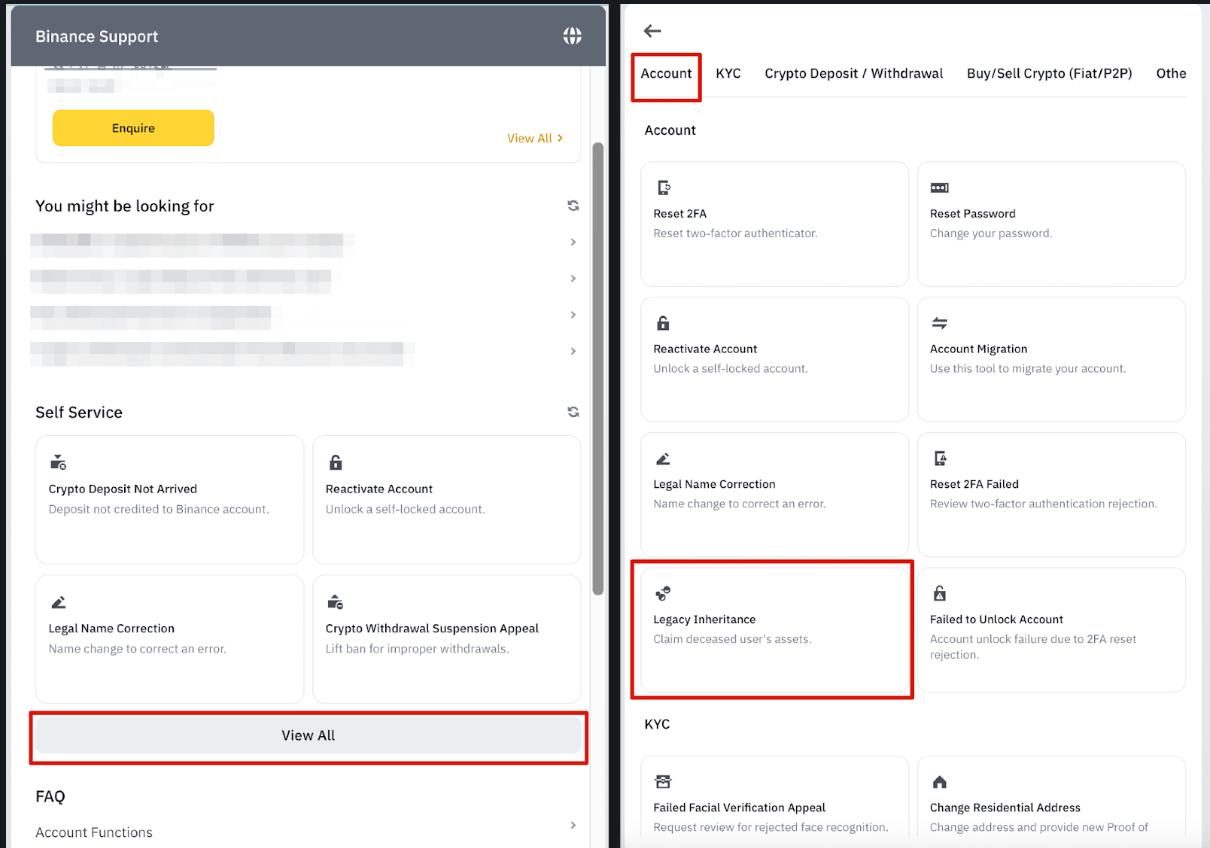
1.Open the inheritance claim. Create or log in to your own Binance account, then go to Customer Support → View All → Self Service → Account → Legacy Inheritance. Binance also provides a direct Inheritance Appeal link.
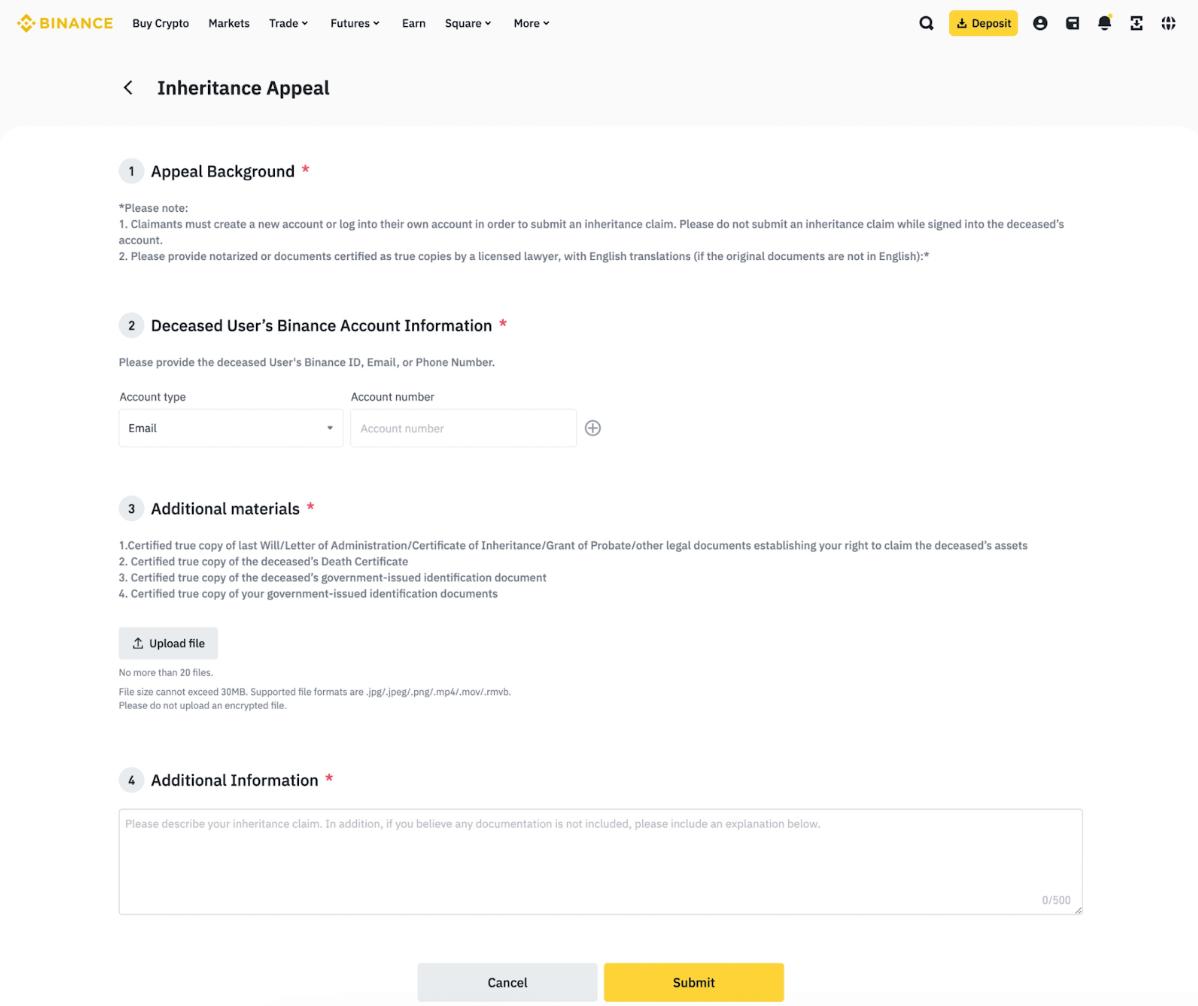
2.Submit the claim and documents. Enter the deceased user’s email address, phone number or Binance UID, then attach the requested inheritance documents and submit the application.
3.Wait for the review and transfer. Binance reviews the claim and, once it confirms the beneficiary or trustee’s entitlement, transfers the assets. The exchange says this usually takes around one to two months, although complex cases may take longer.
What an Executor Needs to Find
Start with an inventory before attempting any transfer. It should identify the holdings and the route to them, while keeping sensitive credentials separate.
- Custodians and accounts: exchange names, account email addresses, statements, transaction exports and the entity operating the account.
- Wallets and chains: public addresses, wallet applications, hardware devices, the blockchain used and any token contract address needed to identify an unfamiliar asset.
- Active positions: staking, lending, liquidity pools, collateral, vesting schedules and bridged assets.
- Recovery instructions: the location and access procedure for protected recovery materials, not the recovery materials themselves.
- Tax evidence: acquisition records, transaction history, a date-and-time price source and the fiat currency used for reporting.
Europe: Succession Law and National Tax
For many cross-border EU estates, the EU Succession Regulation connects succession to the deceased person’s habitual residence at death. In specified circumstances, a person may choose the law of their nationality. The Regulation also provides for a European Certificate of Succession, which may help an heir demonstrate status in another participating EU country. The Regulation does not decide tax treatment.
In practice, this can produce three separate questions: which country’s succession law determines who inherits; which tax authority needs a valuation or filing; and which exchange or wallet provider can act on the documents. EU-level succession rules therefore do not create a single European answer for crypto tax, exchange access or self-custody recovery.
United States: Probate, Digital Accounts and Tax
In the United States, the authority to administer an estate is primarily a state-law probate matter. State digital-assets rules can affect what an executor may request from an online provider, but they do not compel an exchange to bypass identity checks, security controls or its own deceased-user procedure. A self-custody wallet is different again: no provider can recreate a missing private key.
Federal tax is a separate track. The IRS says inherited property generally receives a basis equal to its fair market value at the date of death, subject to the applicable rules. IRS Publication 551 is a useful starting point for that basis question. It is not a statement that every later transfer or sale is tax-free, and it does not replace state estate- or inheritance-tax advice.
United Kingdom: Estate Discovery and Valuation
HMRC treats cryptoassets as estate assets and says their date-of-death value should be included in inheritance-tax information where relevant. Its cryptoassets manual offers a useful official discovery checklist for personal representatives and says identified but inaccessible holdings should be explained and valued as far as possible.
Canada, Australia and Singapore
Canada
The Canada Revenue Agency treats death as a deemed disposition for the final return. That means a valuation at death can matter even if no crypto is immediately sold. Provincial succession rules still govern who administers and receives the estate. CRA guidance
Australia
An inherited asset can carry a cost-base question for capital-gains tax when it is later disposed of. The ATO’s inherited-assets guidance is the practical starting point; it should be read alongside estate advice for the relevant state or territory. ATO guidance
Singapore
Singapore removed estate duty for deaths on or after 15 February 2008. That does not remove the need for probate, access planning or advice on any income generated after death. IRAS estate-duty guidance
Assets an Executor Can Easily Miss
Crypto inheritance is not limited to bitcoin in a wallet. An estate may include staked assets, liquid-staking tokens, DeFi collateral, lending deposits, liquidity-pool positions, NFTs, domains, bridged tokens, exchange rewards and tokens on older networks.
Some positions need attention before the estate is fully settled. Collateral can be liquidated if the loan health factor deteriorates; a validator or staking arrangement may have an unbonding period; and a bridged token may require the original network and application to identify or move it. The inventory should flag these positions separately so an executor knows which ones may be time-sensitive.
Worked example: one estate, three custody routes
A person leaves an exchange account, a hardware wallet and ETH used as collateral in a lending protocol. The exchange account follows the provider’s estate process. Access to the hardware wallet instead depends on the protected recovery procedure, the correct application and the relevant chain.
The lending position adds urgency: the executor must identify the wallet address and protocol, assess whether the collateral remains adequately backed, and obtain professional advice before making a transfer. This is illustrative, not a rule for every estate; it shows why “crypto holdings” should not be treated as one asset type.
How to Document a Crypto Valuation
For every holding, keep the token name and contract address, blockchain, quantity, date and time used, market-price source, fiat conversion rate and supporting screenshot or export. For a liquid token, an executor may document the price from a reputable exchange or data source at the relevant time. For an illiquid, locked or delisted token, record the available market evidence, the methodology used and the reason a quoted price may not represent an executable sale.
Do not assume a wallet balance proves that the full amount was freely transferable. The records should also state whether assets were staked, subject to vesting, locked in a contract, posted as collateral or inaccessible. That gives the lawyer, accountant and beneficiary the same evidence trail.
When More Than One Country Is Involved
List the deceased person’s habitual residence, nationality and tax residence; the exchange entity; where estate proceedings are opened; and the beneficiaries’ residence. Those facts may point to different succession, tax and reporting obligations. A cross-border adviser can then assess the facts from one clear record instead of trying to reconstruct accounts and wallet activity after the event.
Build a Crypto Estate Access Plan
- Create and maintain the inventory. Record platforms, public addresses, wallet types, devices, multisig arrangements and tax records. Update it when holdings move.
- Name the people and their roles. Estate documents should appoint the executor or trustee; separate protected instructions should state who can release recovery information and under what conditions.
- Keep recovery materials separate from estate paperwork. The will can refer to protected instructions without revealing the credentials themselves.
- Test the route without exposing secrets. Confirm that the executor can identify every platform, wallet and time-sensitive position, and knows whom to contact.
- Review after material changes. New wallets, exchanges, multisig signers, passphrases and DeFi positions can all make an old plan incomplete.
Physical security still matters. Coindoo’s guide to protecting crypto against physical threats explains why significant holdings should not depend on one person, device or location.
FAQ
Does an exchange account pass automatically to an heir?
No. The executor normally needs to use that provider’s deceased-user procedure and submit the requested estate documents. A will does not automatically override platform security checks.
Should a seed phrase be included in a will?
No. Wills may be filed, copied or viewed by people who should not control the assets. Store the phrase in a separate protected arrangement, with an access procedure appropriate for the estate.
What should happen to DeFi collateral after the owner dies?
It should be identified promptly because market moves can change the position’s risk. The executor should record the protocol, wallet address and debt-and-collateral details, then obtain appropriate legal, tax and technical advice before acting.
Can inaccessible crypto still matter for tax?
It may. HMRC, for example, says identified but inaccessible cryptoassets should be explained and valued as far as possible. The result elsewhere depends on the relevant jurisdiction and facts.
Four Things Your Heirs Should Be Able to Do
Before relying on an estate plan, test it against four questions: Can the executor identify every holding? Can they prove authority to the provider or recipient? Can they follow a secure recovery route where self-custody is involved? Can they produce a supported valuation for the required filings? If any answer is no, the plan needs work.
Important: This article is educational and does not provide legal, tax, investment, estate-planning or compliance advice. The law governing succession, tax treatment, exchange procedures and wallet recovery depends on the country, state or territory, provider and facts of the estate. Obtain advice from qualified local professionals before putting an inheritance plan into effect.



Alexander Zdravkov is a market analyst and crypto journalist with interests in economics, broader financial markets and digital assets. His journey into crypto began more than four years ago, driven by a fascination with the rapid evolution of blockchain technology and the transformative potential of decentralized finance. He began analyzing market cycles and identifying emerging trends before they reach the mainstream. He holds a degree in International Relations - a background that helped shape his broader perspective on global economics, geopolitics, and the interconnected nature of modern financial markets. Whether covering the latest developments in the crypto sector or exploring broader macroeconomic themes, Alexander focuses on giving readers context rather than simply repeating headlines. During his career, he has authored more than 5,000 articles covering cryptocurrencies, traditional finance, and global market developments. His work spans everything from Bitcoin and altcoins to macroeconomic trends influencing risk assets worldwide.