Strategy Passes Daily Dividends: Why Fridays Matter Now
Strategy common shareholders voted overwhelmingly on October 28 to transition four preferred stock series - STRC, STRF, STRK, and STRD - to daily dividend distributions, a structural overhaul designed to eliminate lumpy ex-dividend price drops and lower the company’s cost of capital for buying Bitcoin.
Key Takeaways
- 99.3% approval: Shareholders cleared daily dividends for four preferred stocks.
- Two-phase rollout: STRC starts November 1; three others follow in January.
- Thursday cutoff: Investors must buy by Thursday for weekend payouts.
- Price stability: Daily payouts aim to keep STRC near $100.
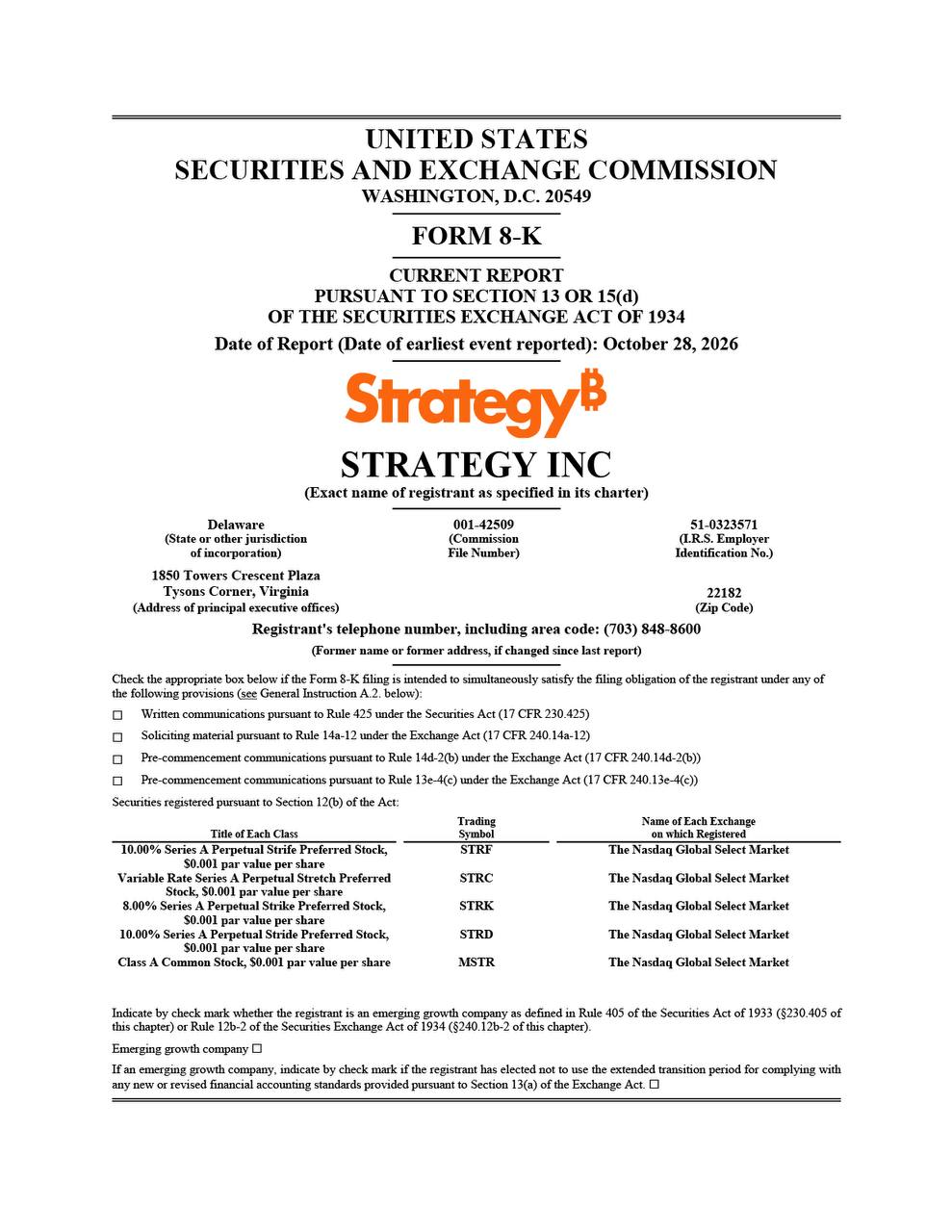
Executive Chairman Michael Saylor said preliminary results showed 99.3% of votes cast in favor following Wednesday’s meeting. Strategy’s subsequent Form 8-K filing confirmed that the amendments passed, advancing September’s proposal pending routine certificate of designations filings.
$MSTR shareholders have approved the Daily Dividends amendment. Preliminary results show 99.3% of votes cast were in favor. The amendment enables $STRF, $STRC, $STRK and $STRD to accrue dividends every calendar day. Thank you to all who voted. https://t.co/w1Cp4GKUy5
— Michael Saylor (@saylor) October 28, 2026
Why Strategy wants 365 dividends a year
While paying dividends every calendar day adds operational complexity, the commercial rationale laid out in Strategy’s definitive proxy statement centers on turning its preferred equity into a tighter, more predictable financing engine for its Bitcoin treasury.
Under standard quarterly or semi-monthly schedules, accrued dividend value builds up inside a preferred share’s price over weeks or months and then drops sharply on the ex-dividend date when the payout separates from the stock. By splitting distributions into daily increments of a few cents, management aims to shrink those ex-dividend adjustments to negligible daily ticks.
That smoothing effect is primarily targeted at STRC, Strategy’s variable-rate perpetual preferred stock designed to trade near its $100 stated amount-functioning similarly to a high-yield corporate money market proxy. If daily distributions keep STRC tightly anchored near $100 with narrower trading spreads and deeper liquidity, Strategy can issue additional preferred shares on more favorable terms to raise cash for future Bitcoin acquisitions.
The rollout schedule and STRC’s November math
Strategy is staging the transition in two phases, starting with STRC – which currently pays dividends twice a month – before moving its three quarterly-paying preferred series (fixed-rate STRF, convertible STRK, and STRD) onto the daily calendar in the new year.
| Security | Current schedule | Daily record dates begin | First daily payment |
|---|---|---|---|
| STRC | Twice monthly | November 1, 2026 | November 2, 2026 |
| STRF, STRK and STRD | Quarterly | January 1, 2027 | January 4, 2027 |
Increasing payout frequency does not raise the annual dividend rate; it simply divides the existing payout into 365 slices. Ahead of the vote, Strategy’s board conditionally declared November’s daily STRC distributions in an October 16 filing, replacing the previously declared semi-monthly schedule.
Based on STRC’s current 12% annualized rate applied to its $100 stated value, the November payout totals $1.00 per share across 30 calendar record dates. Individual daily declarations alternate between $0.03 and $0.04 per share, with cash paid on the following business day from November 2 through December 1. Because STRC carries variable-rate terms, the board can adjust the 12% annualized rate in future periods, and an investor’s effective yield still fluctuates depending on the market price paid per share.
How T+1 settlement creates the Friday catch
While Strategy’s amendments establish record dates on every calendar day-including weekends and bank holidays – actual share ownership and cash payouts must run through standard Wall Street plumbing at the Depository Trust Company (DTC) and Nasdaq.
Because U.S. equities settle on a T+1 basis (one business day after the trade date), an investor must purchase shares at least one business day before a record date to become the settled holder of record entitled to that day’s payout. At the same time, DTC treats record dates falling on Saturdays, Sundays, or holidays as occurring on the preceding eligible business day.
In practice, that rolls an entire weekend’s worth of dividends onto Friday’s record and ex-dividend schedule:
- Buying on Thursday (e.g., November 5): The trade settles on Friday, November 6. The buyer is the settled owner of record on Friday and collects three daily dividends – Friday, Saturday, and Sunday – paid together in a single batch on Monday, November 9.
- Buying on Friday (e.g., November 6): The trade does not settle until Monday, November 9. The Friday buyer misses all three weekend distributions, which instead go to the investor who sold the shares on Friday.
What the November 6-8 weekend block is worth
STRC’s declared schedule assigns $0.04 to Friday, November 6, $0.03 to Saturday, November 7, and $0.03 to Sunday, November 8. Together, those three record dates equal $0.10 per share – or $10 per 100 shares – payable in a single distribution on Monday, November 9 to investors who bought on or before Thursday, November 5.
Missing the Friday-to-Sunday cash distribution does not mean a Friday buyer loses $0.10 in economic value. Because Friday, November 6 serves as the Nasdaq ex-dividend date for all three payouts, STRC shares begin trading that morning without the $0.10 entitlement—meaning the opening share price adjusts downward by roughly $0.10 to reflect the separated cash.

Clearing plumbing and Bitcoin volatility ahead
November’s STRC rollout will serve as a live operational test before STRF, STRK, and STRD join the daily schedule in January. Clearing houses and retail brokerages must accurately process 30 separate record dates per month, batch weekend and holiday entitlements cleanly, and handle dividend reinvestment (DRIP) instructions without administrative friction.
Even if the back-office plumbing runs smoothly, daily payouts only eliminate dividend-date price gaps. Because preferred shareholders hold an unsecured claim on Strategy’s corporate cash flows rather than direct ownership of its Bitcoin reserves, three-cent daily distributions will not insulate STRC, STRF, STRK, or STRD from broader interest-rate swings, credit spreads, or severe downturns in the Bitcoin market.
This article is provided for informational purposes only and does not constitute financial or investment advice. Preferred-stock prices and dividends carry risks, and entitlement depends on the applicable security, settlement and broker arrangements.



Alex is Editor-in-Chief of Coindoo and co-founder of Millennial Media Group, with nearly a decade of experience covering financial markets - crypto first, then everything else. It started in 2016 with Bitcoin. Like most people at the time, he didn't fully understand it - so he kept digging. Blockchain, tokenomics, the projects, the cycles. That curiosity never stopped, and eventually pulled him into traditional markets too: equities, commodities, macro. Not because he left crypto behind, but because you can't properly understand one without the other. What drives him is straightforward: he wants to know why something is happening, not just that it's happening. Most market coverage stops at the headline - price up, price down, here's a chart. Alex finds that kind of reporting actively unhelpful. If you walk away from an article without understanding the mechanism behind the move, what did you actually learn? He holds a degree in Tourism from New Bulgarian University - not the most obvious path into financial markets, but markets have a way of pulling in people who are simply too curious to stay out. He has authored over 200 in-depth analyses and more than 10,000 articles across crypto and traditional finance. He still thinks every day in markets teaches him something new. That's probably why he hasn't stopped.