Grayscale Reveals ‘Compelling Entry Points’ but Data Says No

Grayscale calls November's crypto selloff a buying opportunity, yet the largest Bitcoin fund shed coins and stablecoin supply shrank, and the bank adoption it cites bought no tokens at all.
Key Takeaways
- Bitcoin fell 17% to $64,000 in November
- IBIT shed about 28,000 BTC since October 31
- USDC circulation fell from $73B to $67.9B
- DBS-JPMorgan service moves bank dollars, no crypto
Grayscale Head of Research Zach Pandl published a November 16 note describing Bitcoin’s roughly 17% slide to about $64,000 in the first two weeks of the month, with Grayscale’s market-cap-weighted Crypto Sectors index down about 18% over the same period. His conclusion is that current prices represent “compelling entry points” for medium- and long-term investors because institutional adoption is intact.
The same day, DBS announced a live cross-border service with JPMorgan’s Kinexys that lets institutions move tokenised US-dollar deposits between Singapore and the United States around the clock. Both events count as institutional crypto adoption in the industry’s shorthand. Only one of them involves anyone buying a crypto asset, and it is not the bank launch.
Pandl’s diagnosis, and what it leaves out
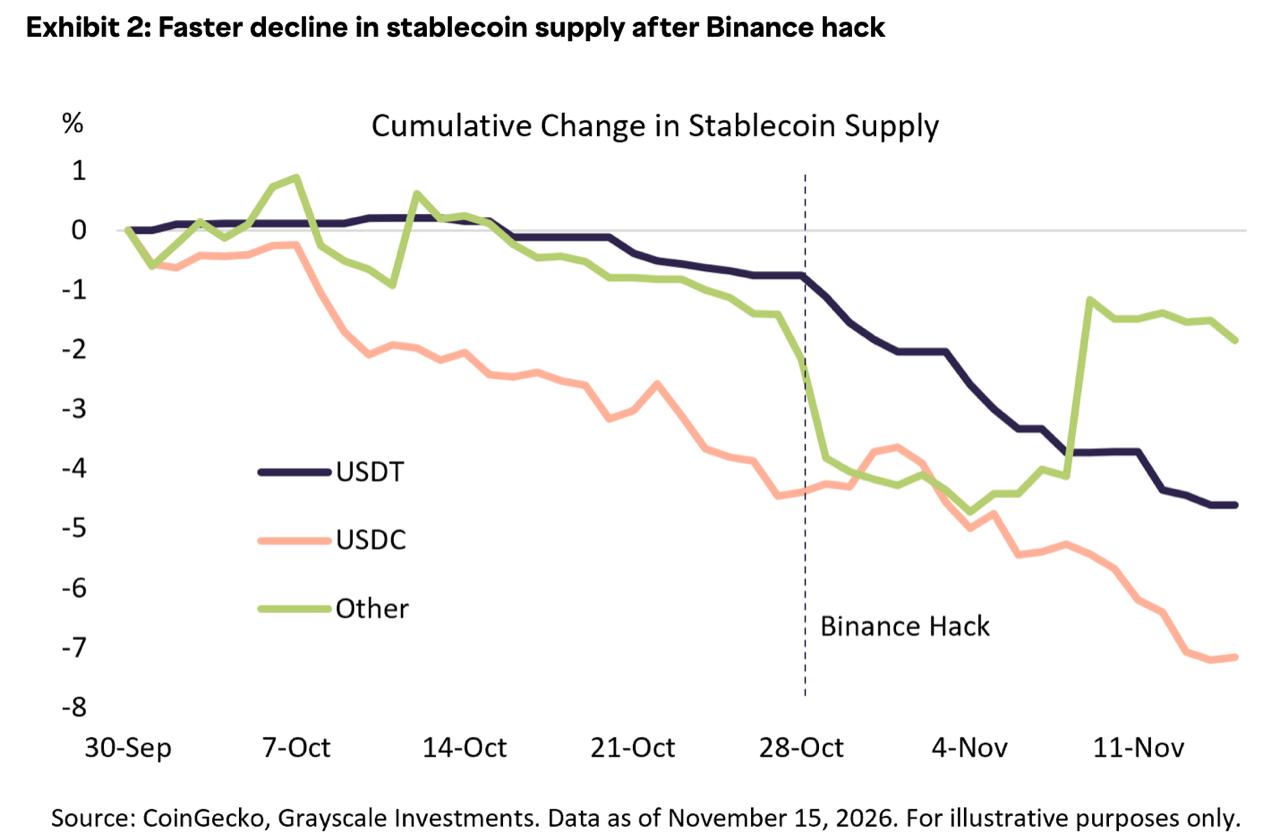
Pandl names two primary drivers. The first is stablecoin outflows: USDC supply started contracting in early October, and the decline accelerated after the October 29 Binance hack, which he reads as investors temporarily pulling money out of crypto over security concerns rather than doubt about regulated stablecoins.
The second is spillover from AI equities. Growth portfolios often hold crypto alongside Nvidia and other AI names, so de-risking those books sells both. He adds a structural link: AI and crypto compete for power capacity, and many Bitcoin miners now sell compute to AI firms, so weaker AI investment reaches Bitcoin’s infrastructure layer.
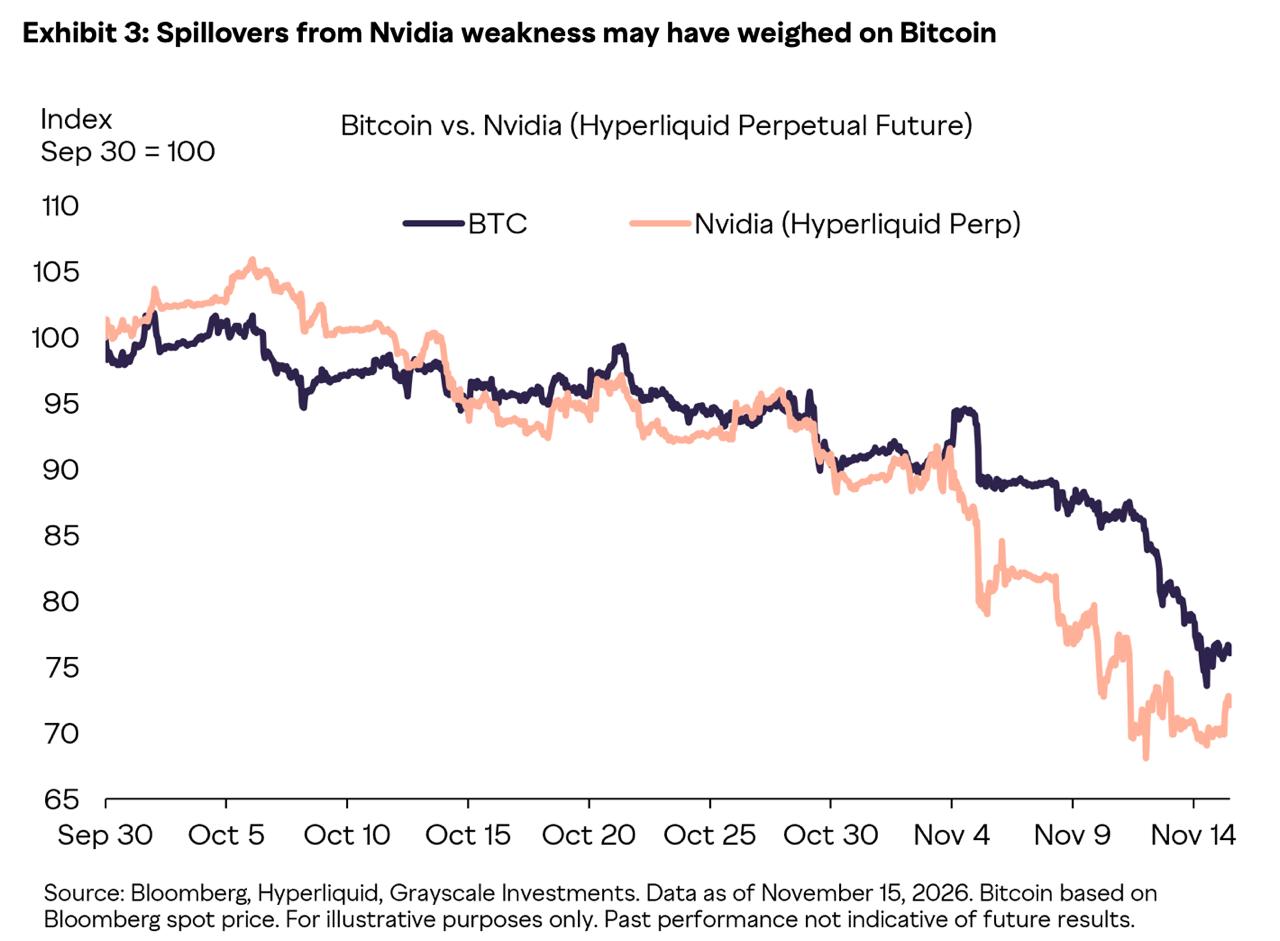
Technical factors did the rest. Bitcoin closed below its 200-day moving average on November 12, a level trend-following funds treat as a sell trigger. Falling prices liquidated leveraged perpetual positions, and much of the selling landed on a weekend when order books are thin. Pandl’s own counterpoint deserves equal weight: he writes that outflows from crypto exchange-traded products contributed slightly but did not look extreme. The fundamentals case rests on institutional adoption of stablecoins and tokenised assets plus persistent demand for alternative stores of value against ongoing deficit spending.
None of that is wrong. It is incomplete. A corporate treasurer adopting blockchain settlement is choosing an operating tool. A fund manager selling Bitcoin is changing a portfolio. The first decision does not offset the second, because they involve different assets. A service can require bank deposits, a dollar stablecoin, a network’s native coin or Bitcoin itself, and each of those creates a different buyer. November’s data lets each one be checked separately.
Tokenised deposits: Bank dollars stay bank dollars
The DBS announcement connects DBS Token Services with Kinexys’s permissioned Blockchain Deposit Account network, with Partior orchestrating settlement. The service handles USD only. Ant International is the first client, using it for real-time treasury management across its entities in both markets. Transfers between the blockchain accounts and conventional demand deposit accounts still pause for three hours on Saturday afternoons, which the banks say they are working to remove.
Every balance in that system is a deposit liability of DBS or JPMorgan. No step in the flow touches BTC, ETH or SOL, and no fee is paid in a public token. The November 2025 framework the two banks announced did envisage JPMorgan deposit tokens on Base, a public Ethereum layer-2, which would have routed some settlement through a public chain. The live service a year later runs on the permissioned network instead. Coindoo’s earlier report on the JPMorgan-DBS launch covers the operational details.
This is the adoption Pandl cites as a favourable trend, and it is real. For a holder of public crypto assets, its value is indirect at best: it normalises blockchain settlement inside regulated banking without adding a single buyer for the tokens those holders own.
Public chains: The fee is the token, and the fee is tiny
Public networks are different in kind because usage has to be paid for in the native asset. Solana’s fee documentation sets the base fee at 5,000 lamports per signature, or 0.000005 SOL, with half burned and half paid to the validator. With SOL trading in the low $80s on November 12, that base fee is worth about four hundredths of a cent. A $10 million USDC transfer with one signature costs the sender a fraction of a cent in SOL plus whatever priority fee they choose to add.
So the mechanism Pandl’s case needs does exist on public chains, but its scale is set by transaction count and congestion, not by the dollar value moved. Circle reported $13.9 trillion of on-chain USDC volume in the third quarter. Almost none of that value had to be converted into a network token to move. Transaction value, transaction count and fee spend are three different numbers, and only the last one is demand for the coin.

Bitcoin: What the IBIT share count shows
Bitcoin has no fee mechanism to lean on. Its case is scarcity and store-of-value allocation, which means the only evidence that matters is whether holdings of BTC are rising. A physically backed fund gives the cleanest reading, as long as the right number is used. An IBIT share changing hands on Nasdaq moves no Bitcoin; only the creation or redemption of baskets changes what the trust holds.
The trust’s third-quarter 10-Q reports 1,434,080,000 shares outstanding on October 31. The iShares product page showed 1,384,280,000 on November 16, with each 40,000-share basket backed by 22.64 BTC. That is a net redemption of about 49.8 million shares, or roughly 28,000 BTC leaving the trust in eleven trading days, about 3.5% of the fund.
Put that beside the price. Holdings fell 3.5% while Bitcoin fell 17%. The largest Bitcoin fund in the world was a net seller, which contradicts the idea that institutions were buying the dip through ETFs, but it was not a large enough seller to explain the move. That supports Pandl’s reading that the marginal seller sat in leveraged futures and spot, not in the ETF wrapper. It also means the adoption his thesis relies on, stablecoins and tokenised deposits, produced no measurable Bitcoin purchases during the period he describes.
Stablecoins: The off-ramp claim, tested
Circle’s transparency page reports issuance, redemptions and circulation separately, which makes Pandl’s first driver checkable. Circulation stood at about 73 billion USDC on October 8, 70 billion on October 29 and 67.9 billion on November 12. That is roughly a 7% contraction in five weeks, with the pace quickening after the Binance incident, exactly the pattern Pandl describes. Circle’s own third-quarter average was 73.3 billion, so the November figure sits well below where the quarter ran.
What the data confirms is net redemption: more USDC was handed back to Circle for dollars than was minted. What it cannot show is where those dollars went. A redemption from an exchange treasury rebalancing toward USDT looks identical, on Circle’s page, to an investor leaving crypto. Pandl’s off-ramp reading is consistent with the figures but not proven by them, and Coindoo’s reporting on dip-buying alongside dollar withdrawals shows the two can run together.
The common mistake is to add this contraction to ETF outflows and falling exchange balances and call the sum “capital leaving crypto.” The three series overlap. An investor who redeems USDC to buy IBIT shares from another holder shows up as a stablecoin outflow and nothing else. Each measure answers one question, and they should be read side by side rather than summed.
Confirms the entry-point case
IBIT shares outstanding back above 1.43 billion, its October 31 level, before the trust’s year-end report.
Confirms the entry-point case
USDC circulation reclaiming 70 billion on Circle’s weekly page by mid-December, with issuance outrunning redemptions.
Weakens it
A second straight month of net IBIT redemptions while bank tokenisation headlines continue, which would show adoption and token demand still decoupled.
What could make Grayscale’s case stronger
Pandl’s note is addressed to medium- and long-term investors and does not claim the market has bottomed. The stronger version of his argument is one where adoption reaches the assets being bought: net fund creations that rebuild holdings, sustained public-chain usage with fee demand large enough to matter, and USDC issuance
Disclaimer: This article is for informational purposes only and does not constitute investment, financial or trading advice. Figures cited are as of the dates stated and are drawn from Grayscale, DBS, SEC filings, iShares, Circle and Solana documentation; they may have changed since publication. Crypto assets are volatile and you may lose some or all of your capital. Conduct your own research or consult a licensed adviser before making any investment decision.



Kosta has reported on cryptocurrency markets and blockchain infrastructure since 2020, bringing over six years of hands-on experience in the crypto industry built through daily tracking of markets, trends, and emerging blockchain developments. Specializing in Bitcoin on-chain analysis, institutional ETF flows, and digital asset price action, his work at Coindoo has been cited by other news agencies and consistently covers market developments with a focus on data-driven reporting across Bitcoin, Ethereum, Solana, and XRP. Over the years, Kosta has contributed to multiple crypto media outlets in different regions, authoring over 6,000 articles across the sector. His reporting spans cryptocurrency markets and the broader fintech industry, tracking not only price action but also the technological and regulatory forces shaping the ecosystem. To support his analysis, Kosta actively leverages on-chain data and metrics from leading platforms such as Santiment, Glassnode, and CryptoQuant, enabling deeper, evidence-based market insights. He believes in the power of transparency and the data that underpins the blockchain ecosystem. His academic background in Marketing Management from Denmark further complements his analytical approach, adding a strong understanding of communication strategy and content positioning to his work.