Fed Minutes Signal More Hikes – Why Bitcoin Should Care
The Fed's October minutes kept further tightening in play and showed officials paused partly because markets had already priced tighter policy, pushing Bitcoin's risk onto the path.
Summary
- Markets did part of the Fed’s tightening.
- The bigger risk is a steeper path.
- Yields and risk appetite hit Bitcoin differently.
- November CPI arrives a day after the vote.
The Federal Reserve published the minutes of its October 27-28 meeting at 19:00 UTC on November 18, three weeks before its next decision.
Markets did part of the Fed’s work
Officials held the target range at 3.75%-4.00% in a 10-2 vote. Governor Lisa Cook and Cleveland Fed President Beth Hammack dissented in favor of a quarter-point increase, a hawkish split behind the October pause.
The full meeting record shows how firmly hikes stayed on the table. Almost all participants judged that further action to raise the target range would likely be appropriate under their baseline outlooks, with the aim of returning inflation to 2% in a timely way.
That consensus is also why the majority could wait. Some participants said market-implied tightening for December and next year was broadly consistent with their own view of the right path, and several took that alignment as a reason why holding steady carried less risk.
When markets price hikes in advance, borrowing costs often rise before the Fed votes. A pause in October therefore did not mean easier conditions for crypto; futures and yields were already doing part of the tightening.
A couple of participants went further, saying an increase larger than 25 basis points could warrant consideration at the next meeting if incoming inflation data proved unfavorable. That was a conditional view from a small group, recorded in October, not a committee plan.
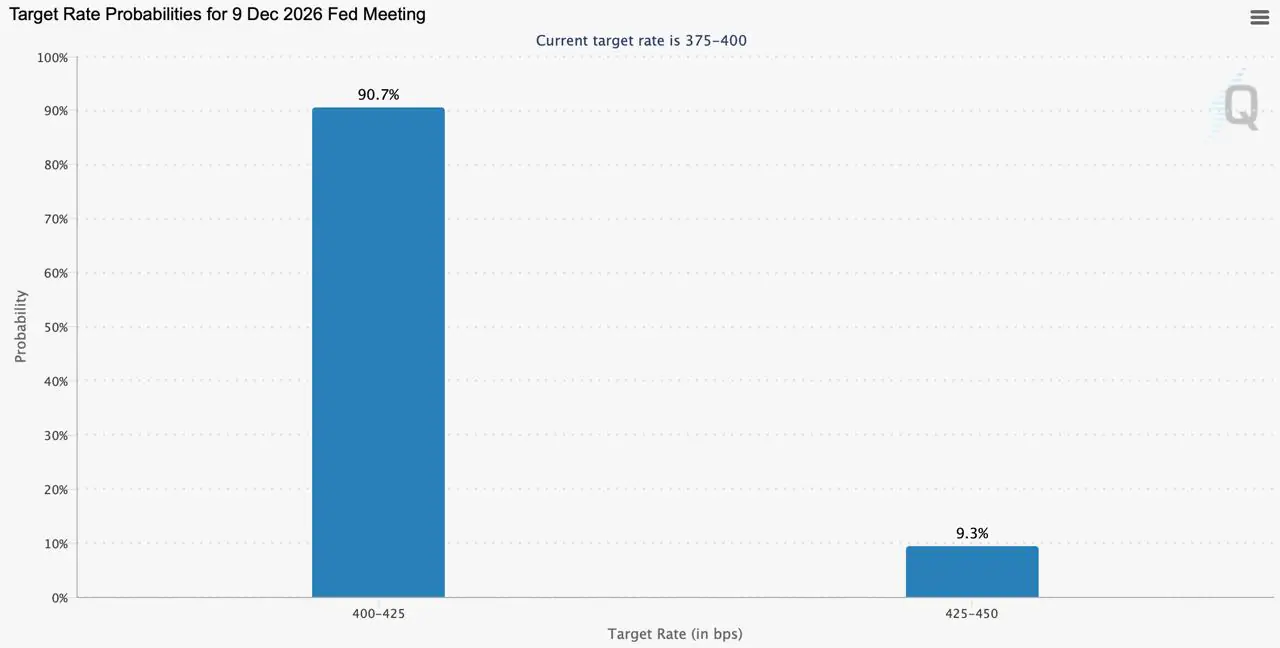
Futures pricing shows how little of that December step is left to surprise. As of the evening of November 18, the CME FedWatch tool, which derives probabilities from fed funds futures, put the chance of a December hike at 100%: 90.7% for a quarter point to 4.00%-4.25% and 9.3% for a half point to 4.25%-4.50%. That 9.3% is the market’s price on the larger move a couple of officials discussed, and the figure to watch as new data arrives before the vote.
The path behind the next hike
The minutes also report the median expectation from the New York Fed trading desk’s survey of market participants: one hike in December, another in March 2027, and a cut in early 2028. Collected before the meeting, it is the clearest snapshot in the document of where investors thought rates were heading.
Under that survey path, the range would reach 4.25%-4.50% after March and stay there until early 2028. With futures treating a December hike as settled, a quarter-point move adds little new information for Bitcoin. Pressure would come from a revision to the path itself, and there are three ways it could get steeper.
Step one, bigger
A December move above 25 basis points would front-load tightening and test positions built around a quarter point.
A third hike
Another increase after March would lift the expected peak, the level that sets how much idle dollars can earn.
A later first cut
Pushing relief beyond early 2028 would extend the stretch in which interest-bearing assets compete with a coin that pays nothing.
Two routes from the rate path to Bitcoin
The first route is yield competition. Bitcoin pays no interest, so every month that Treasury bills and money-market funds pay close to the policy rate raises the return a holder gives up. This route depends mostly on the level of rates and how long it lasts, which is why the timing of the first cut weighs as heavily as December’s decision.
Leveraged traders feel a version of this through borrowing costs, though not one-for-one. Exchange margin rates follow each platform’s terms, DeFi lending rates move with pool demand, and perpetual-futures funding depends on the balance between longs and shorts rather than on the Fed’s benchmark.
The second route is risk appetite. A 2023 IMF working paper by Natasha Che, Alexander Copestake, Davide Furceri and Tammaro Terracciano found that a single common factor explains about 80% of crypto price variation, and that US tightening weakened it through investors’ willingness to take risk, the same channel that moves stocks. The authors read the result as evidence against crypto working as a hedge.
The two routes react to different news. Yield competition builds slowly with the level and duration of rates, while risk appetite responds to surprises that change how much uncertainty investors are prepared to carry. A steeper path would work through both at once. The IMF study supports the direction of that effect but gives no size for any single decision.

The data calendar into December 9
The Bureau of Economic Analysis publishes October’s personal income and outlays report, which carries the PCE price index the Fed targets, at 13:30 UTC on November 25, according to its release schedule. The Bureau of Labor Statistics follows with November’s employment report on December 4.
November’s consumer price index is due on December 10, the day after the decision, per the BLS calendar. That makes October PCE the last major inflation report before the vote, and the most direct test of the “unfavorable data” condition behind the larger-hike view.
Bitcoin’s own flows, from ETF demand to derivatives positioning, will move the price alongside those numbers, so no single print explains a move by itself. The rate question for crypto over the next three weeks is narrower: whether the data bends the path the survey described, through a bigger December step, a hike after March or a later first cut. A quarter-point hike in line with that survey would leave the picture where the October minutes found it.



Kosta has reported on cryptocurrency markets and blockchain infrastructure since 2020, bringing over six years of hands-on experience in the crypto industry built through daily tracking of markets, trends, and emerging blockchain developments. Specializing in Bitcoin on-chain analysis, institutional ETF flows, and digital asset price action, his work at Coindoo has been cited by other news agencies and consistently covers market developments with a focus on data-driven reporting across Bitcoin, Ethereum, Solana, and XRP. Over the years, Kosta has contributed to multiple crypto media outlets in different regions, authoring over 6,000 articles across the sector. His reporting spans cryptocurrency markets and the broader fintech industry, tracking not only price action but also the technological and regulatory forces shaping the ecosystem. To support his analysis, Kosta actively leverages on-chain data and metrics from leading platforms such as Santiment, Glassnode, and CryptoQuant, enabling deeper, evidence-based market insights. He believes in the power of transparency and the data that underpins the blockchain ecosystem. His academic background in Marketing Management from Denmark further complements his analytical approach, adding a strong understanding of communication strategy and content positioning to his work.