Why Bitcoin Fell: Michael Saylor Blames $400B AI Rotation
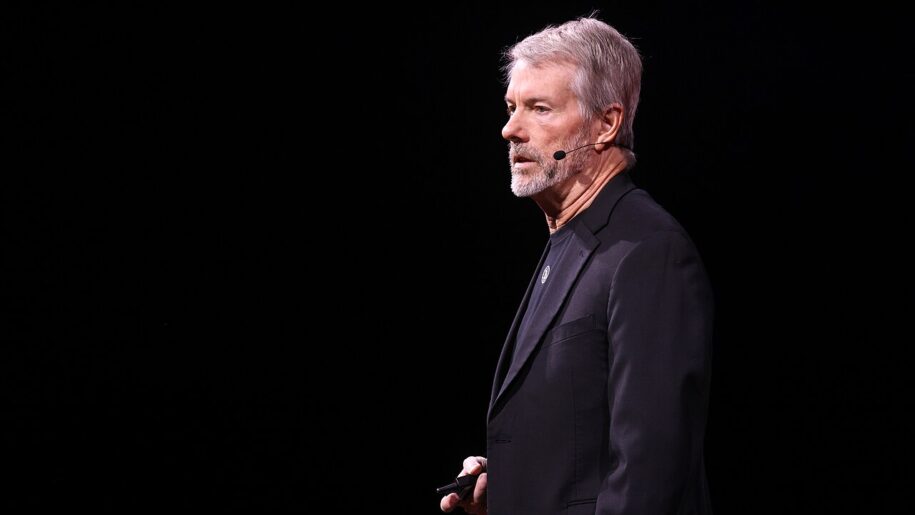
When every major Wall Street bank markets the same deals simultaneously, something has to be sold. In the past 14 days, Bitcoin might have been one of those things.
Key Takeaways
- Five separate raises of $80B or more are happening simultaneously.
- NVIDIA’s data center revenue grew 65% to $215.9B last fiscal year.
- Institutional sellers are offloading credit, SaaS equities, and Bitcoin alike.
- The $400B raise covers only the first six months of Saylor’s $1T projection.
The Explanation Saylor Says Everyone Is Missing
Bitcoin fell from $82,000 to $60,000 over 15 days. Saylor’s explanation is direct.
“Right now is a massive capital rotation,” he said. “$400 billion in just a matter of weeks rolling into AI.”
OpenAI, Anthropic, Google’s Alphabet, and SpaceX are simultaneously raising capital at scales that have no historical precedent. “In the history of the world, there’s never been $80 billion IPOs,” Saylor said. “And we’re getting like one, two, three, four, five.” SpaceX is running an $85 billion IPO. Google is seeking $80 billion from the market. Anthropic is raising $80 billion.
To fund those allocations, institutional investors need liquidity. They are selling across asset classes, private credit, public credit, software-as-a-service equities, anything with value that converts to cash quickly. “They’re selling Bitcoin,” Saylor said. “They’re rolling into the hot new issues.”
The $4 billion that left Bitcoin ETFs over 14 days represents roughly 1% of the $400 billion being raised, small at the macro level, but sufficient to move Bitcoin’s price materially given the concentrated timeframe. “Every single investment bank on Wall Street is out there marketing the OpenAI deal, the Google deal, the SpaceX deal,” Saylor said, “and everybody has got to come up with $400 billion of cash.”
“Not a complicated reason why this is happening,” he added. “It’s a massive vacuum.”
The AI buildout is absorbing capital at historic scale, creating temporary pressure across global markets. That does not weaken Bitcoin. It strengthens the case for scarce, liquid, digital capital. Bitcoin remains the premier asset for the long term. $BTC pic.twitter.com/DMXidrHDB8
— Michael Saylor (@saylor) June 6, 2026
Why NVIDIA’s Numbers Support the Argument
The institutional appetite behind these raises is not speculative. NVIDIA reported fiscal 2026 revenue of $215.9 billion, 65% annual growth year-on-year, with data center sales making up nearly 90% of the total. The stock hit an all-time high of $236.54 on May 14. The Nasdaq-100 absorbed over $1.75 billion in fresh ETF inflows in a single month.
That earnings foundation is what separates the current AI raise from previous technology cycles. When portfolio managers choose between a Bitcoin ETF sitting 51% below its all-time high and an AI infrastructure play backed by 65% revenue growth and accelerating data center demand, the reallocation is not sentiment-driven. It is math.
Saylor estimated $1 trillion in total capital will flow into AI and hyperscalers across 2026. The $400 billion currently being raised covers the first six months of that projection. “This is going to be the biggest year of IPOs and equity issuance in our lifetime,” he said.

How Long the Pressure Lasts
Saylor was direct about the timeline. “It’ll probably continue as long as these mega IPOs come,” he said.
He also framed the broader market volatility as a consequence of capital moving at historic speed across all asset classes simultaneously. “I don’t think any part of the market is immune to that,” he said.
The implication is that the current Bitcoin drawdown is not a signal about Bitcoin’s fundamentals. It is a function of the size of the competing raise. Capital is not leaving because holders have lost conviction. It is leaving because every major financial institution is simultaneously asking the same pool of investors for cash, and something has to be sold.
When the OpenAI, Google, SpaceX, and Anthropic raises complete and the Wall Street marketing effort moves on, the structural source of ETF outflow pressure subsides. What happens to that capital after it is deployed into AI infrastructure, and whether any of it cycles back into Bitcoin, is the question the market will answer when the IPO wave does.
The information provided in this article is for educational purposes only and does not constitute financial, investment, or trading advice. Coindoo.com does not endorse or recommend any specific investment strategy or cryptocurrency. Always conduct your own research and consult with a licensed financial advisor before making any investment decisions.



Kosta has reported on cryptocurrency markets and blockchain infrastructure since 2020, bringing over six years of hands-on experience in the crypto industry built through daily tracking of markets, trends, and emerging blockchain developments. Specializing in Bitcoin on-chain analysis, institutional ETF flows, and digital asset price action, his work at Coindoo has been cited by other news agencies and consistently covers market developments with a focus on data-driven reporting across Bitcoin, Ethereum, Solana, and XRP. Over the years, Kosta has contributed to multiple crypto media outlets in different regions, authoring over 6,000 articles across the sector. His reporting spans cryptocurrency markets and the broader fintech industry, tracking not only price action but also the technological and regulatory forces shaping the ecosystem. To support his analysis, Kosta actively leverages on-chain data and metrics from leading platforms such as Santiment, Glassnode, and CryptoQuant, enabling deeper, evidence-based market insights. He believes in the power of transparency and the data that underpins the blockchain ecosystem. His academic background in Marketing Management from Denmark further complements his analytical approach, adding a strong understanding of communication strategy and content positioning to his work.