US PPI Hits 5.4% – What Crypto Traders Should Watch Next

U.S. producer prices rose 5.4% annually in August as energy costs rebounded, leaving crypto traders focused on Friday’s CPI report and the Federal Reserve’s next move.
Key Takeaways
- Headline PPI matched the 0.4% forecast.
- July’s monthly increase was revised higher.
- Energy drove most goods-price growth.
- Services prices increased only 0.1%.
- CPI now carries greater policy weight.
August PPI matched forecasts despite annual acceleration
The Bureau of Labor Statistics said the Producer Price Index for final demand rose 0.4% in August on a seasonally adjusted basis. The index increased 5.4% from a year earlier.
The monthly result matched the consensus forecast, making the release less of an immediate market surprise than the 5.4% annual figure might suggest. July’s monthly increase was revised from zero to 0.1%, while its annual rate was revised to 4.8%.
Published annual forecasts ranged from 5.3% to 5.4%, depending on the survey or economic calendar. The more consistent comparison was the monthly estimate, which the actual result met.
The measure excluding foods, energy and trade services is designed to reduce the influence of volatile commodity prices and changes in retailers’ margins. It is broader than a conventional measure excluding only food and energy, so the two should not be treated as interchangeable.
A weak 2025 comparison lifted the annual rate
The increase from July’s 4.8% annual rate to 5.4% looks sharper than the monthly result alone. Part of that acceleration came from the comparison period: headline PPI fell 0.2% in August 2025, and that decline dropped out of the 12-month calculation as August 2026’s 0.4% increase entered it.
This base effect contributed materially to the higher annual rate, but it does not explain the entire change with exact precision. The published monthly figures are rounded, and earlier months were revised after the BLS received late reports and corrections.
The result therefore carries two messages. Producer prices rose at a faster annual rate, but the latest monthly increase was already expected. For markets, that distinction matters because a forecast-matching report normally provides less reason for an abrupt repricing than a clear upside surprise.
Goods carried the increase while services stayed subdued
Final-demand goods prices rose 1.1%, while services increased 0.1%. More than three-quarters of the goods increase came from energy, which advanced 4.2%.
Diesel prices jumped 24.1% and accounted for more than one-third of the goods increase. Gasoline, jet fuel and home-heating oil also became more expensive. By comparison, food prices rose 0.1%, while goods excluding food and energy increased 0.4%.
The concentration in fuel prices limits what headline PPI can reveal about persistent inflation. Energy can affect transportation and production costs, but a one-month jump does not show that businesses will pass those costs to consumers. Evidence of that transmission would need to appear in later core producer-price or consumer-price readings.
Services provided a less inflationary signal. Transportation and warehousing prices rose 2.3%, including a 2% increase in truck-freight prices, but trade-services margins declined 0.2%. Services excluding trade, transportation and warehousing were unchanged.
Several categories that can feed into the Federal Reserve’s preferred Personal Consumption Expenditures inflation measure moved in different directions. Airline passenger services, legal services and hospital inpatient care rose, while portfolio-management prices fell. That mixed composition gives policymakers less reason to treat the headline increase as a uniform rise in underlying inflation.

PPI leaves the Fed decision to CPI
Before the release, the 10-year Treasury yield stood near 4.85%, while the CME FedWatch Tool showed markets assigning a 62.2% probability to a September rate increase. Those readings describe positioning before PPI and should not be interpreted as the market’s response to the report.
Economists were more cautious than futures traders. A Reuters poll found that 65 of 93 economists expected the Fed to keep its target range at 3.50%–3.75% at the September 15–16 meeting.
August PPI is unlikely to settle that disagreement because its main monthly readings matched forecasts and much of the goods increase came from energy. The policy implications depend on whether higher fuel and freight costs begin appearing in consumer prices and broader service categories.
That puts greater weight on the September 11 CPI report. Expectations center on a 0.4% monthly increase in headline CPI and a 0.2% rise in core CPI.
- Core CPI at 0.3% or higher: This would add evidence that inflation extends beyond energy and could strengthen expectations for tighter policy.
- Core CPI near 0.2%: The result would keep the Fed debate open, particularly if headline inflation remains elevated.
- Core CPI around 0.1%: Softer underlying consumer inflation would weaken the argument that August’s producer-price increase signals broader price pressure.
The Fed will assess more than one release, but CPI can clarify whether the energy-heavy PPI increase is feeding into the prices consumers pay.
Bitcoin levels and cross-market signals to watch
At the time of writing after the release, Bitcoin traded near $77,200, close to its session low and about 2.9% below the previous close. Its session high was $79,600. Pre-release market coverage had already shown Bitcoin in negative territory, so the full daily decline cannot be attributed to PPI.
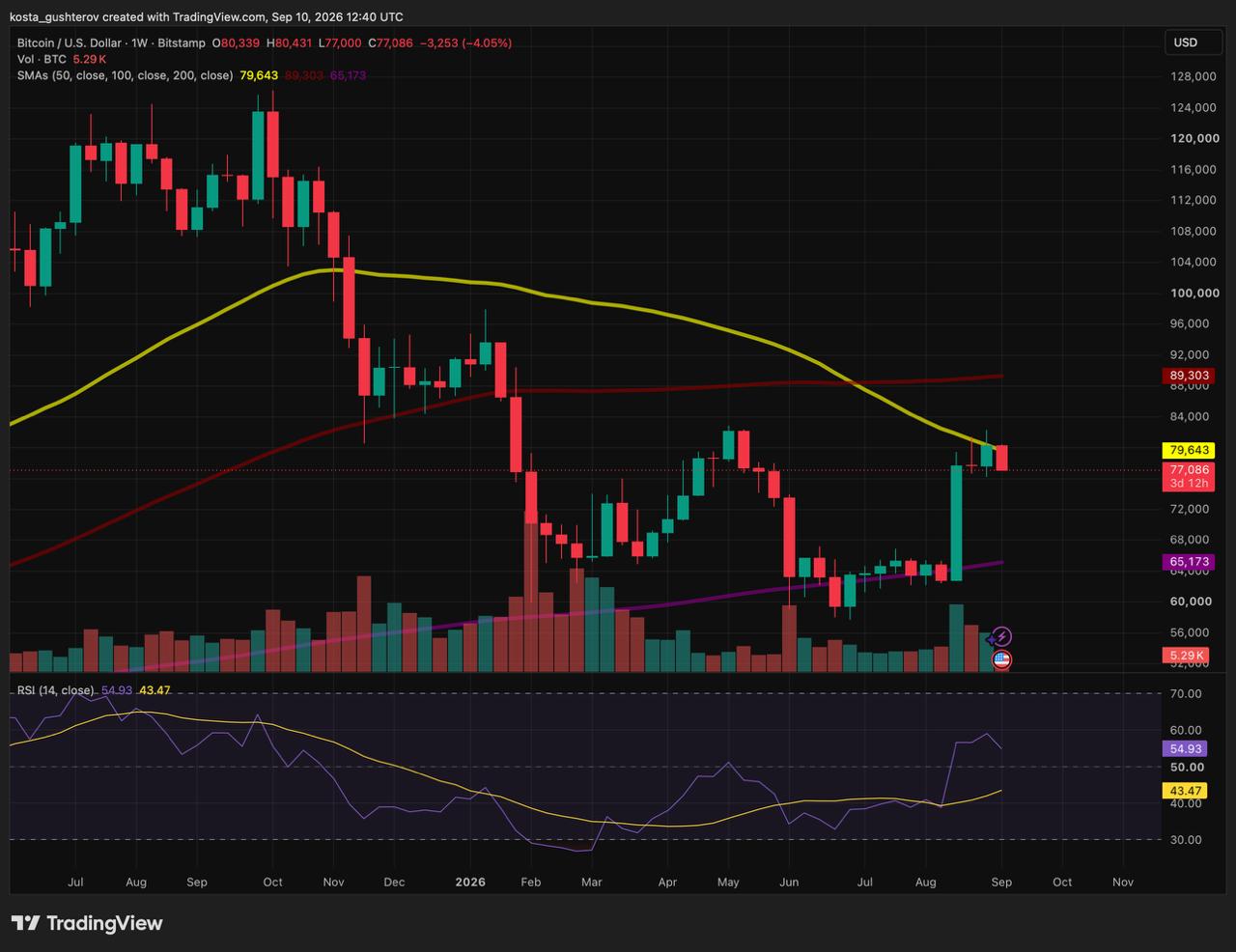
The immediate technical test remains around $76,600, identified as first daily support in our analysis of Bitcoin’s price structure. A decisive break would expose the $73,000 area, followed by a broader support zone near $70,000.
On the upside, Bitcoin would need to recover the $79,500–$80,000 region before testing resistance around $82,400. A brief move above one of these levels would carry less weight than a daily close supported by spot-market demand.
Crypto traders should compare Bitcoin’s price action with four signals:
- Two-year Treasury yield: A rise would indicate stronger expectations for restrictive Fed policy.
- U.S. dollar index: A stronger dollar can create a tougher backdrop for dollar-priced risk assets.
- FedWatch probabilities: Changes after CPI will show whether rate expectations are genuinely shifting.
- Bitcoin’s daily close: Holding $76,600 would matter more than a short intraday bounce.
The policy backdrop was already weighing on crypto before PPI. Federal Reserve Chair Kevin Warsh’s emphasis on inflation had contributed to pressure on Bitcoin in the end of August, while the week’s scheduled inflation releases were among the events expected to move crypto markets.
For now, PPI preserves rather than resolves the market’s central question: whether higher energy and transportation costs will spread into underlying consumer inflation before the Fed meets.
This article is for informational purposes only and does not constitute financial advice.



Kosta has reported on cryptocurrency markets and blockchain infrastructure since 2020, bringing over six years of hands-on experience in the crypto industry built through daily tracking of markets, trends, and emerging blockchain developments. Specializing in Bitcoin on-chain analysis, institutional ETF flows, and digital asset price action, his work at Coindoo has been cited by other news agencies and consistently covers market developments with a focus on data-driven reporting across Bitcoin, Ethereum, Solana, and XRP. Over the years, Kosta has contributed to multiple crypto media outlets in different regions, authoring over 6,000 articles across the sector. His reporting spans cryptocurrency markets and the broader fintech industry, tracking not only price action but also the technological and regulatory forces shaping the ecosystem. To support his analysis, Kosta actively leverages on-chain data and metrics from leading platforms such as Santiment, Glassnode, and CryptoQuant, enabling deeper, evidence-based market insights. He believes in the power of transparency and the data that underpins the blockchain ecosystem. His academic background in Marketing Management from Denmark further complements his analytical approach, adding a strong understanding of communication strategy and content positioning to his work.