How Robinhood Chain’s 10M Daily Transactions Boost Arbitrum

Robinhood Chain has become one of the fastest-growing networks in crypto, and Arbitrum is positioned to be a direct beneficiary.
Key Takeaways
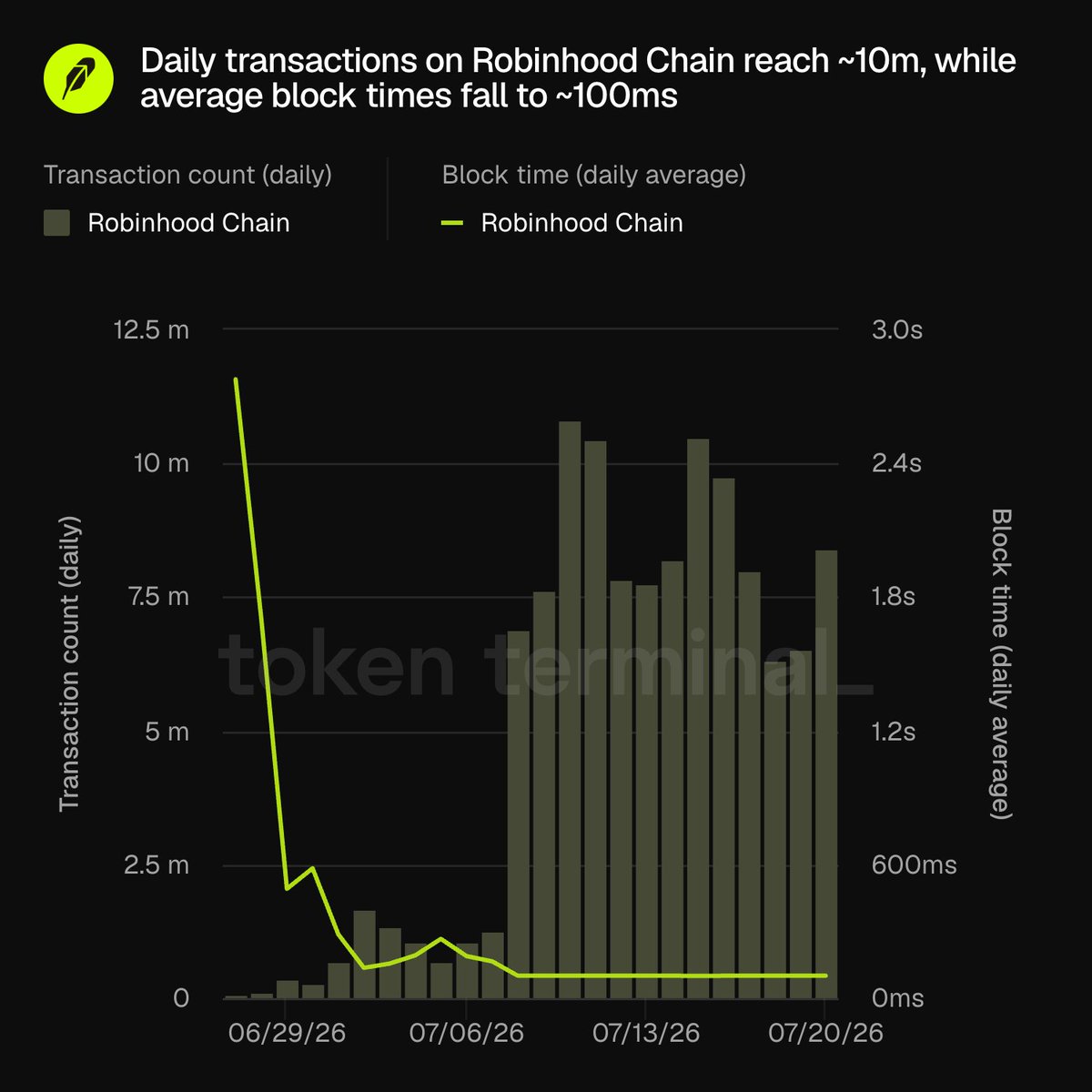
- Robinhood Chain reached roughly 10 million daily transactions within three weeks of its July 1 mainnet launch.
- The chain routes 10% of protocol net revenue to the Arbitrum ecosystem: 8% to the DAO treasury, 2% to the Developer Guild.
- A 90-day gas subsidy is driving activity, keeping current fee revenue minimal until it expires in late September.
- Early volume is dominated by memecoins and DeFi rather than the tokenized stocks the chain was built for.
The Layer 2, built on Arbitrum’s technology stack, reached roughly 10 million daily transactions less than three weeks after its public mainnet opened, and it contributes a share of its revenue back to the Arbitrum ecosystem.
The mechanism is real. The current dollar amounts are not yet meaningful. Understanding both is what separates this story from the version circulating on social media.
A 10 Million-Transaction Chain, With an Asterisk
The clearest picture comes from Token Terminal, which wrote on X that “daily transactions on Robinhood Chain reach ~10m, while average block times fall to ~100ms,” calling the result a consumer-grade user experience onchain. The firm’s chart shows the ramp was not a single spike: daily counts climbed through early July and have held between roughly 7 million and 11 million since July 8, with several sessions above 10 million, while average block times collapsed from about 3 seconds at launch to a flat line near 100 milliseconds. Counting methods vary by tracker but every source points the same direction, and Token Terminal’s earlier comparison, cited by CoinDesk, showed the chain overtaking Coinbase’s Base in daily transactions within two weeks of launch.
Two caveats keep that figure honest. First, Robinhood is covering all user gas fees for the chain’s first 90 days, which brings the cost of transacting to near zero and inflates activity that might not persist once users pay their own way from late September. Second, the composition is not what the chain was built for: DefiLlama data as of mid July shows memecoins and stablecoins dominating a network holding only about $12.8 million in tokenized real-world assets, against total value locked in the hundreds of millions. The pattern echoes Base’s 2023 launch, where speculation arrived first and durable applications later.
Ten million transactions is also not ten million users. Automated contract interactions, swaps and application-generated activity can all produce multiple transactions per participant. The milestone is evidence of technical capacity, not equivalent adoption. For how tokenized stocks and funds actually work as products, see our guide to RWA tokenization platforms.
How Robinhood Activity Becomes Arbitrum Revenue
The economic relationship needs a clarification that most coverage skips. Robinhood Chain does not transfer 10% of every transaction’s value to Arbitrum. Under the Arbitrum Expansion Program, it contributes 10% of the protocol net revenue generated by the chain: 8% to the ArbitrumDAO treasury and 2% to the Arbitrum Developer Guild, routed through the program’s fee infrastructure and incorporated into the DAO’s financial reporting, according to the official ArbitrumDAO factsheet.
The connection to ARB is indirect but real. ARB holders vote on how the DAO treasury is used, including ecosystem funding and treasury allocation. The arrangement includes no automatic ARB buyback and no direct distribution to token holders; it adds revenue to a treasury governed through ARB-based voting.
Why the Numbers Are Still Small
Here is where the thesis meets the ledger. During the subsidy period, the chain’s daily protocol fees have run at approximately $4,000, and FalconX estimated in April that Robinhood Chain could generate about $1.1 million in fees over six months. Ten percent of net revenue on figures that size is not a treasury-moving number for a DAO of Arbitrum’s scale.
The revenue thesis is therefore a forward-looking one. It depends on activity surviving beyond the subsidy, on fee-paying usage replacing subsidized speculation, and on tokenized securities and payments growing into the volumes that speculative trading currently occupies. If those conditions hold, the recurring flow to Arbitrum grows with them. If activity collapses in October, the 10% share applies to very little.

The Real Boost: A Blueprint for More Chains
The larger value to Arbitrum may not be this chain’s fees at all, but what its launch demonstrates. Robinhood opened the mainnet on July 1, 2026 after a February public testnet that, according to the Arbitrum Foundation, processed more than 200 million transactions before production. The company first launched its Stock Tokens on Arbitrum One in 2025, validated the product on shared infrastructure, then migrated to a dedicated chain, the “launch-and-migrate” model described in Arbitrum’s announcement.
Technically, the chain runs first-come, first-served sequencing with roughly 100-millisecond preconfirmations, settles to Ethereum using blob data availability per the official documentation, and is fully EVM-compatible: it uses ETH for gas, supports standard Ethereum wallets, and assets move in over standard infrastructure of the kind covered in our guide to the Arbitrum Bridge and its alternatives. It is also permissionless, meaning external developers deploy without Robinhood’s approval, per Robinhood’s support documentation. The 100-millisecond figure describes ordering and preconfirmation speed, not final Ethereum settlement.
For Arbitrum, a household-name brokerage proving that model at this scale is a sales document for every other institution weighing its own chain. Each additional Expansion Program chain adds another revenue stream to the same treasury. That compounding pipeline, more than this quarter’s fees, is the realistic version of the “Robinhood boosts Arbitrum” story.
The competitive stakes are visible elsewhere: as our analysis of Solana’s second quarter showed, roughly 97% of tokenized-equity trading currently runs through Solana. Robinhood Chain is the most credible attempt yet to pull that market onto Ethereum-aligned rails.
Confirming the Thesis
- Transaction counts and active addresses in October, after the subsidy expires; sustained seven-figure daily activity on paid fees would convert the launch spike into a business.
- The share of activity coming from tokenized securities, visible in the chain’s TVL composition.
- The actual revenue contributions appearing in ArbitrumDAO’s financial reporting, which will put a public dollar figure on what the 10% share is worth.
Until then, Robinhood Chain has proven the technology scales and the revenue pipe exists. Whether meaningful money flows through it is a question the coming months will answer.
Source: Based on Robinhood and Arbitrum official documentation and announcements, the ArbitrumDAO factsheet, and network data from Token Terminal and DefiLlama, checked July 21, 2026.
This article is provided for informational purposes only and does not constitute financial or investment advice.



Kosta has reported on cryptocurrency markets and blockchain infrastructure since 2020, bringing over six years of hands-on experience in the crypto industry built through daily tracking of markets, trends, and emerging blockchain developments. Specializing in Bitcoin on-chain analysis, institutional ETF flows, and digital asset price action, his work at Coindoo has been cited by other news agencies and consistently covers market developments with a focus on data-driven reporting across Bitcoin, Ethereum, Solana, and XRP. Over the years, Kosta has contributed to multiple crypto media outlets in different regions, authoring over 6,000 articles across the sector. His reporting spans cryptocurrency markets and the broader fintech industry, tracking not only price action but also the technological and regulatory forces shaping the ecosystem. To support his analysis, Kosta actively leverages on-chain data and metrics from leading platforms such as Santiment, Glassnode, and CryptoQuant, enabling deeper, evidence-based market insights. He believes in the power of transparency and the data that underpins the blockchain ecosystem. His academic background in Marketing Management from Denmark further complements his analytical approach, adding a strong understanding of communication strategy and content positioning to his work.