Retail Sells Ethereum at Breakeven While Whales Hold at $2,090 Cost Basis

Ethereum has fallen back to $2,312 after failing to hold above $2,420, with RSI hitting 30 in the oversold sector while retail investors deposit record volumes to Binance to take profits and whale cohorts sit on unrealized losses they refuse to crystallize.
Key takeaways:
- ETH at $2,312 – below dotted support, lower high pattern confirmed.
- RSI at 30 – oversold, signal line at 42.99, significant gap.
- Binance inflow: 372,534 ETH – 35% above 7-day average of 277,709.
- Global SOPR at 1.0157 – coins moving to exchanges in profit.
- Whale cohort 10k-100k ETH MVRV: -0.002139 – underwater, not selling.
- Mega-whale realized price: $2,090.30 – structural support.
- Long-term investor realized price: $2,429.30 – resistance the rally just failed at.
- Exchange netflow: -12.6K – mild outflow, ETH leaving exchanges.
The selling hitting ETH at $2,312 is not conviction selling. It is breakeven selling, holders who have been underwater for weeks, finally at a price where they can exit without crystallizing a loss, choosing to do so. That distinction matters because breakeven selling is finite. Conviction selling is not. Understanding which type of selling is in the market changes everything about how to read the current structure.
Who is selling and why
Binance received 372,534 ETH in the most recent daily period, 35% above the 7-day average of 277,709. The SOPR data explains who is sending it. The global Spent Output Profit Ratio sits at 1.0157, above 1, meaning the coins being moved on-chain were acquired at a lower price than they are being moved at today. People are sending ETH to Binance because they are in profit and want to sell it.
The retail cohort SOPR at 0.0001498 adds specificity. This near-zero reading means the retail participants depositing to Binance are barely in profit. They are not selling large gains. They are selling small gains or near-breakeven positions. They have been underwater for weeks, finally reaching a price where they can exit without a significant loss, and choosing to do so.
That selling is self-exhausting. Breakeven sellers are not trend sellers. They are not bearish on ETH — they are recovering a position. Once they exit they leave the market. The retail inflow spike of 372,534 ETH to Binance represents the current wave of that behavior. When it clears, the resistance it creates clears with it. The question is whether fresh demand arrives before or after that happens.
Who is holding and why
The whale cohort holding 10,000 to 100,000 ETH has an MVRV of -0.002139, negative, meaning this group is in unrealized loss. They paid more for their ETH than it is worth today. They are not distributing because doing so would crystallize that loss. This is passive support, not accumulation, not conviction buying, just the behavioral reality that holders in loss tend to hold rather than realize the damage.
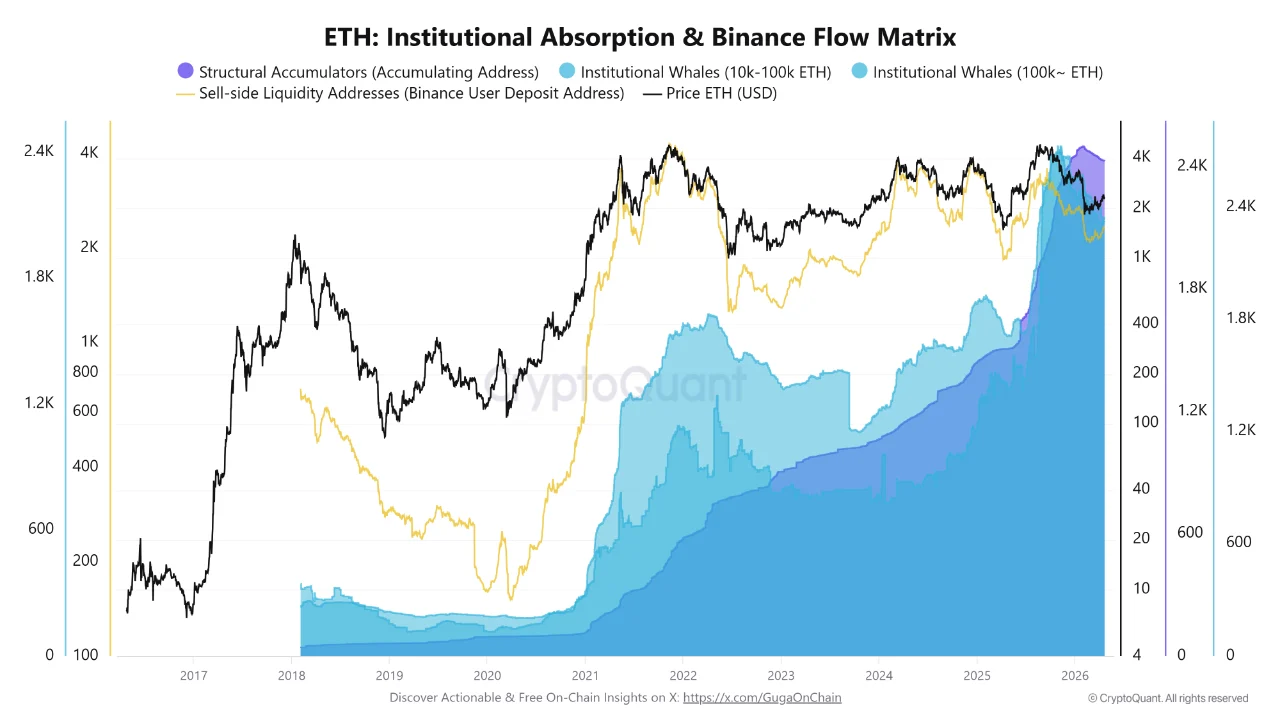
The structural floor comes from a different group. Mega-whales, wallets holding 100,000+ ETH, have a realized price of $2,090.30. They are comfortably in profit at $2,312. The institutional absorption chart shows their holdings growing through every correction in the 2021-2026 dataset. They did not sell at the 2022 bottom. They did not sell at the 2025 correction. They are not offloading at $2,312. That consistency across multiple market cycles is the data point, not a motive attributed to them, just the behavior the chart shows.
READ MORE:

Ex-Goldman Sachs Executive: Bitcoin Is Sitting on the Most Misread Setup He Has Seen in Years
The netflow data and who was buying the dip
The exchange netflow chart shows large negative readings, ETH leaving all exchanges, on April 19-21, exactly when price was recovering from the $2,260 low. Readings of -130,000 to -180,000 ETH represent significant withdrawal activity. The cohort most consistent with that behavior is the mega-whale group — wallets holding 100,000+ ETH with a realized price of $2,090. They have the capital, the time horizon, and the on-chain pattern of buying through corrections that the institutional absorption chart shows across the full 2021-2026 dataset. The -130K to -180K netflow during the April 20 dip carries the same signature.
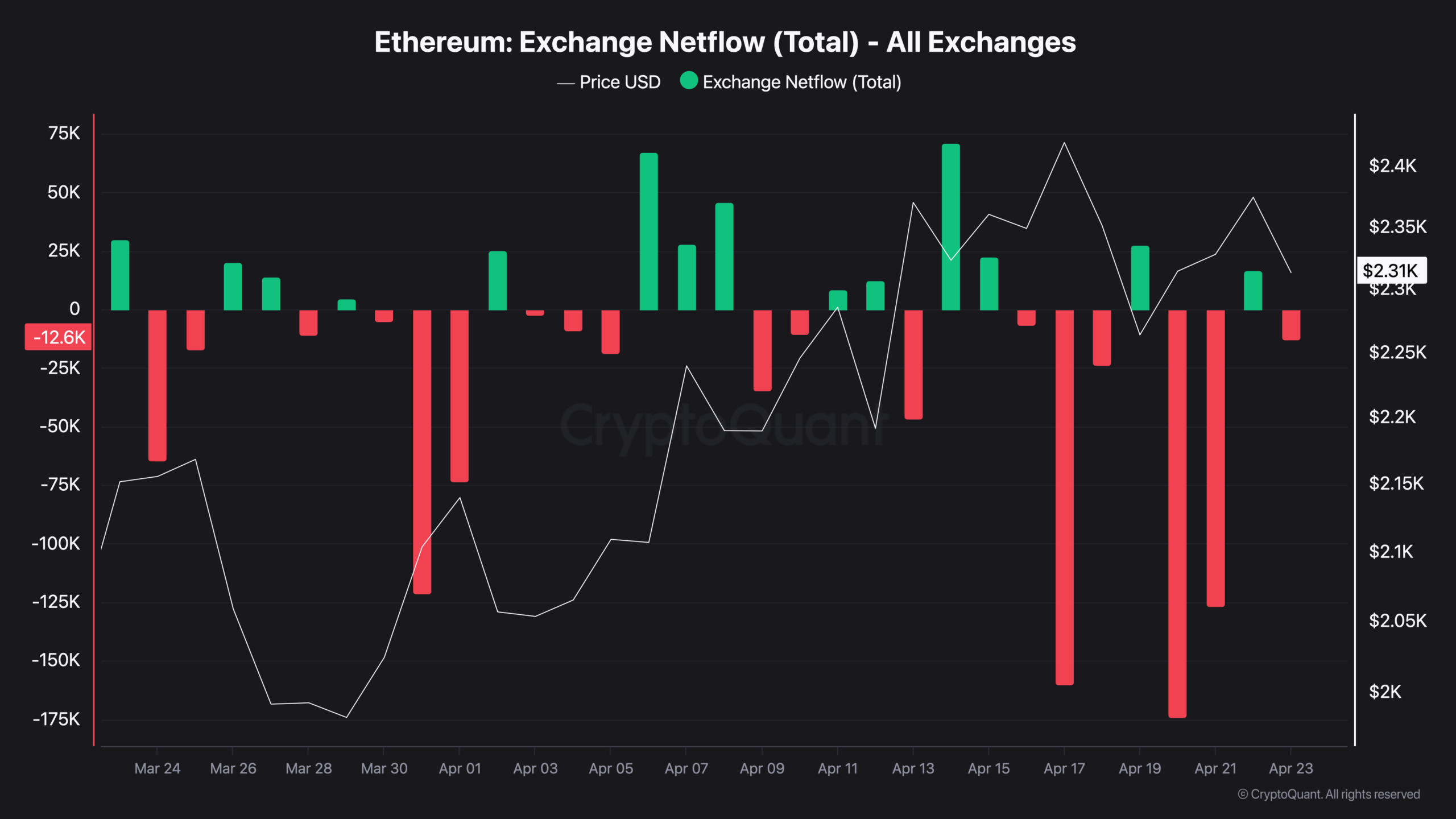
Current netflow is -12,600, mildly negative, not extreme. The aggressive accumulation of the dip has slowed. Whether it resumes at $2,312 — a lower level than where the April 20 buying occurred, is what the next netflow reading will show.
The two levels that define everything
Those two levels, $2,090 and $2,429, are not resistance and support in the technical analysis sense. They are the average cost basis of two specific groups of real holders. That makes them behaviorally anchored, not just technically observed.
Current price $2,312 sits between them. $2,090.30 is where mega-whales bought on average. Below that level the largest holders are underwater and their incentive to hold strengthens further. $2,429.30 is where long-term structural accumulators, the most patient buyers in the market, bought on average. The April 22 rally reached $2,420 and failed. It got within $9 of that level and was rejected by retail selling before it could close above it.
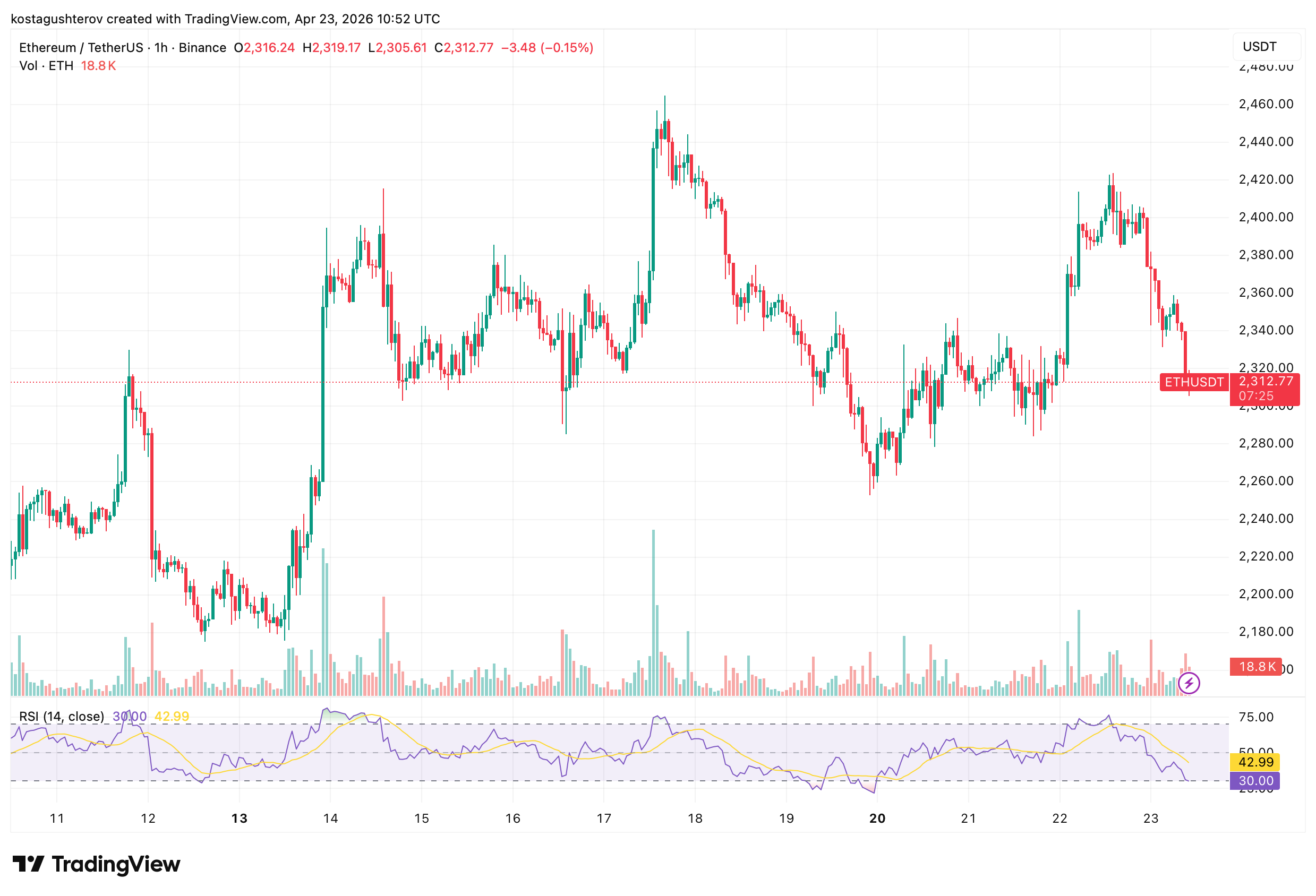
That near-miss matters. The rally had enough momentum to approach the structural resistance but not enough demand to absorb the selling that emerged there. With RSI now at 30 and price at $2,312, the market is approaching oversold conditions for the third time in six days, each time from a lower high.
The specific signal that resolves the tension is not a price level, it is a behavioral shift. On the upside: retail SOPR dropping back below 1 while netflow turns consistently negative would mean the breakeven sellers have exhausted themselves and ETH is leaving exchanges faster than it arrives. That is the setup that preceded every sustained ETH move in the 2024-2025 dataset. On the downside: netflow turning consistently positive while mega-whale MVRV approaches their realized price at $2,090 would mean even the most patient buyers are approaching their threshold. Neither signal is present today. The market is waiting for one of them to appear.
The information provided in this article is for educational purposes only and does not constitute financial, investment, or trading advice. Coindoo.com does not endorse or recommend any specific investment strategy or cryptocurrency. Always conduct your own research and consult with a licensed financial advisor before making any investment decisions.



Alexander Zdravkov is a market analyst and crypto journalist with interests in economics, broader financial markets and digital assets. His journey into crypto began more than four years ago, driven by a fascination with the rapid evolution of blockchain technology and the transformative potential of decentralized finance. He began analyzing market cycles and identifying emerging trends before they reach the mainstream. He holds a degree in International Relations - a background that helped shape his broader perspective on global economics, geopolitics, and the interconnected nature of modern financial markets. Whether covering the latest developments in the crypto sector or exploring broader macroeconomic themes, Alexander focuses on giving readers context rather than simply repeating headlines. During his career, he has authored more than 5,000 articles covering cryptocurrencies, traditional finance, and global market developments. His work spans everything from Bitcoin and altcoins to macroeconomic trends influencing risk assets worldwide.