Morpho Jumps 13% After Standard Chartered Gives $60 Target

Morpho's token spiked after Standard Chartered's analyst backed the DeFi lending protocol with an aggressive long-term price target.
Key Takeaways
- MORPHO jumped over 13% after Standard Chartered initiated coverage.
- The bank set a $60 end-2030 target, implying roughly 30x upside.
- The forecast rests on a projected 37x growth in DeFi assets by 2030.
- Real institutional integrations and a $175M raise anchor the near-term case.
Morpho’s token spiked after a major traditional bank put its name behind the DeFi lending protocol. MORPHO is trading at $2.128 on Coinbase at the time of writing, up 13% on the day, after Standard Chartered initiated coverage with an aggressive long-term price target. The move is a clean, news-driven catalyst: the volume confirms real participation, not a thin-liquidity spike.
The Move
Today’s candle is the largest single-day gain on the TradingView’s chart, printed on 1.11M in volume, among the heaviest bars in the window.
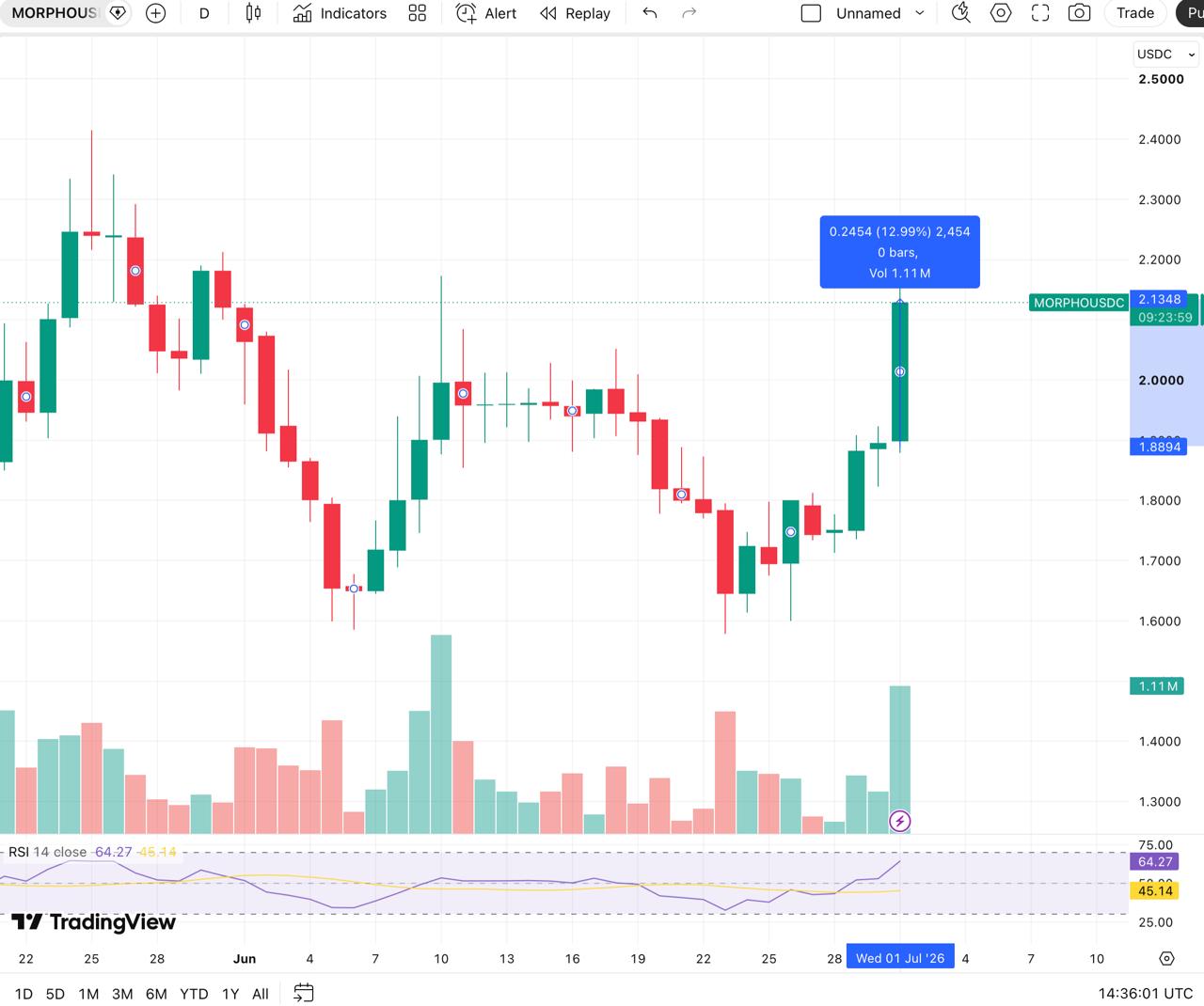
Price broke cleanly above the $2 level it had been chopping under for most of June, opening around $1.89 and reaching $2.1598 before losing a bit of the steam. RSI jumped to 64.24 against a signal line of 45.13, the strongest momentum reading on the chart, though not yet overbought. The breakout comes off a June range between roughly $1.60 and $2.15, with MORPHO having bottomed near $1.58 around June 22-23 before grinding back up.
The Catalyst
Standard Chartered initiated coverage on Morpho, led by digital assets research head Geoff Kendrick, with an end-2030 price target of $60, implying roughly 30x upside from current levels. According to Coindesk, the bank projects MORPHO will outperform both Bitcoin and Ethereum over the period. “We are bullish on the outlook for Morpho, the second-largest decentralised finance (DeFi) lending protocol after Aave,” Kendrick wrote in the note. It’s worth noting this follows a similar Standard Chartered call on Aave ($3,500 by 2030) a week earlier, part of a widening bank bet on DeFi.
The Forecast, Year by Year
The $60 figure is a staged trajectory, not a single jump, and it should be read as Standard Chartered’s projection, not an established price:
| Year-End | SC Target |
|---|---|
| 2026 | $3.50 |
| 2027 | $11.00 |
| 2028 | $22.00 |
| 2029 | $40.00 |
| 2030 | $60.00 |
Even the 2026 target of $3.50 implies substantial upside from current levels within this year alone.
The Four Pillars of the Thesis
Standard Chartered’s case rests on four supports:
- A dual business model: Morpho runs Morpho Markets, its lending protocol, alongside Morpho Vaults, infrastructure letting traditional asset managers and on-chain banks deploy capital. The bank frames this “dual-play,” protocol plus infrastructure, as the differentiator.
- The tokenization bet: the $60 target leans heavily on a projected 37-fold growth in total DeFi assets by 2030. This is the load-bearing assumption, the target is essentially a leveraged bet on tokenization playing out.
- Institutional integration already live: Fireblocks, Anchorage, and Bitwise have integrated Morpho’s vault infrastructure to manage on-chain yields. This is the strongest concrete evidence, real adoption that already exists rather than being projected.
- Balance-sheet strength: Morpho Labs raised $175 million in a recent round led by Paradigm and a16z, giving it runway.
The 13% pop shows how powerful a major bank’s coverage can be for a mid-cap DeFi token when the market is ready to respond. But that reaction is far from automatic. When Standard Chartered later gave Chainlink a $200 end-2030 target, LINK barely moved, showing that even an aggressive institutional call does not necessarily translate into immediate buying pressure.
The $60 target is a different matter. It’s a 2030 projection built on a specific and unproven macro assumption, that DeFi assets grow 37x, and a 30x-plus target four years out is inherently speculative regardless of the source’s credibility. The most defensible parts of the thesis are the current facts: the existing institutional integrations and the $175 million raise. The extrapolated price ladder is the projection layered on top. The confirmed catalyst moved the price today; whether the forecast holds depends on a tokenization wave that hasn’t happened yet.



Alex is Editor-in-Chief of Coindoo and co-founder of Millennial Media Group, with nearly a decade of experience covering financial markets - crypto first, then everything else. It started in 2016 with Bitcoin. Like most people at the time, he didn't fully understand it - so he kept digging. Blockchain, tokenomics, the projects, the cycles. That curiosity never stopped, and eventually pulled him into traditional markets too: equities, commodities, macro. Not because he left crypto behind, but because you can't properly understand one without the other. What drives him is straightforward: he wants to know why something is happening, not just that it's happening. Most market coverage stops at the headline - price up, price down, here's a chart. Alex finds that kind of reporting actively unhelpful. If you walk away from an article without understanding the mechanism behind the move, what did you actually learn? He holds a degree in Tourism from New Bulgarian University - not the most obvious path into financial markets, but markets have a way of pulling in people who are simply too curious to stay out. He has authored over 200 in-depth analyses and more than 10,000 articles across crypto and traditional finance. He still thinks every day in markets teaches him something new. That's probably why he hasn't stopped.