MiCA Stablecoin Update: Europe Still Has Just 17 Authorized Issuers in 2026

Europe’s stablecoin market has entered 2026 with little change in the number of fully authorized issuers under the EU’s Markets in Crypto-Assets (MiCA) framework, highlighting both regulatory progress and clear bottlenecks in adoption.
More than a year and a half after MiCA rules for stablecoins began applying, regulators have authorized just 17 E-Money Token (EMT) issuers across the European Union. That figure remains unchanged at the start of the new year, according to a January 2026 snapshot of approvals.
- The number of MiCA-authorized EMT issuers remains stuck at 17 entering 2026
- Euro-denominated stablecoins dominate, but USD-linked tokens still account for more than a third of approvals
- Alipay’s BREUR token shows MiCA can support closed, institutional settlement use cases
- No asset-referenced stablecoins have been approved so far, despite their prominence in the regulation
MiCA EMT landscape remains concentrated
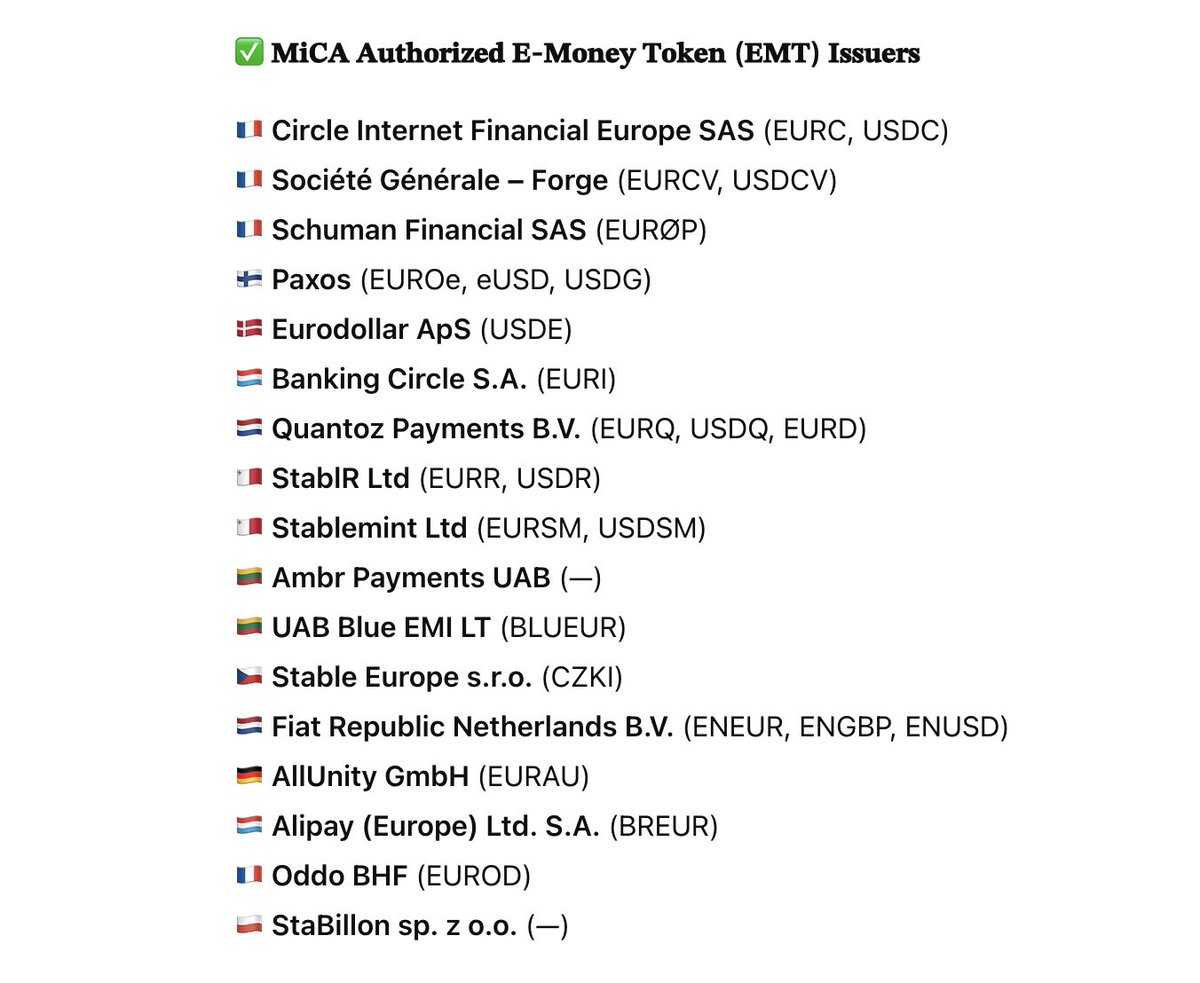
The 17 authorized EMT issuers are spread across 10 EU member states, with France emerging as the most active jurisdiction. French entities account for four approvals, followed by clusters in countries such as Malta, Lithuania, the Netherlands, and Luxembourg. Germany, Finland, Denmark, the Czech Republic, and Poland each host a single authorized issuer.
Among the best-known names on the list are Circle (EURC, USDC), Société Générale – Forge (EURCV, USDCV), Paxos, Fiat Republic, and Quantz Payments. Several smaller regional players, including Schuman Financial, StablR, Stablemint, and AllUnity, round out the list.
25 single-currency EMTs approved so far
While there are 17 authorized issuers, the total number of approved single fiat-backed EMTs stands at 25. These tokens are overwhelmingly euro-focused, reflecting MiCA’s emphasis on monetary sovereignty and EU-based settlement.
Of the 25 approved EMTs:
- 14 are denominated in euros
- 9 are denominated in US dollars
- 1 is denominated in Czech koruna
- 1 is denominated in British pounds
This split underscores that, despite MiCA being an EU framework, USD-linked stablecoins still play a notable role in the bloc’s regulated crypto market.
Alipay’s token highlights “closed-loop” use cases
One of the most notable updates comes from Alipay Europe, which has launched the Bettr Settlement Token under the ticker BREUR. Despite being MiCA-authorized, the token will not be available to the general public.

According to its documentation, BREUR is restricted to approved affiliates of Ant International. It will not be listed on public exchanges, traded on secondary markets, or offered to retail users, positioning it as an internal settlement instrument rather than a consumer-facing stablecoin. This model points to a growing divide between regulated, enterprise-only stablecoins and those intended for broader market use.
Asset-referenced tokens still absent under MiCA
Perhaps the most striking development is what has not happened. As of January 2026, there are still zero authorized Asset-Referenced Tokens (ARTs) under MiCA.
ARTs – which include stablecoins backed by baskets of currencies, commodities, or non-currency assets such as gold – represent a significant portion of the MiCA rulebook. Titles III and IV of the regulation were designed specifically with these instruments in mind, yet no issuer has crossed the regulatory finish line.
One key obstacle remains legal uncertainty. National regulators continue to differ on whether certain products, particularly gold-backed tokens, should fall under MiCA’s ART regime or instead be classified as financial instruments subject to MiFID rules. This lack of harmonized interpretation appears to be stalling market adoption.
As MiCA continues to roll out in practice, the early data suggests Europe’s stablecoin framework is functioning – but cautiously. Whether 2026 brings broader adoption, especially for asset-backed and public-facing tokens, may depend on how quickly regulators resolve lingering classification and interpretation issues.
The information provided in this article is for educational purposes only and does not constitute financial, investment, or trading advice. Coindoo.com does not endorse or recommend any specific investment strategy or cryptocurrency. Always conduct your own research and consult with a licensed financial advisor before making any investment decisions.



Alexander Zdravkov is a market analyst and crypto journalist with interests in economics, broader financial markets and digital assets. His journey into crypto began more than four years ago, driven by a fascination with the rapid evolution of blockchain technology and the transformative potential of decentralized finance. He began analyzing market cycles and identifying emerging trends before they reach the mainstream. He holds a degree in International Relations - a background that helped shape his broader perspective on global economics, geopolitics, and the interconnected nature of modern financial markets. Whether covering the latest developments in the crypto sector or exploring broader macroeconomic themes, Alexander focuses on giving readers context rather than simply repeating headlines. During his career, he has authored more than 10,000 articles covering cryptocurrencies, traditional finance, and global market developments. His work spans everything from Bitcoin and altcoins to macroeconomic trends influencing risk assets worldwide.