South Carolina Signs Crypto Bill Covering Self-Custody, Mining, and CBDC

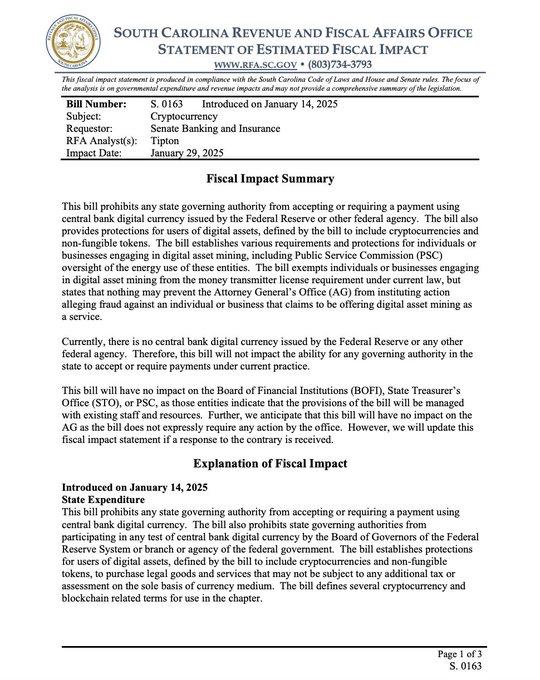
South Carolina's Governor has signed S.0163 into law, a bill introduced on January 14, 2025 that establishes protections for digital asset users, miners, and self-custody holders while prohibiting state authorities from accepting or facilitating central bank digital currency.
Key Takeaways
- S.0163 signed into law.
- CBDC prohibition covers both acceptance and test participation by state authorities.
- Self-custody and non-discriminatory tax protections extend to all digital assets, not Bitcoin only.
- Fiscal impact assessed as zero under current conditions.
The CBDC Ban and Why the Test Participation Clause Matters More
The bill prohibits any state governing authority from accepting or requiring payment in central bank digital currency issued by the Federal Reserve or any other federal agency. The fiscal impact statement notes this provision has no immediate effect because no such currency currently exists.
The CBDC prohibition is immediately costless because no digital dollar exists yet, but the test participation ban is the provision with operational teeth: it prevents South Carolina state authorities from being enrolled in a federal pilot before residents have any opportunity to assess the implications. Prohibiting participation in any CBDC test by the Board of Governors of the Federal Reserve or any branch of the federal government means the state cannot be used as a testing ground even before a digital dollar becomes official policy.
What the Mining Framework Actually Creates
The bill exempts individuals and businesses engaged in digital asset mining from the money transmitter license requirement under current South Carolina law. It simultaneously maintains Public Service Commission oversight of energy use by mining entities. Analytically, this creates a deliberate asymmetry: the state retains the regulatory lever it considers legitimate, energy consumption, while removing what the bill’s structure suggests is an overcategorization of mining as financial transmission. The Attorney General retains authority to act against fraud by anyone claiming to offer digital asset mining as a service, preserving consumer protection without classifying legitimate mining operations as financial services.

The Self-Custody and Tax Provisions Read Together
The bill establishes protections for digital asset users to purchase legal goods and services without being subject to additional tax or assessment on the sole basis of currency medium. Combined with self-custody protections, these provisions address both the holding and the spending layer of digital asset ownership. The protections apply to digital assets broadly, defined to include cryptocurrencies and non-fungible tokens, not Bitcoin exclusively.
Why the Four Provisions Are One Decision
A bill that protects self-custody, bans discriminatory taxation, safeguards proof-of-work mining, and blocks CBDC participation is not four separate provisions: it is a single architectural decision to treat digital assets as a permanent feature of the state’s economic landscape rather than a category awaiting federal definition. Each provision addresses a different vector through which state or federal action could constrain digital asset activity, and together they close those vectors simultaneously.
Analytically, the legislation reads as proactive rather than reactive: it establishes the framework before the conflicts it anticipates have fully materialized. If the Federal Reserve initiates a formal CBDC pilot program within the next twelve months and South Carolina’s test participation ban is challenged in federal court, the bill’s durability will be tested at the point it was most deliberately designed for. If no such challenge emerges and the mining exemption operates without legal contest through the end of 2026, the framework will have achieved its purpose without requiring enforcement.
The information provided in this article is for educational purposes only and does not constitute financial, investment, or trading advice. Coindoo.com does not endorse or recommend any specific investment strategy or cryptocurrency. Always conduct your own research and consult with a licensed financial advisor before making any investment decisions.



Alexander Zdravkov is a market analyst and crypto journalist with interests in economics, broader financial markets and digital assets. His journey into crypto began more than four years ago, driven by a fascination with the rapid evolution of blockchain technology and the transformative potential of decentralized finance. He began analyzing market cycles and identifying emerging trends before they reach the mainstream. He holds a degree in International Relations - a background that helped shape his broader perspective on global economics, geopolitics, and the interconnected nature of modern financial markets. Whether covering the latest developments in the crypto sector or exploring broader macroeconomic themes, Alexander focuses on giving readers context rather than simply repeating headlines. During his career, he has authored more than 5,000 articles covering cryptocurrencies, traditional finance, and global market developments. His work spans everything from Bitcoin and altcoins to macroeconomic trends influencing risk assets worldwide.