Jupiter Processed $3 Trillion in Volume – Why Is JUP Still Below $0.20?

Jupiter (JUP) has quietly become one of the most important pieces of infrastructure in Solana's DeFi ecosystem, yet the token's market value continues to raise questions about how crypto markets price utility, adoption, and long-term value accrual.
Key takeaways
- Jupiter has processed over $3 trillion in cumulative volume while its token trades below $0.20.
- Coinbase, Robinhood, MetaMask, and Uniswap have all embedded Jupiter’s routing API.
- The fee switch has not been activated, which is the central open question for JUP valuation.
- DAO governance was suspended in late 2025 over token allocation disputes and remains in a recovery phase.
If you evaluate Jupiter strictly by what its token is worth – roughly $0.193 as of mid-June 2026 – you will almost certainly draw the wrong conclusion. The protocol has processed more than $3 trillion in cumulative trading volume, controls between 80% and 95% of all aggregator traffic on Solana, and has been quietly embedded into the backend infrastructure of Coinbase, Robinhood, MetaMask, and Uniswap. The gap between those figures and a market capitalization of around $640 million is the central question surrounding JUP – and resolving that disconnect requires looking beyond the token’s price action and examining Jupiter’s role within Solana’s infrastructure.
| JUP Token — Market Data, June 16 2026 | |
|---|---|
| Price | $0.1927 |
| 24h Change | -0.61% |
| 7-Day Change | +24.90% |
| Market Cap | $640,074,390 |
| 24h Volume | $43,022,544 |
| Circulating Supply | 3.32B JUP |
| Max Supply | 7.00B JUP |
| YTD Volume Processed | $1.08 Trillion |
What an aggregator actually does — and why it matters at scale
Jupiter began as a routing engine. When a user wants to swap one token for another on Solana, Jupiter scans every active decentralized exchange on the network — Orca, Raydium, and others — and calculates which combination of pools produces the best execution price, accounting for fees, slippage, and available liquidity. The user sees a single transaction; behind it, Jupiter may have split the order across three different venues simultaneously.
The mechanism is not conceptually different from a flight comparison site: the airlines exist independently, but the aggregator determines which one gets the booking. At small scale, this is a convenience. At the scale Jupiter now operates — contributing heavily to Solana’s $34.5 billion in weekly DEX volume — it has become a critical piece of infrastructure for accessing liquidity on the network. Any application that needs access to Solana’s liquidity finds it most efficient to route through Jupiter rather than building direct integrations with every individual DEX. That structural position is what enabled the B2B pivot that defines Jupiter’s current phase.
The emphasis on broad distribution and user access is consistent with Jupiter’s stated philosophy. Speaking at Solana Summit Germany, Jupiter President Xiao-Xiao Zhu said the protocol’s “DNA” has always centered on rapid consumer adoption and globally accessible, permissionless finance, regardless of a user’s background or location.
"The DNA of Jupiter, the DNA of Solana, initially, was just rapid consumer adoption. And that DNA we will never betray."
"Self-custodial, permissionless, globally accessible from day one. Whether it's a wealthy American or a teenager in emerging markets, having that global,… pic.twitter.com/8gH0aoSYsf
— Solana (@solana) June 13, 2026
How Coinbase, Robinhood and MetaMask ended up running on Jupiter’s rails
The most consequential development in Jupiter’s recent history is not a product launch — it is a distribution shift. During late 2025 and into 2026, Jupiter’s routing API was integrated into the backends of Robinhood, Coinbase, MetaMask, and Uniswap. Coinbase has gone a step further: users can now execute on-chain Solana trades directly within the standard Coinbase interface, with Jupiter handling liquidity routing invisibly underneath.

This reframes what Jupiter is. The consumer-facing swap interface at jup.ag is no longer Jupiter’s primary product — Jupiter is increasingly becoming backend infrastructure that other platforms use rather than develop themselves. A closer comparison in traditional finance is a payment processing network: most users never think about it, but every transaction depends on it. Jupiter also partnered with Bitwise Asset Management to build isolated USDe-denominated lending markets, allowing institutional allocators to use real-world assets as collateral within DeFi. Separately, the Frontier Traders Program — launched alongside the Solana Foundation — offers fee rebates and prioritized access to token launches for quantitative firms processing over $500 million in monthly volume.
Jupiter vs. Uniswap vs. Hyperliquid: three different bets on what DeFi should be
Situating Jupiter within the broader DEX landscape requires a direct comparison with its two most prominent global rivals — Uniswap on multi-chain spot trading, and Hyperliquid on decentralized perpetuals.
| Metric | Jupiter (Solana) | Uniswap (Multi-chain) | Hyperliquid (L1) |
|---|---|---|---|
| Role | Liquidity Aggregator | Automated market maker AMM | Perpetuals orderbook AppChain |
| YTD Volume | $1.08 trillion | $2.5T+ (all-time) | $750B+ (perpetuals) |
| Fees | Dynamic (routing free) | Fixed: 0.01%–1.0% | Maker 0.02% / Taker 0.05% |
| Stablecoin | JupUSD (yield-bearing) | None (USDC/USDT only) | USDH (margin clearing) |
| Value FOR TOKEN HOLDERS | Staking rewards + DAO | Fee-switch token burn | Insurance fund + buybacks |
| Liquidity model | Routes across all Solana DEXs | Siloed into own pools | On-chain CLOB (CEX-style) |
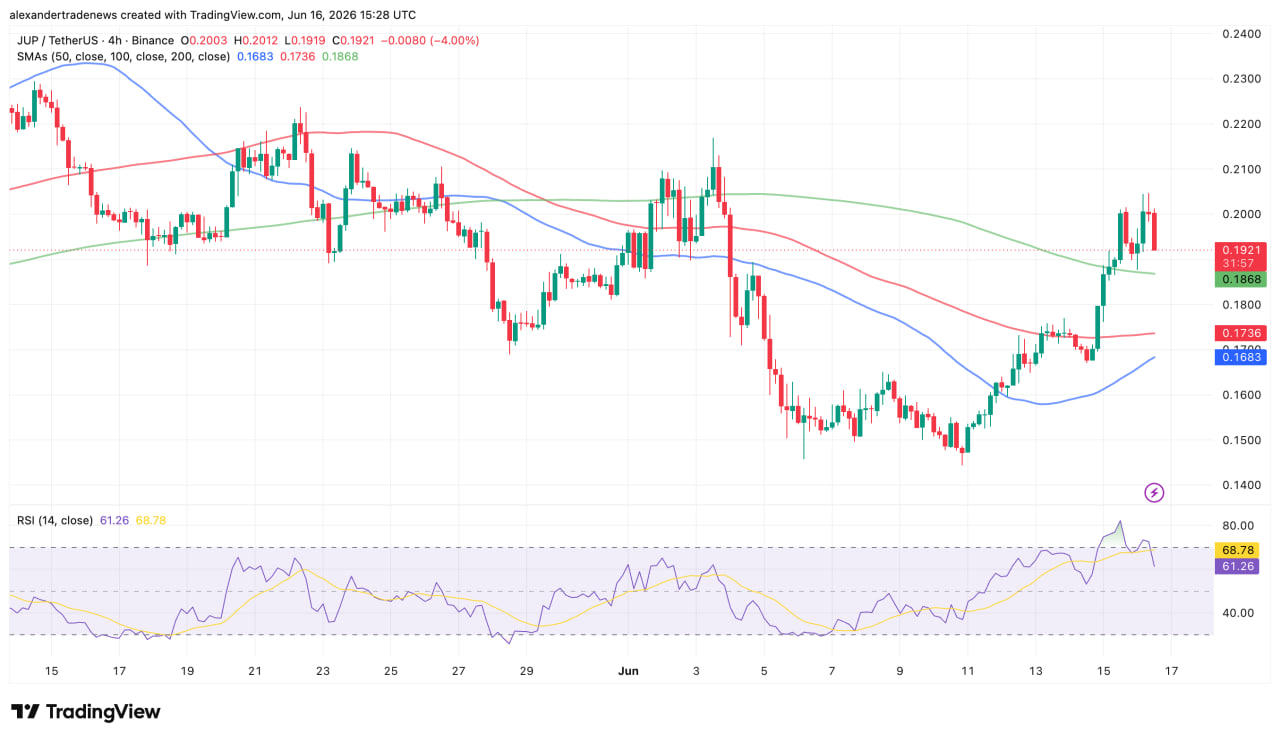
Technical picture: above all moving averages, RSI approaching caution territory
On the 4-hour chart, JUP is trading above all three key moving averages for the first time in several weeks — a configuration that typically follows a sustained accumulation phase rather than a short-term spike. The 25% weekly gain has pushed price from a low near $0.148 back above the SMA200, which now sits at $0.1868 and has flipped from resistance to support.
- SMA50 at $0.1683 – price is 14.5% above it, the widest gap of the three averages, reflecting how deep the prior drawdown was
- SMA100 at $0.1736 – crossed to the upside earlier this week alongside rising volume
- SMA200 at $0.1868 – the most watched level; reclaiming it after weeks below could mark a meaningful shift in market structure.
- RSI 14 at 61.86, signal line at 68.82 – momentum is strong but the signal line is approaching overbought territory, suggesting the $0.20 level may act as short-term resistance before any further continuation
Beyond swaps: lending, stablecoins, and prediction markets
The “DeFi Superapp” label reflects Jupiter’s rapid expansion beyond token swaps over the past 18 months. Each new product addresses a specific capital efficiency problem that the original swap interface could not solve.
| Product | What it does | Why it matters |
|---|---|---|
| JupUSD | Yield-bearing stablecoin (built with Ethena) | Earns yield automatically during DCA orders, limit orders, and prediction market activity — idle capital between trades no longer sits flat |
| JupSOL | Liquid staking for SOL | Users retain full liquidity while underlying SOL generates staking and MEV-backed yields — removes the traditional illiquidity cost of staking |
| Jupiter Lend | On-chain lending protocol | Completed public beta with 83,000+ active users and zero bad debt — significant in a space where undercollateralized lending has repeatedly caused collapses |
| ApePro | Low-latency memecoin terminal | Connects directly to Solana’s RPC infrastructure; executes trades during high-congestion periods when standard consumer wallets slow or fail |
| Jupiter Forecast | Native prediction market (June 2026) | Isolated liquidity pools designed for professional trading firms; competes directly with Polymarket |
Token mechanics and the fee switch question that changes everything
JUP’s tokenomics reached a structural milestone in 2026: the multi-year unlock schedule concluded, bringing circulating supply to approximately 3.32 billion tokens against a hard cap of 7 billion. The DAO passed a “Net-Zero Emissions” proposal that scaled back near-term unlock commitments and paused core team vesting schedules, reducing the structural sell pressure that had weighed on price throughout 2024 and 2025.
The long-term valuation debate centers on one mechanism: the fee switch. Jupiter generates significant protocol revenue from trading activity, but currently none of it flows to JUP token holders. If the DAO activates a fee distribution mechanism — routing a portion of protocol revenue to stakers — the token’s fundamental case changes materially. That decision has not been made, and given the governance difficulties of late 2025, it is not imminent. Until it is, JUP functions as a governance token whose relationship to the protocol’s actual cash flows remains indirect.
Three structural risks that the volume numbers don’t show
Bear case factors
Governance fractures. In late 2025, Jupiter’s core team suspended DAO voting after disputes over token allocations and voting distributions raised concerns about the effectiveness of the governance model. Since then, the project has gradually resumed certain governance activities and community discussions, but a comprehensive long-term framework for decision-making and revenue sharing has yet to emerge. Because the fee switch ultimately requires DAO approval, uncertainty around governance remains a direct obstacle to any mechanism that could link protocol revenue to JUP holders.
Fee volatility tied to memecoin cycles. Protocol fees have dropped as much as 29% week-over-week during quiet retail periods. ApePro and the memecoin infrastructure are profitable when speculative activity is high; they do not constitute a stable revenue floor when it is not. The institutional integrations with Bitwise and the Frontier Traders Program are intended to address this, but the revenue mix remains heavily retail-dependent.
Single-network concentration. Every metric cited in this article exists within Solana. If the network experiences sustained downtime, a security incident, or loses developer momentum to competing Layer-1 networks, Jupiter has no fallback. Jupiter’s investment case depends heavily on Solana remaining a leading venue for on-chain activity.
What the $1 trillion number actually means
The $1 trillion figure, by itself, says little about how much of that activity ultimately benefits JUP holders. Raw numbers include perpetuals leverage, bot activity, and wash trading that inflate totals across every protocol in the industry — Jupiter is not unique in this respect. More telling is the protocol’s growing list of B2B integrations. When Coinbase — a publicly traded, regulated centralized exchange — builds Jupiter’s routing into its product without announcing it as a feature, that reflects a judgment that Jupiter’s infrastructure is more reliable than anything Coinbase could build internally for Solana execution. That kind of quiet, structural adoption is harder to manufacture than volume numbers and more difficult for competitors to replicate quickly. Whether it translates into JUP token appreciation depends almost entirely on whether DAO governance can resolve the fee switch question — and when.
This article is for informational purposes only and does not constitute financial advice. Consult a professional before making investment decisions.



Alex is Editor-in-Chief of Coindoo and co-founder of Millennial Media Group, with nearly a decade of experience covering financial markets - crypto first, then everything else. It started in 2016 with Bitcoin. Like most people at the time, he didn't fully understand it - so he kept digging. Blockchain, tokenomics, the projects, the cycles. That curiosity never stopped, and eventually pulled him into traditional markets too: equities, commodities, macro. Not because he left crypto behind, but because you can't properly understand one without the other. What drives him is straightforward: he wants to know why something is happening, not just that it's happening. Most market coverage stops at the headline - price up, price down, here's a chart. Alex finds that kind of reporting actively unhelpful. If you walk away from an article without understanding the mechanism behind the move, what did you actually learn? He holds a degree in Tourism from New Bulgarian University - not the most obvious path into financial markets, but markets have a way of pulling in people who are simply too curious to stay out. He has authored over 200 in-depth analyses and more than 10,000 articles across crypto and traditional finance. He still thinks every day in markets teaches him something new. That's probably why he hasn't stopped.