XRP’s Binance Reset Doesn’t Prove the Selloff Is Over

XRP trades near $1.05 after Binance’s open interest and leverage ratio fell to three-month lows, while Bybit now carries more XRP leverage than it did in August.
Key Takeaways
- Binance XRP open interest back at August levels
- Bybit’s book $26 million larger than August
- Reserve rebound explains part of the ratio drop
- $0.99 and $1.08 frame the price test
The figures come from two CryptoQuant notes published November 11: Amr Taha on open interest and Arab Chain on the estimated leverage ratio. One puts Binance’s XRP open interest at $189 million, the other puts the ratio around 0.14, and both call their reading the lowest in three months. Read together with Binance’s reserve chart, they describe something narrower than a market-wide deleveraging.
Binance went back to August. Bybit didn’t.
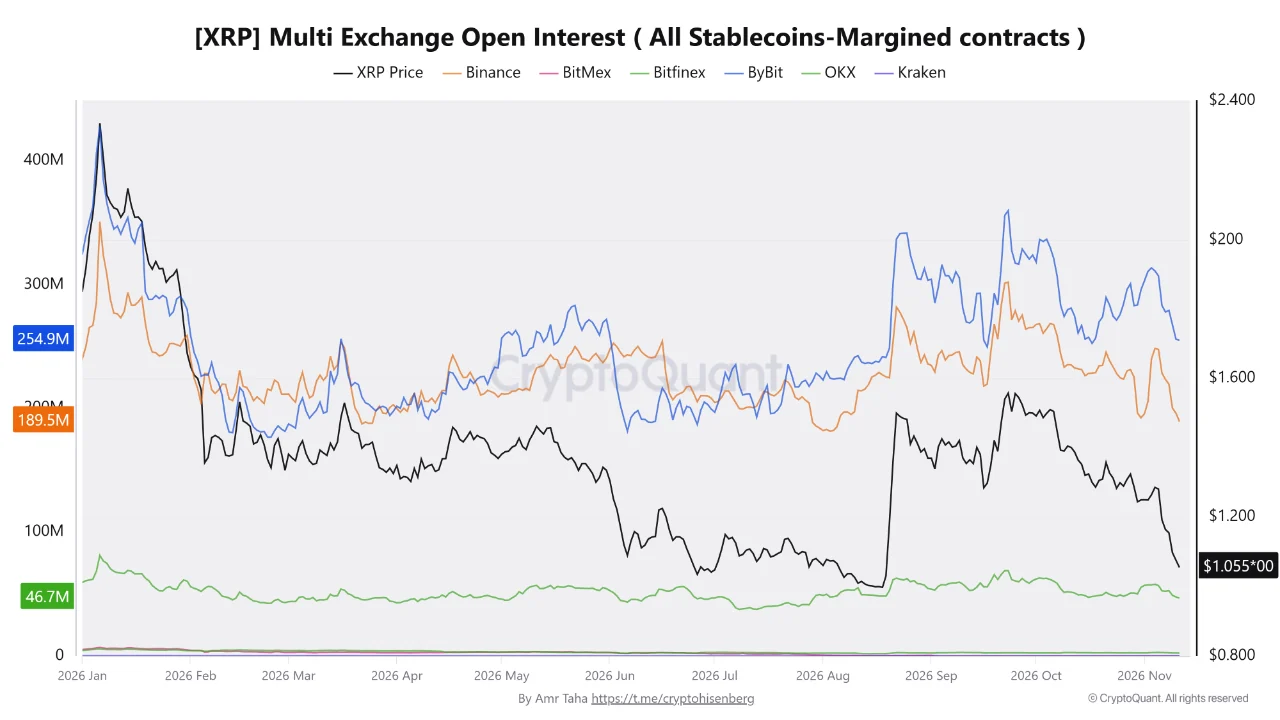
Taha anchors both exchanges to the same date. On August 2, Binance held $182 million in stablecoin-margined XRP open interest; on November 11 it held $189 million, $7 million more. Three months of trading, including XRP’s run above $1.80 and the fall back under $1.10, left Binance’s book almost exactly where it started.
Bybit took the other path. Its $229 million on August 2 became $255 million on November 11, a gain of $26 million, or about 11%. Over the window in which Binance’s traders were net closing, Bybit’s were net adding. That is why the exchange now leads Binance by $66 million.
| Exchange | Open interest | Share |
|---|---|---|
| Bybit | $255 million | 52.0% |
| Binance | $189 million | 38.6% |
| OKX | $46 million | 9.4% |
| Three-exchange total | $490 million | 100% |
Bybit and OKX together carry 61% of this subtotal. The multi-exchange chart shows the ordering is recent: Binance was the larger XRP book for most of the first half of the year, and Bybit has held the lead since late August. A three-month low on the exchange that has been shedding share says little about the one that has been gaining it.
What open interest cannot show is how much margin backs it. A larger book with ample collateral and a smaller one full of thin positions produce the same dollar figure. The leverage ratio is meant to fill that gap, which is why a second three-month low on the same day looks like confirmation. It is mostly the same number.
One input, two three-month lows
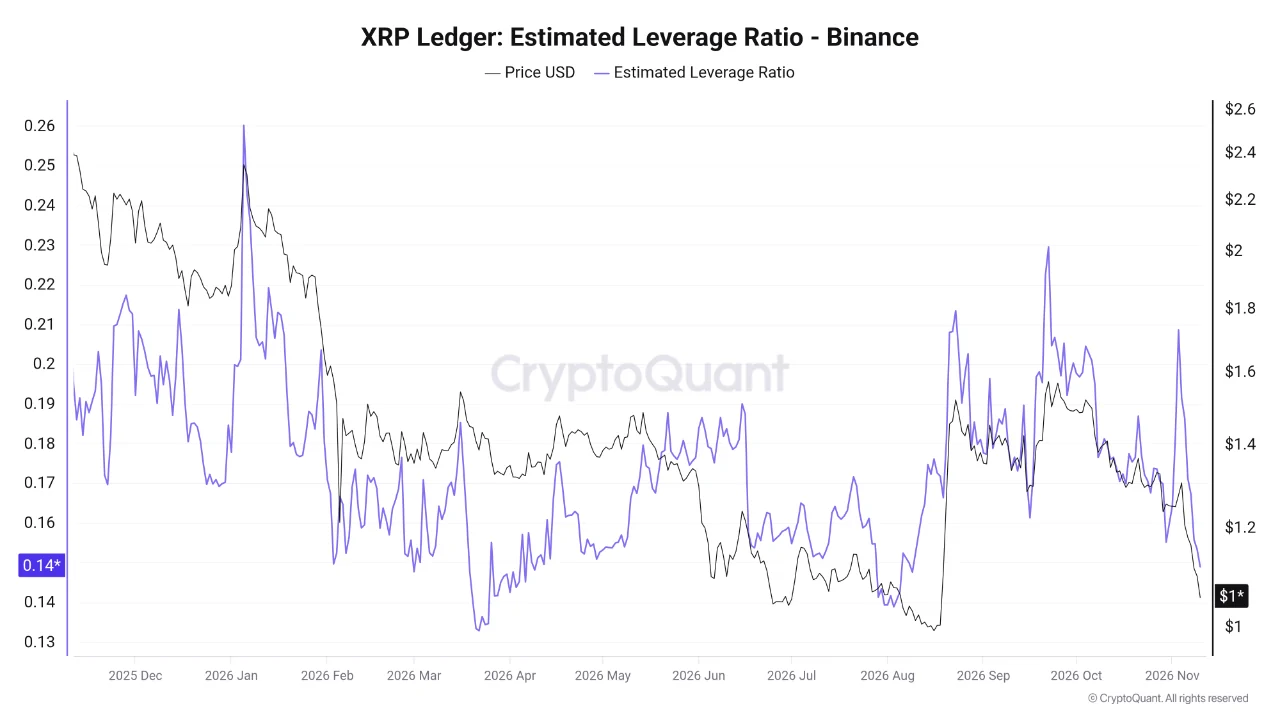
CryptoQuant’s methodology defines the estimated leverage ratio as open interest divided by exchange reserves. Open interest is the numerator, so when Taha’s figure falls, Arab Chain’s falls with it. The two notes are one observation seen from two angles.
The ratio is also an exchange-wide aggregate. A reading of 0.14 does not mean traders are running 0.14 times leverage, and it does not identify any price at which positions would be liquidated. Arab Chain’s own note says as much: a lower ratio reduces sensitivity to sharp moves, but it does not mean the risk has gone.
And the denominator has been anything but stable this month.
Binance’s reserves fell 12%, then rose 10%, and the ratio followed
CryptoQuant’s reserve chart for Binance shows tracked XRP holdings sliding from about 2.69 billion on October 28 to roughly 2.36 billion on November 3, a drop of around 12% in six days. Over the same days the leverage-ratio chart spikes to roughly 0.2, its highest reading since early October. Fewer coins in the denominator, with open interest changing less, pushed the ratio up.
Then the reserve rebounded, climbing back above 2.6 billion by November 4 and ending near 2.59 billion on November 10, about 10% above the trough. The ratio fell with it, from that 0.2 spike to 0.14.
On these approximate chart readings, the reserve rebound accounts for roughly a third of the ratio’s decline from its November peak before a single position is counted as closed. The remainder is open interest actually falling, which Taha’s figures confirm. But the “three-month low” headline compresses a two-part story: part deleveraging, part a denominator returning to normal after an unusual dip.
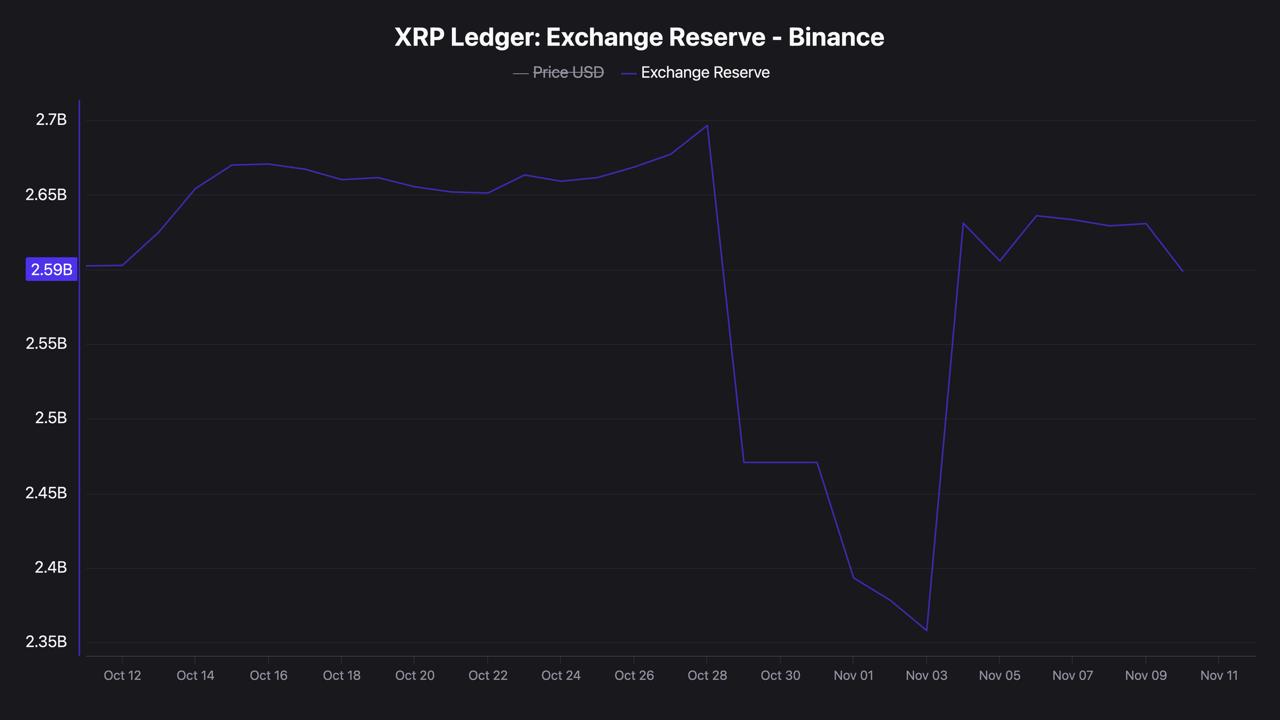
Two cautions on lining the series up. The open-interest chart counts stablecoin-margined contracts only, while the reserve chart counts all XRP in Binance wallets, most of which is not collateral for those contracts. And coins arriving on an exchange are as consistent with holders preparing to sell as with anything calmer.
XRP Price: the test is $0.99 and $1.08
Coindoo’s November 10 channel-breakdown analysis marked $0.99–$1.03 as support and $1.08–$1.11 as the first recovery band; $1.03 was that session’s low. From $1.05 at the time of writing, support is about 5.7% below and the recovery band sits 2.9%–5.7% above.
Price also leaks into the derivatives figures. Arab Chain’s note was taken with XRP near $1.09; Taha’s, hours later, near $1.05, a 3.7% gap. Open interest is quoted in dollars, so some of any further decline in Binance’s figure will be contracts marked down rather than closed. The same effect means Bybit’s $26 million gain since August is larger in XRP terms than in dollars, because XRP was more expensive for most of that window.
The conditions for calling this a market-wide reset rather than a Binance-specific one are specific. Bybit’s book would need to shrink toward its August level, the ratio would need to keep falling once reserves have stabilised, and spot demand would need to absorb the deposits behind last week’s volume surge. On the chart, holding $0.99-$1.03 and closing back above $1.08 over the coming daily sessions would support that case; a daily close under $0.99 would undercut it, whatever Binance’s ratio reads that day.
For now, Binance’s traders have unwound three months of positioning and its reserves have refilled. Bybit’s traders have done the opposite. The exchange with the smaller XRP book has reset; the one with the larger book has not.
Data context: CryptoQuant notes dated November 11, 2026. Reserve and leverage-ratio values are approximate readings from the published charts; open-interest figures are as stated in Amr Taha’s note. Technical levels reference Coindoo’s November 10 analysis.
Disclaimer: This article is for informational purposes only and does not constitute investment, financial or trading advice. The figures and chart readings cited come from third-party data providers and Coindoo’s own technical analysis, and the price levels discussed are scenarios, not forecasts. Cryptocurrency markets are highly volatile; always do your own research and consult a licensed financial adviser before making any investment decision.



Kosta has reported on cryptocurrency markets and blockchain infrastructure since 2020, bringing over six years of hands-on experience in the crypto industry built through daily tracking of markets, trends, and emerging blockchain developments. Specializing in Bitcoin on-chain analysis, institutional ETF flows, and digital asset price action, his work at Coindoo has been cited by other news agencies and consistently covers market developments with a focus on data-driven reporting across Bitcoin, Ethereum, Solana, and XRP. Over the years, Kosta has contributed to multiple crypto media outlets in different regions, authoring over 6,000 articles across the sector. His reporting spans cryptocurrency markets and the broader fintech industry, tracking not only price action but also the technological and regulatory forces shaping the ecosystem. To support his analysis, Kosta actively leverages on-chain data and metrics from leading platforms such as Santiment, Glassnode, and CryptoQuant, enabling deeper, evidence-based market insights. He believes in the power of transparency and the data that underpins the blockchain ecosystem. His academic background in Marketing Management from Denmark further complements his analytical approach, adding a strong understanding of communication strategy and content positioning to his work.