Iran Is Accepting Stablecoins to Let Oil Tankers Through the Strait of Hormuz
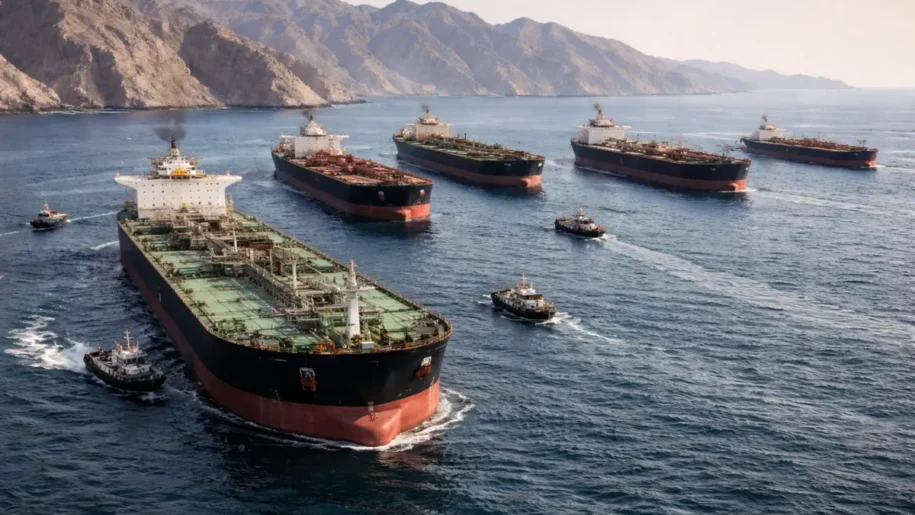
The Islamic Revolutionary Guard Corps has institutionalized a toll system at the world's most critical energy chokepoint, requiring payments in yuan or crypto. Analysts say it may be the largest real- world stablecoin use case ever recorded.
Iran’s Islamic Revolutionary Guard Corps has turned the Strait of Hormuz into a functioning toll booth, and it is accepting stablecoins as payment.
According to reporting from Bloomberg, the IRGC has established a formal vetting and escorted passage system for commercial vessels seeking to transit the strait, the narrow waterway through which roughly 20% of the world’s daily oil and LNG supply normally flows. Payments start at approximately $1 per barrel of cargo for oil tankers. For a Very Large Crude Carrier carrying two million barrels, that translates to a toll of up to $2 million per voyage.
To bypass the U.S.-led SWIFT financial system and existing sanctions architecture, the IRGC is requiring that payments be settled exclusively in Chinese yuan or stablecoins, cryptocurrencies pegged to the value of hard currencies such as the U.S. dollar.
The operational mechanics are precise. Ship operators seeking transit must submit detailed documentation, vessel ownership structure, flag registration, cargo manifests, crew nationalities, and Automatic Identification System tracking data, to intermediary companies with ties to the IRGC operating outside Iran. The IRGC’s Hormozgan Provincial Command processes that data and conducts background checks. Vessels with links to the United States, Israel, or other nations Iran designates as hostile are excluded entirely.
If cleared, operators are assigned a permit code and route instructions. As the vessel approaches the strait, the captain broadcasts the passcode over VHF radio and is met by an Iranian patrol boat that escorts the ship through a narrow five-mile corridor between the islands of Larak and Qeshm, a stretch the shipping industry has already dubbed “the Iranian tollbooth.”
A Tiered System of Access
The IRGC applies a ranking system from one to five to grade the friendliness of nations, with ships flagged to countries like China, Russia, or Pakistan receiving more favorable terms. At least 26 vessels had transited under the approved corridor system as of mid-March, according to Lloyd’s List, which confirmed at least one tanker operator paid approximately $2 million for passage. Between March 1 and March 15, approximately 89 to 90 vessels transited under some form of IRGC clearance.
Iran’s parliament is also advancing legislation to formalize the toll structure, with one lawmaker framing it as analogous to fees collected at the Suez Canal. “We ensure its security, and it is natural for ships and tankers to pay us duties,” the lawmaker told reporters.
The Crypto Angle
For digital asset markets, the stablecoin payment requirement represents something qualitatively new: a recurring, institutionally-mandated demand for crypto as a cross-border commodity settlement tool rather than a speculative instrument.
According to CNN, if the toll regime scales, at full pre-war volumes of roughly 20 million barrels per day, representing approximately 10 VLCCs daily, the system could theoretically generate $20 million per day, or around $600 million per month, from oil alone, the stablecoin flows involved would dwarf any previously documented sanctioned-economy use case. Venezuela’s state oil company, for comparison, routes roughly 80% of its oil revenue through USDT rails.
The arrangement also functions as a live stress test of crypto’s capacity to act as sovereign financial infrastructure. Whether regulators treat participating institutions as sanctions violators will determine how broadly the system can operate. Legal experts warn that transacting with the IRGC, which is subject to U.S., EU, and UK sanctions, exposes ship operators to potential violations of anti-money laundering rules regardless of the currency used.
Nearly 2,000 vessels remain stranded on both sides of the strait, according to the International Maritime Organization, as operators weigh the cost and legal exposure of paying the toll against the cost of indefinite delay or rerouting around the Cape of Good Hope.
The information provided in this article is for educational purposes only and does not constitute financial, investment, or trading advice. Coindoo.com does not endorse or recommend any specific investment strategy or cryptocurrency. Always conduct your own research and consult with a licensed financial advisor before making any investment decisions.



Alexander Zdravkov is a market analyst and crypto journalist with interests in economics, broader financial markets and digital assets. His journey into crypto began more than four years ago, driven by a fascination with the rapid evolution of blockchain technology and the transformative potential of decentralized finance. He began analyzing market cycles and identifying emerging trends before they reach the mainstream. He holds a degree in International Relations - a background that helped shape his broader perspective on global economics, geopolitics, and the interconnected nature of modern financial markets. Whether covering the latest developments in the crypto sector or exploring broader macroeconomic themes, Alexander focuses on giving readers context rather than simply repeating headlines. During his career, he has authored more than 5,000 articles covering cryptocurrencies, traditional finance, and global market developments. His work spans everything from Bitcoin and altcoins to macroeconomic trends influencing risk assets worldwide.