eToro’s CEO Declares Bear Market and Gives His Price Target for Bitcoin in 2030

Yoni Assia, eToro's CEO confirms crypto bear market, defends $250K Bitcoin by 2030, and explains why $100 trillion in real-world assets moving on-chain is inevitable.
Key Takeaways:
- Bear market confirmed – recovery timing unknown.
- Four-year cycle is self-fulfilling prophecy.
- $250K Bitcoin by 2030, conservative estimate.
- Regulation is blocking $100 trillion on-chain.
- Crypto already pricing traditional stocks 24/7.
- Bear markets are build time, not retreat time.
- US regulatory clarity real, but arrival not guaranteed.
The Bear Market Nobody Wanted to Name
There is a particular kind of evasion that runs through crypto market conferences. Prices are down, sentiment is fragile, and nobody on stage wants to be the person who said the word. Yoni Assia said it.
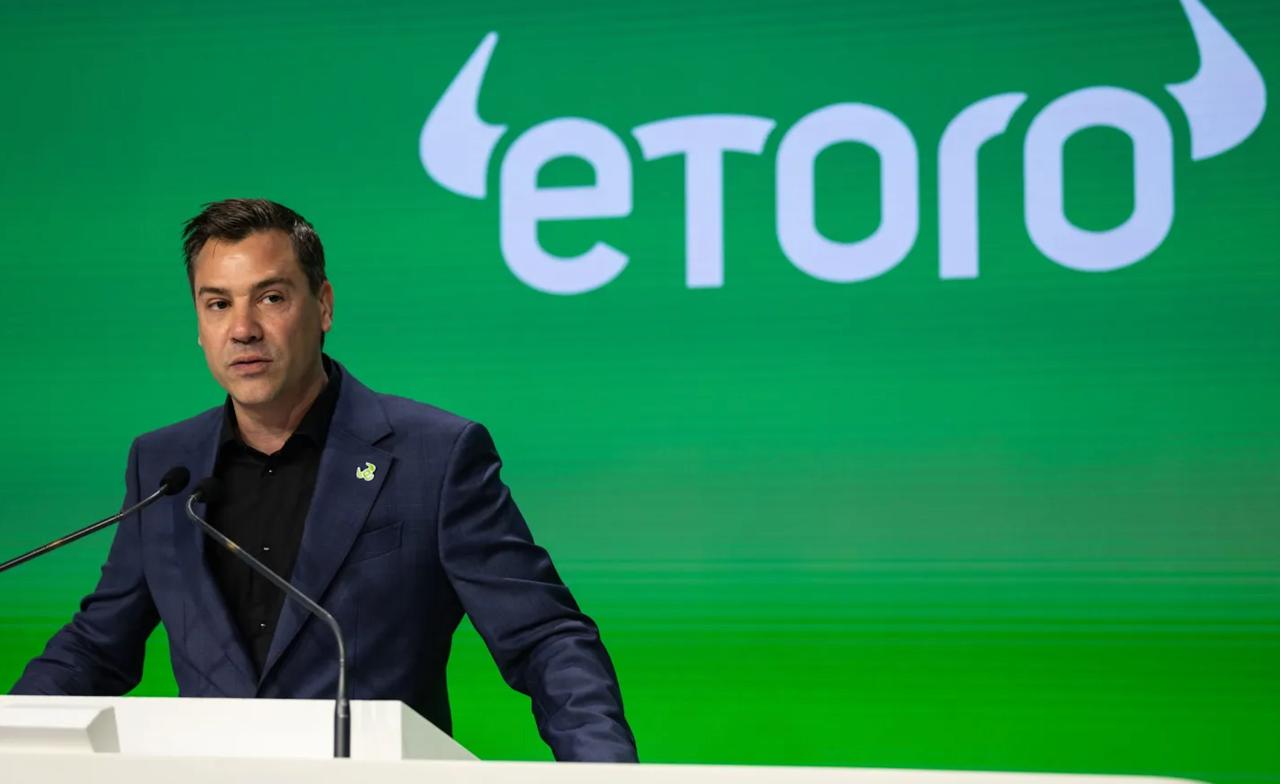
Asked directly whether the market is in a bear, the eToro CEO did not hedge. “We are in a bear market”, he said in a recent interview. The question is when we get out of it.
That directness is more significant than it sounds. Assia is not a permabull commentator with nothing to lose. He is the CEO of a publicly listed trading platform with a billion and a half dollars on its balance sheet and retail traders whose behavior he watches in real time. When he says bear market, he is reading the same data his users are generating. And what that data shows, he argues, is that the cycle has not broken, it has simply done what cycles do.
The pattern is familiar to anyone who has been through more than one: 2013, 2017, 2021, 2025. October and November hitting all-time highs, then the slide beginning. Assia has been through four of these.
He sold a portion of his Bitcoin on October 6th at $126,000. He then bought back at $110,000, at $105,000, at $100,000, and it kept dropping. He is not sharing that as a confession. He is sharing it as evidence that even the people who understand the cycle get caught in it, because the cycle’s power is partly psychological and partly mechanical. The mechanism does not care how many cycles you have seen. It runs anyway, and right now, it is running toward the same question every cycle eventually forces: not whether the bottom is in, but whether enough participants decide it is and begin acting like it is.
The Self-Fulfilling Machine
The four-year cycle debate has become one of crypto’s most exhausted arguments. Is it dead? Is it structural? Does institutional adoption change it? Assia’s answer cuts through most of that noise.
It is a self-fulfilling prophecy, he says. People who have been through previous cycles become cautious at the top. Their caution creates selling. The selling creates the downturn. The downturn triggers defensive moves from people who were not planning to sell. The cycle causes itself.
What makes this observation worth pausing on is what it implies about the current moment. If the cycle is self-fulfilling, then the question is not whether the fundamentals justify a recovery, it is whether enough participants collectively decide the bottom is in and begin acting on that belief. The recent move from $65,000 to $75,000, recorded during the Paris Blockchain Week interview period, was in Assia’s reading the first signal that momentum may be shifting. Not confirmation. A signal.
The deeper question is whether institutional holders, ETFs, treasury companies, sovereign funds, now large enough to be a structural force in the market, dampen that self-fulfilling mechanism or simply slow it. The honest answer, looking at the evidence, is that they slow it. Sticky institutional capital does not eliminate reflexivity, it raises the threshold required to trigger it. The cycle is probably getting longer. It is not dying. And a longer cycle with a higher floor is a different animal from the sharp crashes of 2018 and 2022, more grinding, less dramatic, harder to time, and more punishing for people waiting for a clean signal that never arrives quite the way it used to.
$100 Trillion On-Chain
Assia has been writing about tokenization since 2012. Tether, he notes, almost launched on colored coins he co-authored that year. The fact that he is still describing $100 trillion in real-world assets moving on-chain as a future event rather than a present one is itself the story, not because the vision is wrong, but because the gap between the vision and the infrastructure required to deliver it keeps revealing itself to be wider than the previous year’s optimism suggested.
The bottleneck, he argues, is not technology. It is regulation, specifically the absence of a legal infrastructure that makes on-chain ownership of regulated assets trustworthy enough for institutions and individuals to act on. You would not buy an apartment on-chain, he says, unless you fully understood how that real estate was registered into your tokenized assets. That trust infrastructure does not yet exist at scale.
The US regulatory movement is real and he credits it, the SEC clarifying that non-custodial wallets like MetaMask and Zengo do not need to register as broker-dealers is meaningful. The DTCC enabling tokenization of stocks directly on-chain is potentially transformative. But Assia is careful to frame these as steps in a direction, not arrival at a destination.
His response to the hypothetical anti-crypto administration is the one place in the conversation where his confidence slightly outruns the evidence. Once the infrastructure is built, once CeFi and DeFi begin converging, a future hostile administration cannot undo it, that is his argument. It is probably correct directionally. But infrastructure can be starved of adoption even without being dismantled. A hostile regulatory environment does not need to reverse the gains. It only needs to slow the next ones. That gap between “not reversible” and “guaranteed to continue” is where the real risk lives, and it is a risk the current regulatory optimism does not fully price. The window is open. The question is how much gets built before someone decides to narrow it.
Crypto Is Already Forcing Traditional Markets to Follow
The most underreported observation in the conversation is not about Bitcoin’s price or tokenization timelines. It is about what is already happening to traditional capital markets right now.
Tesla and Facebook are trading on-chain, 24 hours a day, seven days a week. Crypto markets are forming prices for those stocks before traditional exchanges open. Assia calls it a magnet — crypto pulling capital markets toward continuous operation whether those markets want to move or not. He believes this will eventually force traditional exchanges to go 24/7.
That is not a prediction. That is a description of a structural pressure that is already in motion. The question is not whether it happens, the mechanism is already running. The question is how long incumbent institutions can resist it before the arbitrage between on-chain and off-chain pricing becomes operationally impossible to ignore.
The consequences for traditional institutions are more disruptive than the headline suggests. A 24/7 market does not just change trading hours, it changes risk management, staffing, liquidity provision, and the entire infrastructure built around the assumption that markets close. Banks, clearinghouses, and exchanges have spent decades optimizing for a world with opening bells and closing bells. Crypto is quietly making that world obsolete from the outside in, not by competing with it directly but by making continuous pricing the default expectation for a generation of traders who have never known anything else. By the time traditional institutions finish debating whether to adapt, the retail base that once needed them for price discovery will have already moved on.
The Conservative Who Called $250,000
Assia’s Bitcoin price target lands with an almost deliberate lack of drama. $250,000 by 2030. The interviewer points out that this is conservative compared to the million-dollar targets circulating in the same room. Assia calls himself a crypto conservative and does not apologize for it.
That framing deserves to be taken seriously rather than dismissed. Assia is running a public company, managing retail trader flows across 25 markets, and sitting on a balance sheet large enough to make acquisitions mid-bear. His $250,000 is not a marketing number — it is the number a person gives when they are accountable for being wrong. That accountability is what separates it from the targets being floated by people with nothing at stake in the timing.
The $250,000 thesis rests on continued institutional adoption, regulatory clarity, and the halving cycle’s supply dynamics compressing available Bitcoin against growing demand. What Assia adds that most targets do not is the tokenization layer, if $100 trillion in real-world assets begins moving on-chain over the next four years, the infrastructure required for that migration runs through the same networks Bitcoin operates on. The rising tide does not just lift Bitcoin. It makes the entire on-chain ecosystem structurally harder to exit.
The bear market he just named does not change that direction. It changes the timeline. And on the question of timeline, Assia has already demonstrated, by buying back at $110,000, $105,000, and $100,000 into a falling market, that he is willing to be early and wrong in the short term in service of a thesis he believes is correct in the long one.
Bitcoin is currently trading around $75,000. The gap between here and $250,000 is not the interesting part of Assia’s thesis. The interesting part is what has to be built between now and then, and whether the regulatory window that currently exists stays open long enough for it to happen. He is not waiting to find out. He already has the balance sheet deployed.
The information provided in this article is for educational purposes only and does not constitute financial, investment, or trading advice. Coindoo.com does not endorse or recommend any specific investment strategy or cryptocurrency. Always conduct your own research and consult with a licensed financial advisor before making any investment decisions.



Kosta has reported on cryptocurrency markets and blockchain infrastructure since 2020, bringing over six years of hands-on experience in the crypto industry built through daily tracking of markets, trends, and emerging blockchain developments. Specializing in Bitcoin on-chain analysis, institutional ETF flows, and digital asset price action, his work at Coindoo has been cited by other news agencies and consistently covers market developments with a focus on data-driven reporting across Bitcoin, Ethereum, Solana, and XRP. Over the years, Kosta has contributed to multiple crypto media outlets in different regions, authoring over 6,000 articles across the sector. His reporting spans cryptocurrency markets and the broader fintech industry, tracking not only price action but also the technological and regulatory forces shaping the ecosystem. To support his analysis, Kosta actively leverages on-chain data and metrics from leading platforms such as Santiment, Glassnode, and CryptoQuant, enabling deeper, evidence-based market insights. He believes in the power of transparency and the data that underpins the blockchain ecosystem. His academic background in Marketing Management from Denmark further complements his analytical approach, adding a strong understanding of communication strategy and content positioning to his work.