Bitcoin Price Drops to $63,000 as ETF Outflows Continue

Bitcoin’s recovery above $65,000 lasted less than a full session. After reaching roughly $65,600 on July 27, BTC gave back the entire move and returned to the support area it had defended last week.
Key Takeaways
- Price now tests the 50-day SMA.
- ETFs posted three straight outflow days.
- Losing $63,275 would expose $62,000.
The July 28 candle shows Bitcoin trading near $63,350 at the time of writing after falling as low as $63,000. That places price almost directly on the 50-day simple moving average at $63,275.
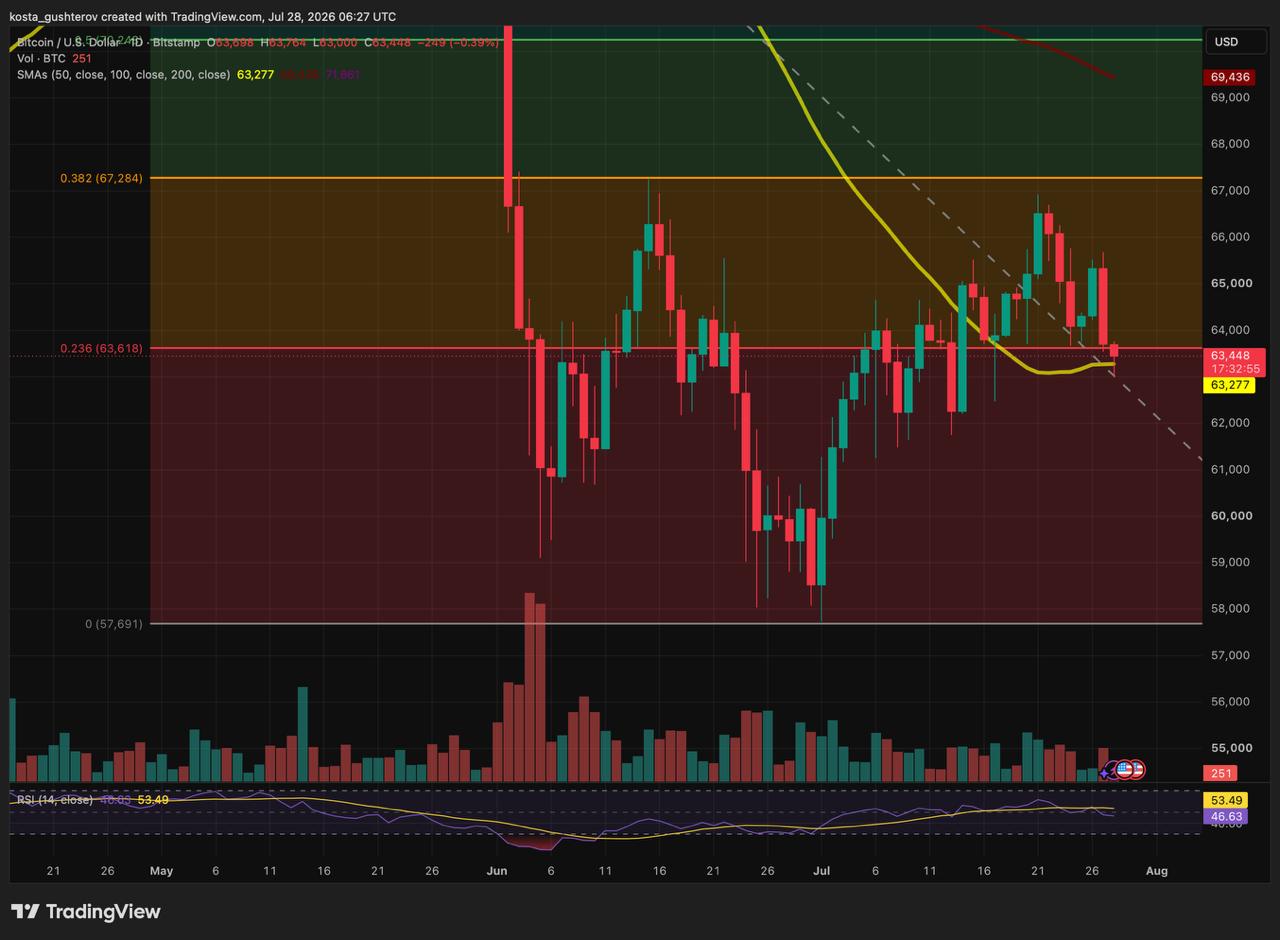
The reversal also means Bitcoin never tested $67,370, the level needed to confirm the stronger breakout outlined in our July 27 analysis.
The current candle remains open, so trading near the 50-day SMA at $63,275 does not yet confirm a breakdown. Holding the wider $63,300–$63,600 support area would keep the recent defence intact and give Bitcoin another chance to recover above $65,000.
A confirmed daily close below the moving average would keep the bearish sequence active and expose the $62,000 area. Three consecutive days of ETF outflows add pressure while buyers attempt to hold support.
ETF Flows Have Turned Negative
US spot Bitcoin ETFs have recorded net outflows for three consecutive trading days. The funds lost $225.18 million on July 23, another $240.08 million on July 24 and $11.64 million on July 27.
Combined outflows over those sessions reached approximately $476.9 million. The sequence followed a week in which the funds still finished with a modest net inflow of $33.79 million, supported by stronger results earlier in the period.
The latest data shows that the weekly positive total did not develop into sustained buying. ETF demand weakened as Bitcoin struggled to hold its recovery above $65,000.
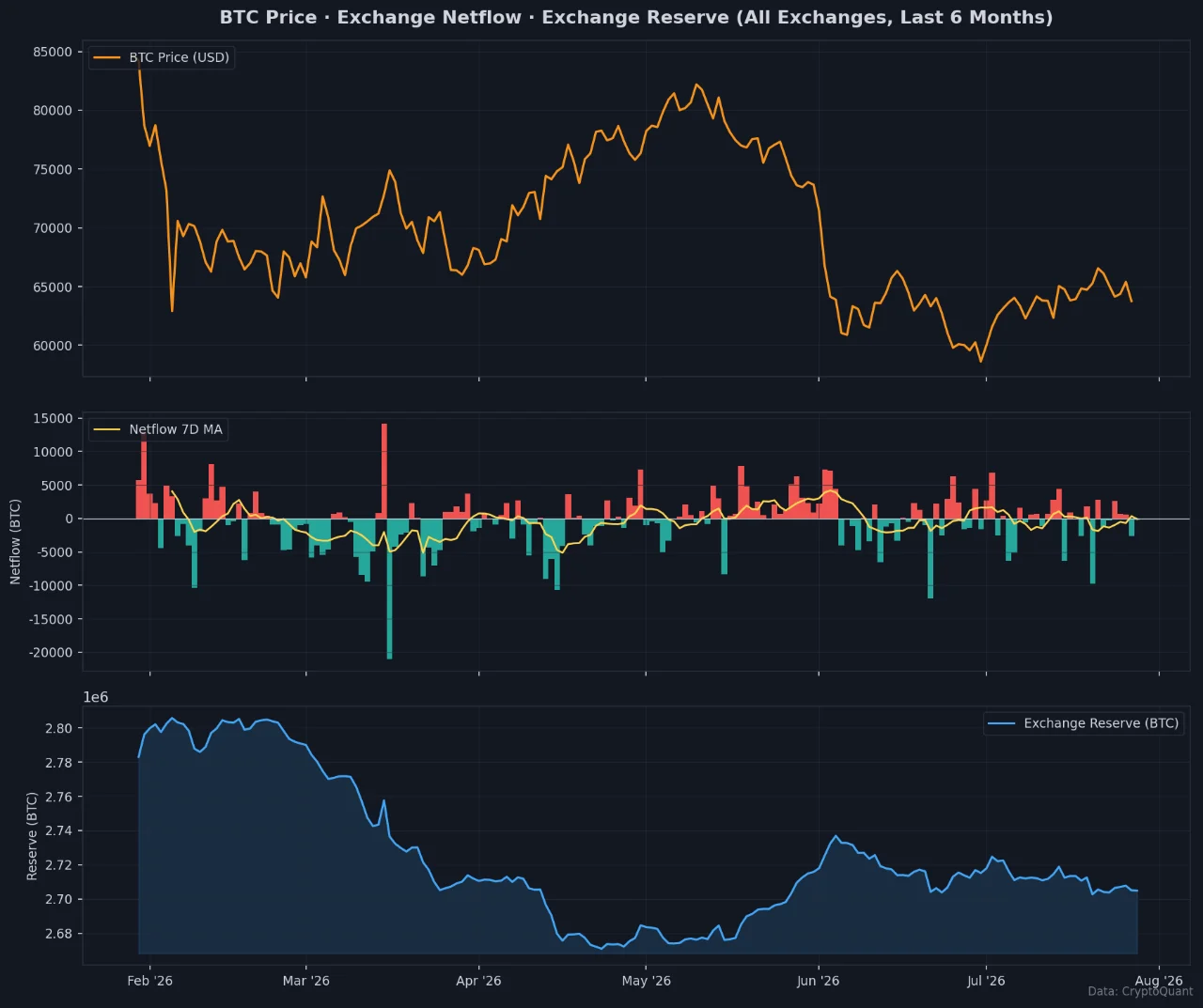
A CryptoQuant report provides a longer-term counterpoint to the recent ETF weakness. Exchange reserves have fallen by roughly 78,000 BTC over six months, from 2.783 million to 2.705 million BTC, leaving fewer coins immediately available for trading.
The report’s main thesis is that holders are still moving Bitcoin into self-custody, leaving the market with less readily available sell-side supply even as short-term demand remains weak.
That shrinking liquid supply does not solve the weak spot-demand problem visible among short-term holders, but it could make Bitcoin more responsive if buyers return because exchanges have less supply available to absorb that demand.
The pullback may also reflect fading regulatory optimism after the U.S. Senate keeps the Digital Asset Market Clarity Act further down its agenda.
Votes scheduled: At 6:30pm, on Tuesday, July 28th, the Senate will proceed to two roll call votes on the following:
1. Confirmation of Executive Calendar #833, Walter Clayton to be Director of National Intelligence.
2. Motion to invoke cloture on the motion to proceed to Cal.…— Senate Cloakroom (@SenateCloakroom) July 27, 2026
With sanctions legislation and federal nominations taking priority, a vote now appears unlikely before the final days leading into the August 8 summer recess.
Another source of pressure came from the U.S. dollar, which rose to a one-month high as markets kept alive the possibility of another Federal Reserve rate increase, according to Reuters. The Reserve Bank of Australia also left the door open to further tightening, adding to a less supportive backdrop for risk assets such as Bitcoin.
- Disclaimer: This article is for informational and analytical purposes only and does not constitute financial or investment advice. Technical levels and ETF flows do not guarantee future price movements.
- Methodology: Price levels are based on the supplied daily BTC/USD Bitstamp chart captured on July 28, 2026. ETF figures are based on SoSoValue daily spot Bitcoin ETF flow data.



Kosta has reported on cryptocurrency markets and blockchain infrastructure since 2020, bringing over six years of hands-on experience in the crypto industry built through daily tracking of markets, trends, and emerging blockchain developments. Specializing in Bitcoin on-chain analysis, institutional ETF flows, and digital asset price action, his work at Coindoo has been cited by other news agencies and consistently covers market developments with a focus on data-driven reporting across Bitcoin, Ethereum, Solana, and XRP. Over the years, Kosta has contributed to multiple crypto media outlets in different regions, authoring over 6,000 articles across the sector. His reporting spans cryptocurrency markets and the broader fintech industry, tracking not only price action but also the technological and regulatory forces shaping the ecosystem. To support his analysis, Kosta actively leverages on-chain data and metrics from leading platforms such as Santiment, Glassnode, and CryptoQuant, enabling deeper, evidence-based market insights. He believes in the power of transparency and the data that underpins the blockchain ecosystem. His academic background in Marketing Management from Denmark further complements his analytical approach, adding a strong understanding of communication strategy and content positioning to his work.