Bitcoin Whales Recover but Short-Term Holders Sink

Bitcoin is not showing a clean bullish reversal or a renewed capitulation. The data instead points to a market capable of producing a sharp rebound through positioning, but one that still needs stronger spot accumulation and improving capital flows to turn that move into a sustainable recovery.
Key Takeaways
- Small whales have returned to unrealized profit.
- Short-term holder market cap broke its 2024 low.
- Exchange netflow reached positive 5,044 BTC.
- Open interest rose as funding turned negative.
- Fresh spot demand remains the missing confirmation.
The Rebound Repaired Cost Basis, Not Capital Formation
The most constructive signal comes from wallets holding between 100 and 1,000 BTC. According to a CryptoQuant analysis of whale unrealized profits, this cohort returned to a profitable position following Bitcoin’s recent rebound.
Crossing into profit means the market price has moved above the aggregate cost basis reflected by the indicator. Holders in that group are no longer sitting on the same unrealized losses, reducing one source of pressure that could force or encourage them to sell into weakness.
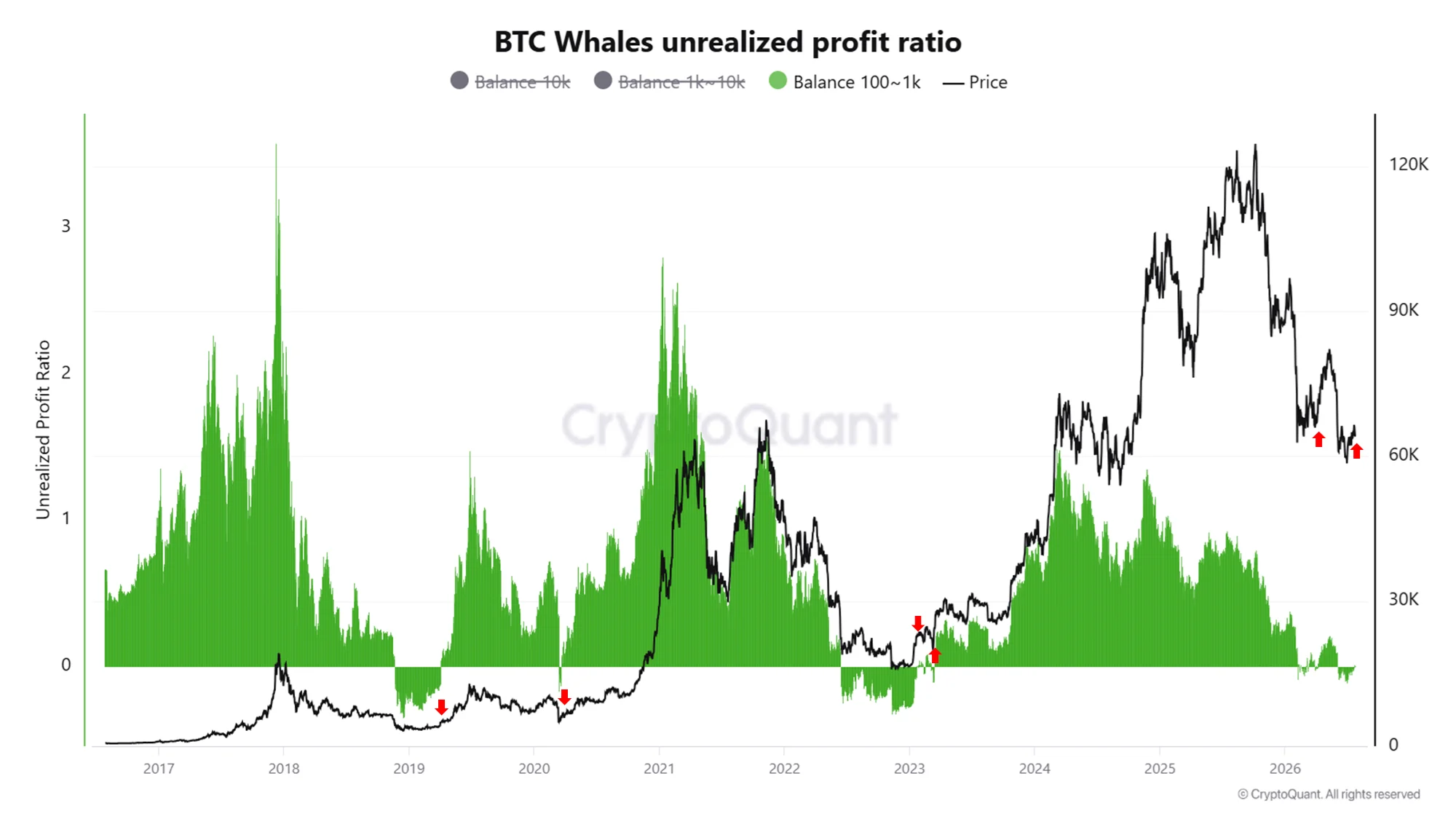
The signal does not show that these whales purchased more Bitcoin. It only establishes that their existing holdings have returned to profit as the price recovered, which can happen without substantial new capital entering the market, particularly when the move begins from depressed prices.
Similar transitions appeared in March and April and were followed by short-term advances, according to the report. The historical comparison supports the possibility of another relief move but cannot establish its scale or duration. Two recent precedents are too limited to turn the threshold into a reliable cycle signal.
Newer Bitcoin Holders Still Represent a Depressed Market
The broader short-term holder data remains considerably weaker.
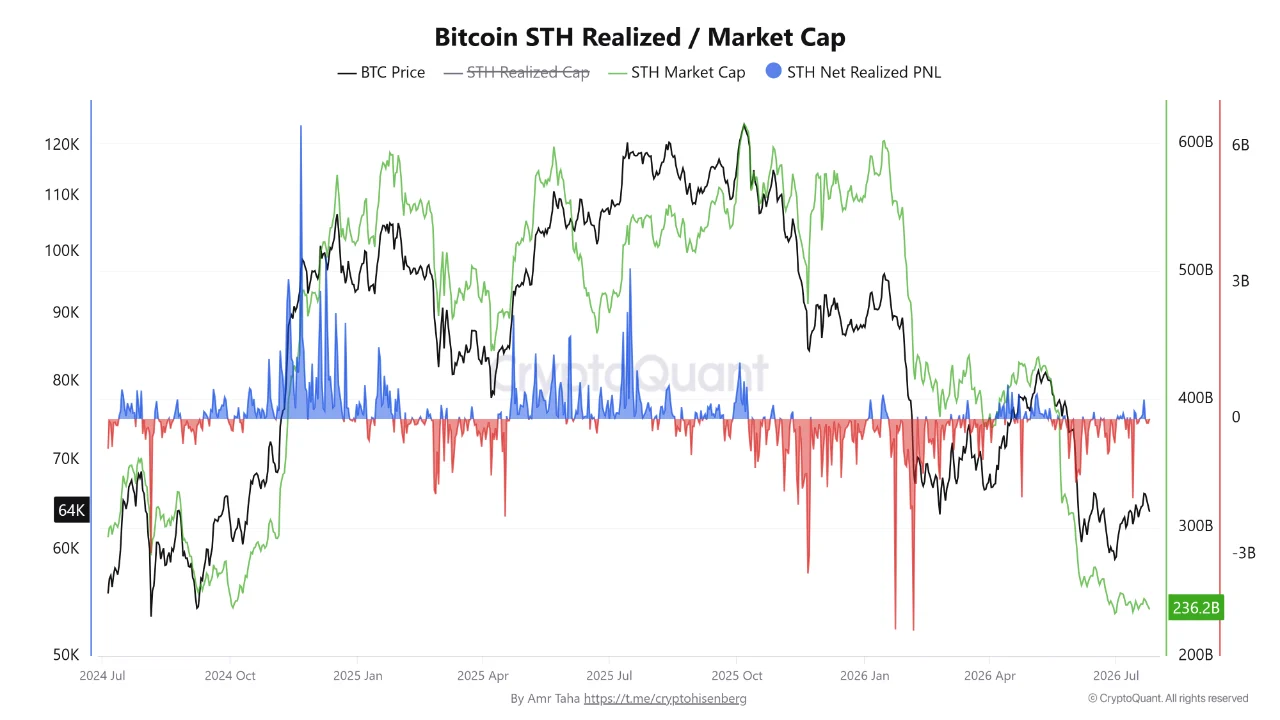
Bitcoin’s short-term holder market cap fell to $236.2 billion on July 25, according to a separate CryptoQuant analysis of the cohort. This marked only the second move below the level recorded on October 3, 2024, which had been the lowest reading of that year.
The decline should not be interpreted as capital of that size entering or leaving Bitcoin. Short-term holder market cap measures the current market value represented by coins classified within that cohort, and it can fall for several distinct reasons:
- A lower Bitcoin price reduces the value of the coins already held in the group.
- Supply leaves the cohort as previously acquired BTC ages into the long-term holder classification.
- Fewer coins are being acquired or moved by newer market participants.
Those mechanisms carry different implications. Coins ageing into long-term ownership reduce the supply associated with more price-sensitive holders, potentially strengthening the market’s underlying ownership structure. A contraction caused by weak new demand is less constructive, because recent buyers often provide the marginal capital required to sustain a recovery.
The market cap figure alone cannot separate the two, but the loss data points toward pressure rather than a quiet transfer into long-term ownership. Short-term holders realized approximately $1.75 billion in losses on July 13, around $340 million or 24% above the $1.41 billion recorded on June 2.
Loss realization had eased by July 25, but short-term holder market cap remained near an unusually depressed level. Reduced loss-taking means fewer holders are capitulating at the same intensity. It does not mean new demand has arrived to replace them.
More Leverage Is Arriving Before Stronger Capital Inflows
The immediate market structure is becoming more dependent on derivatives.
The 5,044 BTC net inflow marked a 91% daily increase and the third-largest single-day figure of the previous 31 days, according to CryptoQuant’s combined market analysis.
Positive netflow means more BTC entered labelled exchange wallets than left them during the measured period. It increases the amount of Bitcoin potentially available for trading or sale, but it cannot confirm that every deposited coin will be sold. Some BTC may be transferred for collateral, internal portfolio management or derivatives activity. The movement still creates a less favourable supply position than an equivalent net outflow, because the coins have moved closer to liquid markets.
Positioning shifted at the same time. Funding moved from 0.003826 to -0.001371, the only negative reading in the supplied 31-day period. Negative funding indicates that short positioning has become more dominant in perpetual futures, with short traders paying those holding the opposing side.
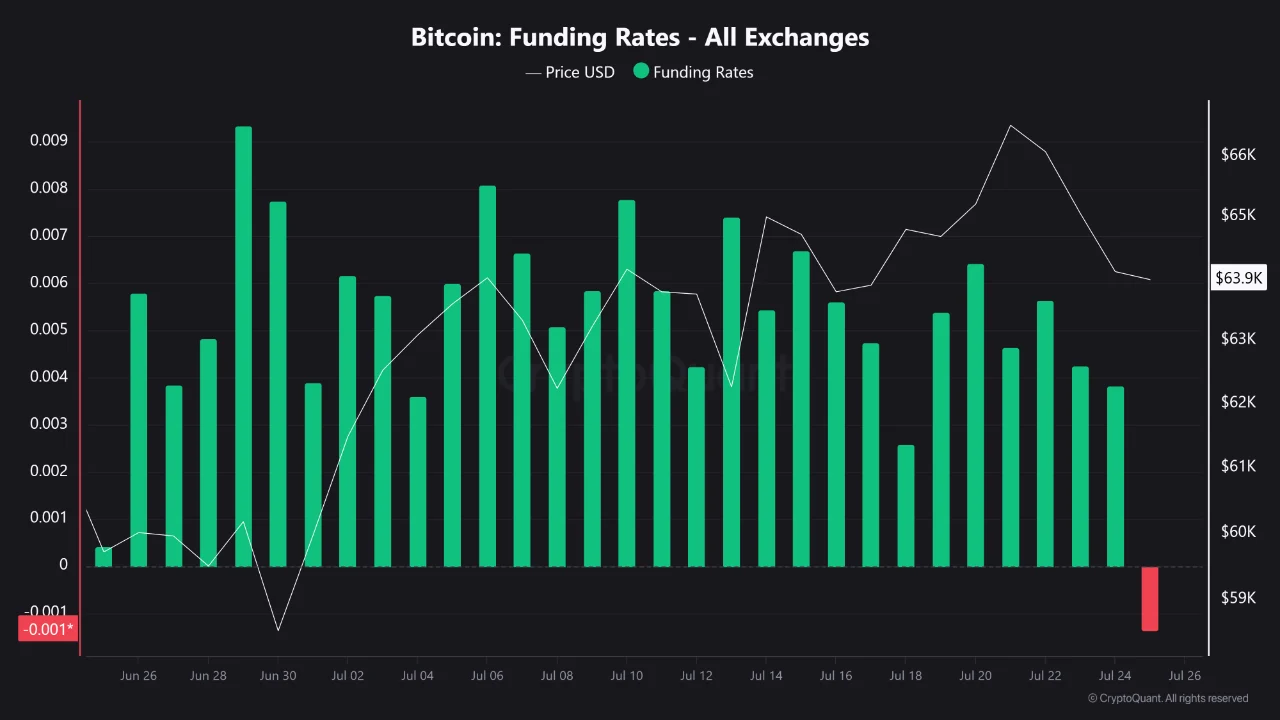
Open interest rose 0.69% to approximately $22.5 billion and stood 4.59% above its 30-day average. More derivative exposure is being added while the market leans bearish, which raises the amount of leveraged positioning vulnerable to liquidation in either direction. A further decline could validate those short positions and add pressure. An unexpected price increase could force traders to close them, accelerating a short squeeze.
Realized Cap Exposes the Weakness Behind the Rebound
Total Bitcoin realized cap declined for three consecutive days to approximately $1.061 trillion.
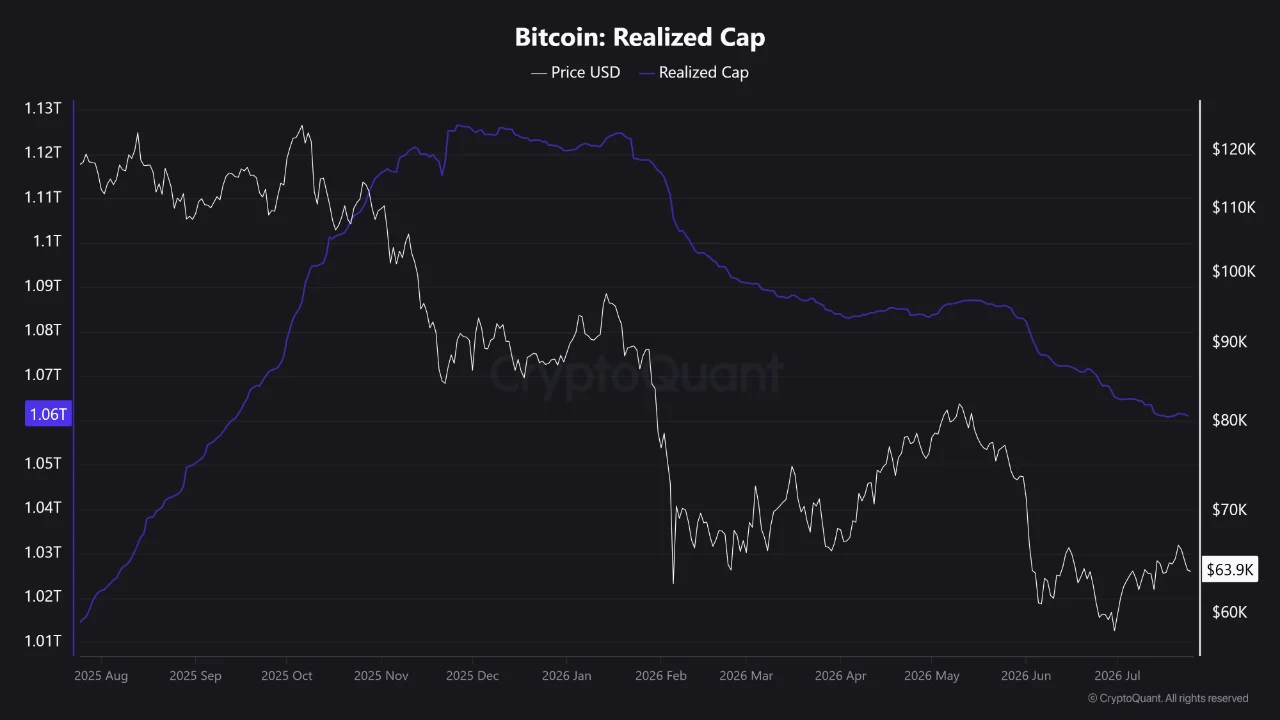
Unlike ordinary market capitalization, which values circulating supply at the latest market price, realized cap values each coin at the price when it last moved. It is commonly used as an estimate of the value stored in the network based on on-chain cost basis.
A small three-day decline does not establish a large capital exodus. Realized cap can fall when coins acquired at higher prices move at lower prices, replacing a more expensive cost basis with a cheaper one. It can rise when BTC changes hands above its previous recorded value.
The direction still matters. A sustained recovery would require new transactions occurring at stronger valuations, capital remaining in the network and demand absorbing any additional exchange supply. The latest decline shows none of those conditions developing.
A Short Squeeze Would Not Confirm a Lasting Recovery
The clearest near-term catalyst sits in the derivatives data rather than the spot market.
Bitcoin could rise sharply if negative funding persists while price refuses to decline. Traders holding short positions would face growing pressure as the market moves against them, and forced closures could add buying demand to the rebound.
A decline in open interest during a price increase would support that interpretation, showing that positions are being closed as Bitcoin rises, consistent with short covering rather than a broad expansion of risk-taking. That would still leave the source of the move unresolved, because liquidation-driven demand disappears once the vulnerable positions have been removed.
A more durable recovery would need confirmation from spot and on-chain data. Exchange netflow would need to turn negative or at least retreat from the current inflow, showing that immediately available supply is no longer increasing. Realized cap would need to stabilise and resume expanding, indicating the network’s recorded capital base is growing again.
Short-term holder market cap would also need to recover, though that signal requires interpretation alongside the others. A higher Bitcoin price can lift the metric without proving that a meaningful number of new buyers has entered. Growth accompanied by realized-cap expansion would carry more weight.
Failure to Attract Demand Would Put Whales Back Underwater
The bearish scenario does not depend on exchange deposits becoming immediate market sales.
Pressure would build if netflows remained positive while Bitcoin failed to advance, particularly with open interest continuing to rise. That would indicate the market is absorbing more potentially tradable supply while leveraged exposure grows.
A further decline in realized cap would strengthen the conclusion that the rebound is not drawing new capital into the network. Another increase in short-term holder losses would show that recent buyers are returning to active capitulation rather than simply remaining underwater.
The whale signal provides a clear invalidation point. If the unrealized profit ratio for wallets holding 100 to 1,000 BTC falls back below zero, the cohort’s brief recovery would have failed, restoring the pressure that the rebound temporarily removed.
Bitcoin sits between an improving cost-basis signal and a weak flow structure. The latest data does not confirm a broad recovery, but it also does not support treating the market as uniformly bearish. Until realized cap expands and exchange flows improve, the rebound is better understood as squeeze-capable but demand-unconfirmed.
- Disclaimer: This article is for informational purposes only and should not be treated as financial or investment advice. On-chain metrics describe historical and current network activity; they do not predict future price. Markets are volatile. Make your own decisions and consult a professional before trading.
- Methodology: Whale unrealized profit, short-term holder market cap, exchange netflow, funding, open interest and realized cap figures are sourced from CryptoQuant analyses published July 25, 2026. Metric definitions follow CryptoQuant’s published user guide.



Alex is Editor-in-Chief of Coindoo and co-founder of Millennial Media Group, with nearly a decade of experience covering financial markets - crypto first, then everything else. It started in 2016 with Bitcoin. Like most people at the time, he didn't fully understand it - so he kept digging. Blockchain, tokenomics, the projects, the cycles. That curiosity never stopped, and eventually pulled him into traditional markets too: equities, commodities, macro. Not because he left crypto behind, but because you can't properly understand one without the other. What drives him is straightforward: he wants to know why something is happening, not just that it's happening. Most market coverage stops at the headline - price up, price down, here's a chart. Alex finds that kind of reporting actively unhelpful. If you walk away from an article without understanding the mechanism behind the move, what did you actually learn? He holds a degree in Tourism from New Bulgarian University - not the most obvious path into financial markets, but markets have a way of pulling in people who are simply too curious to stay out. He has authored over 200 in-depth analyses and more than 10,000 articles across crypto and traditional finance. He still thinks every day in markets teaches him something new. That's probably why he hasn't stopped.