Why Old Bitcoin Is Going to Coinbase, Not Binance

Binance’s share of Bitcoin spot trading has slid to its lowest since 2020, yet the selloff raised its volumes and left its grip on leverage untouched.
Key Takeaways
CryptoQuant analyst Gaah flagged the drop in a Nov. 29 Quicktake, noting that Coinbase picked up most of the difference.
What the six-year low measures
The figure is a rolling 30-day share of Bitcoin spot volume across the exchanges CryptoQuant tracks. On Nov. 20, Binance’s reading fell to 40.1%, the lowest since November 2020. A year earlier it sat near 50%, and its 2026 median is about 44%. Over the same stretch, Coinbase’s 30-day share climbed from roughly 16% around Oct. 20 to about 21%, close to its 2026 high of 23% in January.
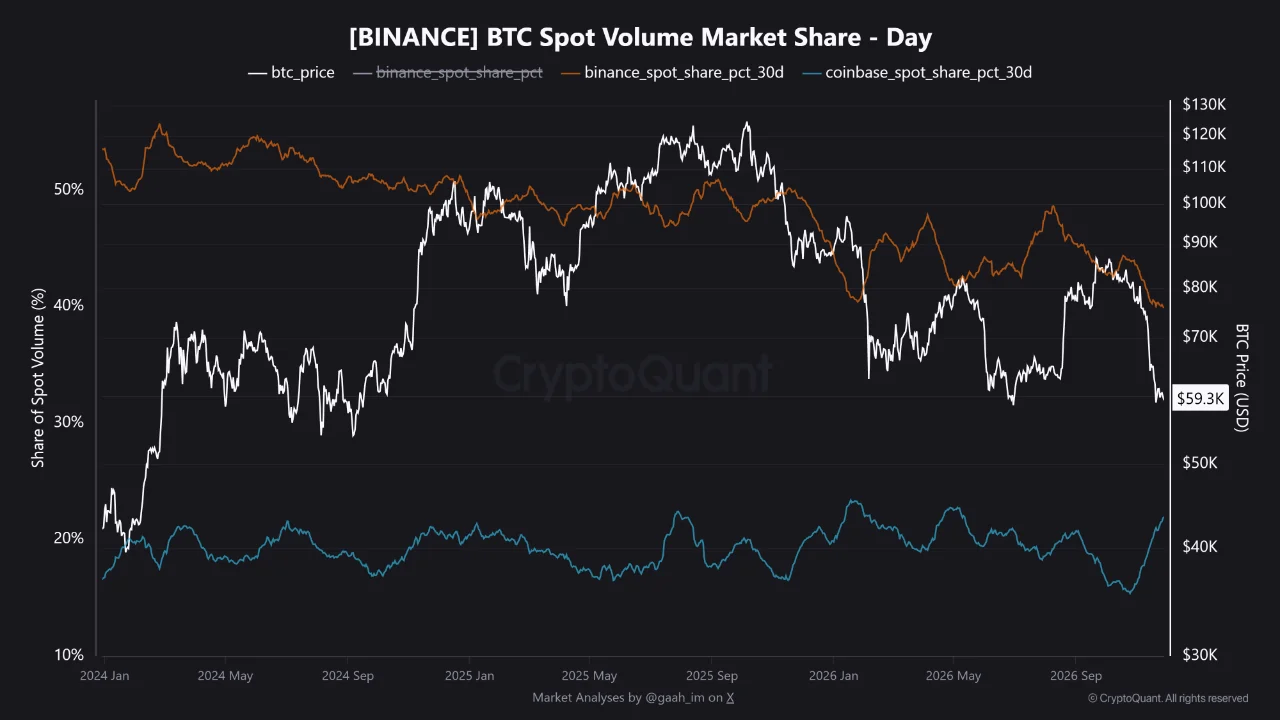
A share can fall for two very different reasons: a venue loses business, or everyone else gains it faster. Gaah’s note points to the second. Binance’s spot volume did not dry up, and on Nov. 17 it still handled close to half of the tracked total. Dollar turnover shows which of the two stories holds, and where the extra trading came from.
A selloff that raised turnover almost everywhere
To test it, Coindoo pulled CryptoQuant’s daily spot data for seven venues’ main Bitcoin pairs from Oct. 30 to Nov. 28 and split the period in two. The first 14 days end on Nov. 12, when Bitcoin closed near $71,460 on Binance. The next 14 cover the slide to a Nov. 20 close near $58,950 and the days after it. Average daily dollar turnover across the seven venues rose about 39% between the two halves.
Seven-venue check: average daily BTC spot turnover
| Venue | Oct. 30–Nov. 12 → Nov. 13–26 | Share |
|---|---|---|
| Binance | $1.12B → $1.69B (+51%) | 39.0% → 42.2% |
| Coinbase | $0.63B → $0.90B (+44%) | 21.9% → 22.6% |
| OKX | $0.60B → $0.74B (+24%) | 20.8% → 18.7% |
| HTX | $0.24B → $0.24B (−1%) | 8.5% → 6.1% |
| Kraken | $0.21B → $0.31B (+49%) | 7.2% → 7.7% |
| Bitfinex | $60M → $90M (+50%) | 2.1% → 2.2% |
| Gemini | $15M → $18M (+23%) | 0.5% → 0.5% |
Pairs: BTC/USDT on Binance, OKX and HTX; BTC/USD on Coinbase, Kraken, Bitfinex and Gemini. Turnover is daily BTC volume multiplied by the daily close. Source: CryptoQuant market data; Coindoo calculations.
Two things stand out. First, nobody’s business collapsed: the crash brought more trading to almost every venue, so Coinbase did not gain ground because Binance went quiet. Second, within this basket the venues that lost share in the second half were OKX and HTX, while Binance’s main pair and Coinbase both gained. Binance’s daily share even topped 50% on Nov. 17 and Nov. 26.
That does not contradict the six-year low. CryptoQuant’s index covers more exchanges and more trading pairs, so the levels differ. What the narrower data adds is timing. Coinbase already held close to 22% of this basket in the first half of November, before Bitcoin’s fall from about $71,500 to $59,000. The shift the 30-day index captures appears to have been largely in place by early November, in a window that also covered Binance’s Oct. 29 hack and its withdrawal suspension. The data used here starts on Oct. 30, so it cannot show whether the hack caused the move, only that the move predates the selloff’s worst days.
Older coins headed to Coinbase, not Binance
The flows into each exchange tell a different story from the volume. In a Nov. 28 note, Gaah found that in the seven days to Nov. 22, about 87% of Bitcoin deposited on Binance came from coins that had moved within the previous 24 hours, the highest share since August 2023. Coins held for six months or longer made up less than 2%. That is mostly fast money cycling between exchanges, desks and trading wallets.
Coinbase looked different. Coins held six months or more arrived there at about 3,200 BTC a day over the same week, around 16% of its inflows and the most since early July. Binance received roughly 130 BTC a day from that group. A separate CryptoQuant analysis by Yavuz Akbay found that coins dormant for 12 to 18 months – bought mostly above $80,000 between May and November 2025 – sent 24,200 BTC to exchanges across Nov. 20, 23 and 24. Coinbase Prime, the firm’s desk for large clients, received 102,400 BTC from Nov. 19 to 25, its busiest week in three months.
Not every one of those coins was sold. Coinbase also provides custody, and some of the traffic reflects institutions moving coins between their own wallets. Part of it lines up with BlackRock’s IBIT transfers during the same week. Deposits alone cannot settle whether this supply became sell orders.
The price gap points to selling on Coinbase
CryptoQuant’s Coinbase Premium Index offers a check. It compares Bitcoin’s price on Coinbase’s BTC/USD market with Binance’s BTC/USDT market, so a negative reading means buyers on Coinbase paid less than on Binance. The index was below zero on every one of the 30 days from Oct. 30 to Nov. 28, averaging about −0.14%, and it stayed negative after adjusting for the dollar value of USDT.
The deepest readings came on the days that mattered most. On Oct. 30, the day after Binance’s hack, the index sat near −0.24%. On Nov. 20, when Bitcoin closed at its low and Binance’s 30-day share hit 40.1%, it reached about −0.23%, leaving Bitcoin about $137 cheaper on Coinbase on average that day. The USDT-adjusted reading that day, about −0.27%, was the weakest of the period. The gap had narrowed to about −0.05% on Nov. 14 and 15, then widened again into the Nov. 20 low.
A persistent discount means sellers on Coinbase had to accept lower prices than traders on Binance were paying. That fits the deposit data: older supply landed on Coinbase, and Coinbase was where Bitcoin traded weakest. It does not prove those deposits were sold, but it shows the selling pressure concentrated on the venue where they arrived.
The leverage never left Binance
Futures tell the opposite story. Binance’s share of Bitcoin futures open interest moved between 34.0% and 35.3% across the 30 days, and Gaah put it at 34.6% on Nov. 28, in line with its 2026 median near 35%. Total open interest fell from about $25.9 billion to $19.7 billion, a 24% drop, and Binance’s fell by almost exactly the same proportion. Traders cut their positions everywhere; they did not move them away from Binance.
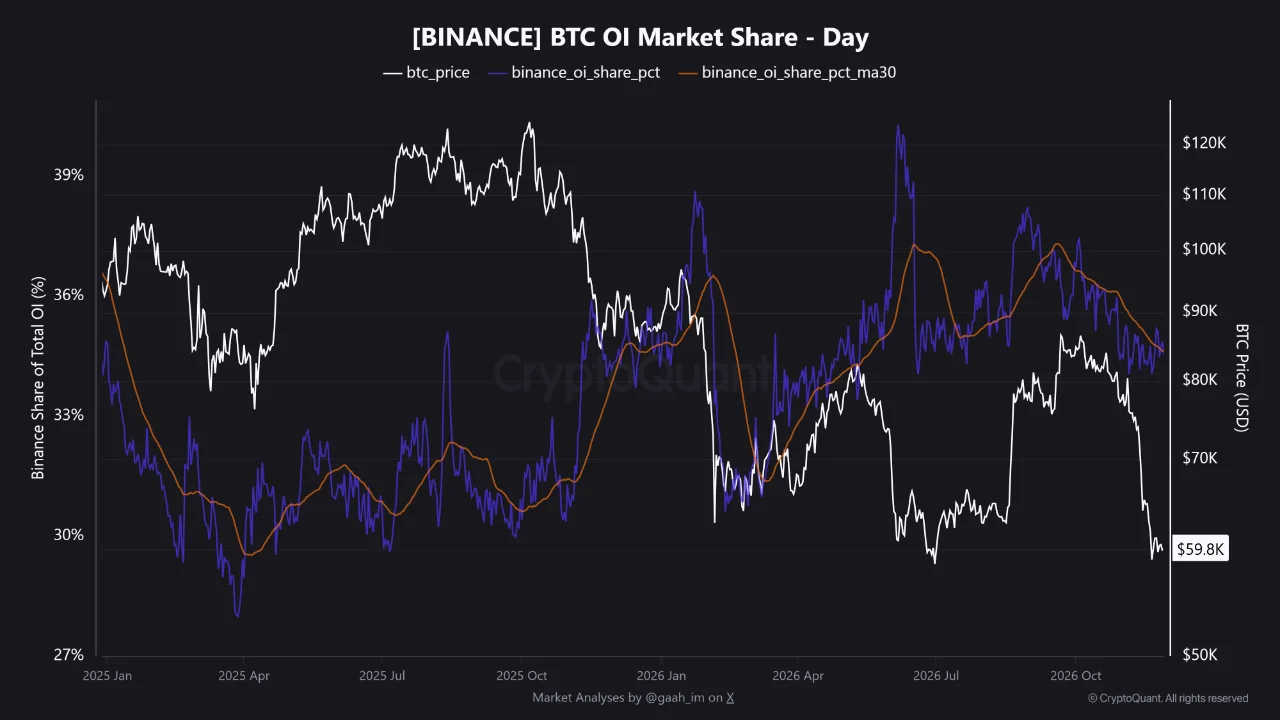
That leaves Binance more of a derivatives venue than before. CryptoQuant analyst Amr Taha calculated that Binance’s seven-day average futures volume reached 10.7 times its spot volume on Nov. 25, up from about 9 times in August, in a Nov. 29 Quicktake. Liquidity there has also thinned: Gaah estimated in a Nov. 27 note that every $100 million of net aggressive buying or selling on Binance’s BTC/USDT perpetual now moves the price about 61 basis points, against roughly 38 on Nov. 8. Coindoo’s earlier look at Binance futures after the hack covers how that positioning held up in coin terms.
Put together, the market split its jobs during the selloff. Older coins and institutional flows arrived at Coinbase, where Bitcoin traded at a discount. Binance kept its slice of the leveraged bets and its share of short-term spot traffic. The six-year low measures the first shift, not a retreat by Binance traders.
What would separate a rotation from a lasting shift
Gaah’s note sets out the test. If Coinbase’s share keeps rising, more of Bitcoin’s spot price discovery is happening on the U.S. side. If Binance drifts back toward 44–45% as volatility cools, the move reads as a temporary rotation tied to the selloff.
Two other readings would help settle it. A Coinbase Premium Index back at or above zero would show U.S. buyers absorbing supply rather than discounting it. Older-coin deposits are the second marker: Yavuz Akbay wrote that if those flows drop back under 3,000 BTC a day while Bitcoin holds above its Nov. 20 close, the selling has likely been absorbed, while more days above 8,000 BTC would suggest large holders are still distributing. Until those readings turn, Binance’s lower spot share says more about where older supply met the market than about Binance losing its traders.



Kosta has reported on cryptocurrency markets and blockchain infrastructure since 2020, bringing over six years of hands-on experience in the crypto industry built through daily tracking of markets, trends, and emerging blockchain developments. Specializing in Bitcoin on-chain analysis, institutional ETF flows, and digital asset price action, his work at Coindoo has been cited by other news agencies and consistently covers market developments with a focus on data-driven reporting across Bitcoin, Ethereum, Solana, and XRP. Over the years, Kosta has contributed to multiple crypto media outlets in different regions, authoring over 6,000 articles across the sector. His reporting spans cryptocurrency markets and the broader fintech industry, tracking not only price action but also the technological and regulatory forces shaping the ecosystem. To support his analysis, Kosta actively leverages on-chain data and metrics from leading platforms such as Santiment, Glassnode, and CryptoQuant, enabling deeper, evidence-based market insights. He believes in the power of transparency and the data that underpins the blockchain ecosystem. His academic background in Marketing Management from Denmark further complements his analytical approach, adding a strong understanding of communication strategy and content positioning to his work.