Who Runs $TRUMP? Trump Says It Isn’t Him

Donald Trump says he does not run $TRUMP. Published documents instead describe separate corporate roles across the website, token allocation, trademark licensing and trading revenue.
Key Takeaways
- Fight Fight Fight operates its website.
- Two entities collectively hold 80%.
- Trading-revenue recipients are publicly identified.
- Decision authority remains partly undisclosed.
Trump’s answer covers personal control
During a September 4 Oval Office ceremony, Trump was asked about his cryptocurrency. In the White House’s official recording, he replied:
“I don’t run it. I don’t focus on that, but somebody told me it sells very well.”
The answer addresses Trump’s personal involvement in running the project. It does not explain the corporate structure behind it, which is divided among several entities rather than assigned to a single publicly identified operator.
The project’s terms name the company providing its website and related services. Separate disclosures identify the entities holding most of the token allocation, receiving trading revenue and licensing the president’s brand. Examining those roles does not require treating Trump’s statement as false but requires recognizing that personal management and financial involvement are different questions.
The published documents assign four corporate roles
The official $TRUMP website presents Fight Fight Fight LLC as the company behind the project’s online services. The allocation and trademark disclosures then introduce three other entities with distinct interests.
These roles explain different parts of the project, but they do not reveal a complete chain of command. Operating the website, owning an allocation and licensing a trademark do not automatically give an entity the same authority over every token-related decision.
The 80% allocation is not liquid supply
The website says 200 million $TRUMP tokens were available at launch and that total supply will grow to one billion over three years. CIC Digital and Fight Fight Fight collectively own 80% of the allocation, subject to release schedules extending across that three-year period.
The wording does not mean that 800 million tokens are already circulating or immediately available for sale. It also does not show how the collective allocation is divided between the two companies.
For holders, the practical issue is the rate at which locked supply becomes transferable. Future releases can change the amount available to the market, regardless of who handles the project’s daily administration. That makes the published unlock schedule more useful to traders than treating the headline 80% figure as current liquid supply.
The terms separate sale approval from execution
The project’s terms and conditions say Fight Fight Fight, CIC Digital or affiliated parties may sell, transfer or otherwise dispose of tokens under announced plans or through other permitted arrangements.
They also allow an independent custodian or broker to receive discretion over the timing, price and volume of individual transactions. This creates an important distinction: a company can authorize a sale program while leaving the execution of particular trades to a third party.
Trump could therefore be uninvolved in individual transactions without the public knowing who approved the broader strategy. The terms do not identify the people who would authorize a disposition plan, revise an unlock-related decision or approve another major commercial change.

Trading revenue creates a separate financial interest
The allocation is only one part of the disclosed economics. The website also states that CIC Digital and Celebration Cards will receive revenue derived from $TRUMP trading activity.
Its main disclosure does not specify the percentage collected, the precise calculation method or how revenue is divided between the recipients. Nor does naming the corporate recipients prove that Trump personally receives every dollar earned by them.
The financial relationship nevertheless extends beyond the future value of locked tokens. That distinction became relevant when Trump’s annual filing reported substantial income connected to the memecoin business, prompting renewed calls for restrictions on digital assets issued by public officials. The resulting ethics debate was examined in an earlier report on Trump’s memecoin income.
The market did not deliver a clear reaction
The remaining question is whether traders treated Trump’s remark as market-moving news.
On the September 4 TRUMP/USDT daily chart, the token was trading near $2.28 and was down approximately 4.5% during the active session. Because that candle included trading before and after the comment, its decline cannot be attributed to the remark.
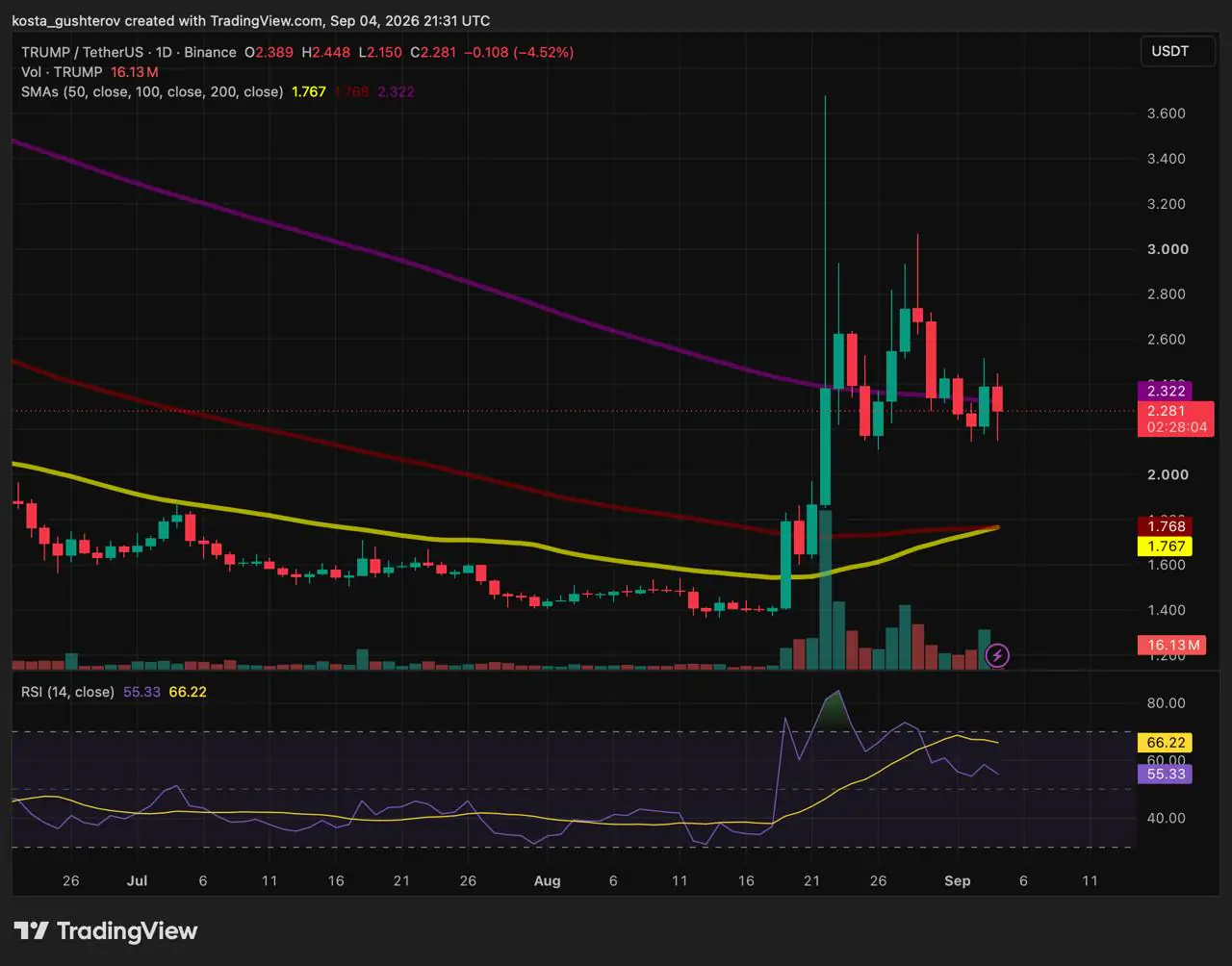
Price was sitting below the 200-day moving average near $2.32, which now serves as the closest recovery level. The session low around $2.15 provides nearby support. Holding between those levels would leave $TRUMP consolidating rather than establish a decisive response to Trump’s answer.
The ownership and revenue distinctions still matter to traders because earlier analysis of $TRUMP holder performance found that losses were concentrated among later buyers while early participants captured substantial gains. Understanding how tokens and revenue are distributed is therefore relevant even when no immediate price reaction can be proved.
What the records establish
Publicly disclosed
The website provider, trademark owner, collective 80% allocation, three-year release period and corporate recipients of trading revenue.
Still undisclosed
The allocation split, complete revenue formula and the individuals who approve major token-sale or commercial decisions.
Trump’s denial is consistent with the published documents, but those documents reveal only the corporate roles, not the complete decision-making chain behind $TRUMP.
The article is provided for informational purposes only and does not constitute investment advice.



Kosta has reported on cryptocurrency markets and blockchain infrastructure since 2020, bringing over six years of hands-on experience in the crypto industry built through daily tracking of markets, trends, and emerging blockchain developments. Specializing in Bitcoin on-chain analysis, institutional ETF flows, and digital asset price action, his work at Coindoo has been cited by other news agencies and consistently covers market developments with a focus on data-driven reporting across Bitcoin, Ethereum, Solana, and XRP. Over the years, Kosta has contributed to multiple crypto media outlets in different regions, authoring over 6,000 articles across the sector. His reporting spans cryptocurrency markets and the broader fintech industry, tracking not only price action but also the technological and regulatory forces shaping the ecosystem. To support his analysis, Kosta actively leverages on-chain data and metrics from leading platforms such as Santiment, Glassnode, and CryptoQuant, enabling deeper, evidence-based market insights. He believes in the power of transparency and the data that underpins the blockchain ecosystem. His academic background in Marketing Management from Denmark further complements his analytical approach, adding a strong understanding of communication strategy and content positioning to his work.