Three Altcoins Worth Watching This Month – And Why
Most of the attention this month has gone to Bitcoin. Meanwhile, three altcoins are quietly going through real developments - upgrades, institutional integrations, and liquidity unlocks that have nothing to do with market sentiment.
Key Takeaways
- POL is trading above both key moving averages following the sPOL launch and $1.14B in tokenized real-world assets.
- ADA is consolidating, but whale accumulation and the upcoming Van Rossum upgrade keep it on institutional radars.
- LINK pulled in $5.3M in weekly institutional inflows and gained real-time access to $80T in equities data.
Polygon, Cardano, and Chainlink are moving along separate trajectories, driven by distinct developments, and that is precisely why they are worth examining together rather than in isolation.
Polygon (POL): Infrastructure Upgrade With a Real Liquidity Effect
On April 14, Polygon launched sPOL – its native liquid staking token. The effect is not cosmetic. Roughly $330 million in previously locked capital can now be used simultaneously to secure the network and participate in DeFi protocols. Before this change, users had to choose between the two.
The token itself is no longer MATIC – the transition to POL is complete, and the new token follows a burn mechanism modeled after Ethereum’s EIP-1559. The key difference is that unlike ETH, POL carries no fixed supply cap, which preserves long-term validator incentives.
According to data from DefiLlama, the network has crossed $1.21 billion in tokenized real-world assets, and the Giugliano upgrade from early April optimized block production specifically for enterprise-grade payment requirements. Polymarket – the leading prediction market platform – continues to process a significant share of its transactions on Polygon, which sustains user activity at a level rarely seen outside of the top-tier chains. Separately, Polygon is in the middle of transitioning toward its AggLayer architecture, which aims to connect multiple blockchains with shared liquidity rather than operating as a standalone sidechain.
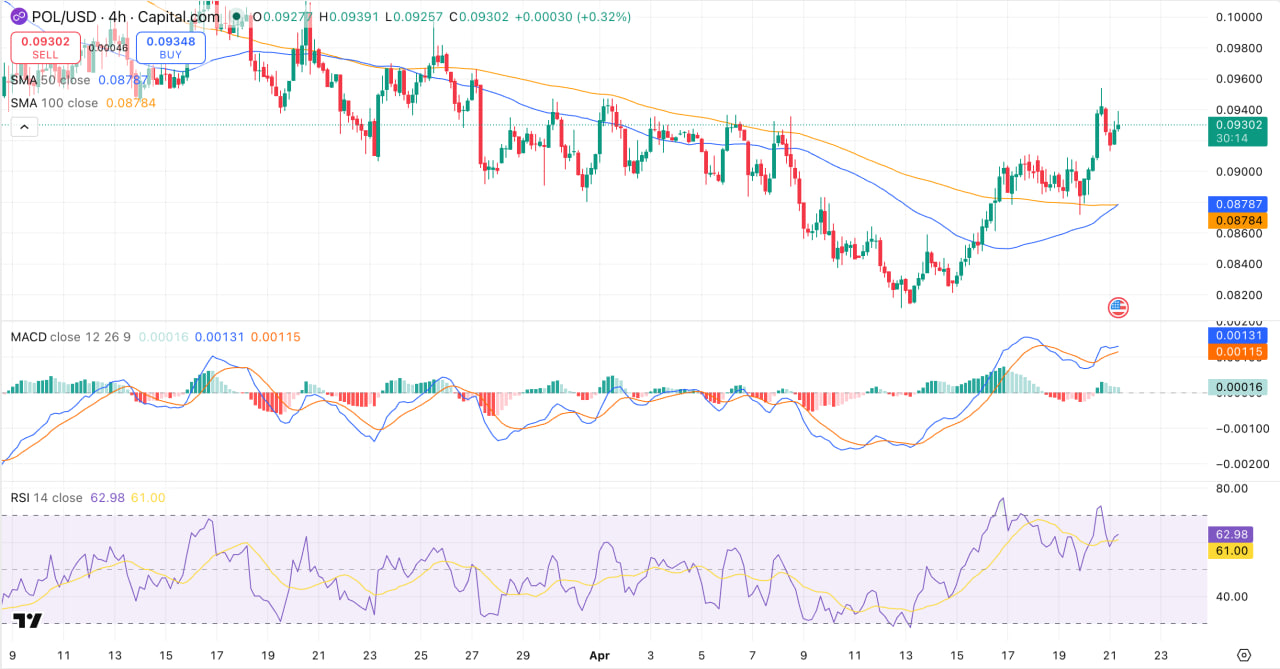
Technical Picture (4H): POL is trading around $0.093, above both SMA 50 ($0.08787) and SMA 100 ($0.08784). RSI sits at 62.98, signaling strong momentum without clear overbought conditions. The MACD line ($0.00131) is above the signal line ($0.00115) and the structure is bullish. A confirmed break above $0.094-$0.096 would be the next meaningful confirmation level.
Cardano (ADA): Governance Upgrade and Institutional Pipeline
Cardano rarely gets credit for what it does methodically. The Van Rossum hard fork – scheduled for late April 2026 as Protocol Version 11 – is the most significant upgrade since Vasil. It includes improvements to Plutus efficiency (the smart contract scripting layer) and node-level security hardening.
The more interesting development from an institutional standpoint is Midnight – a sidechain with programmable privacy using zero-knowledge proofs. Its mainnet stabilized at the end of March, and Monument Bank is already using the infrastructure to tokenize £250 million in deposits. When a commercial bank selects a specific blockchain for a regulatory-compliant operation, that is not a press release – that is a working integration.
In mid-April, whale wallets holding more than 10 million ADA accumulated approximately 819 million ADA – roughly $214 million – near key support levels. That kind of positioning ahead of a scheduled protocol upgrade tends to reflect conviction rather than coincidence.

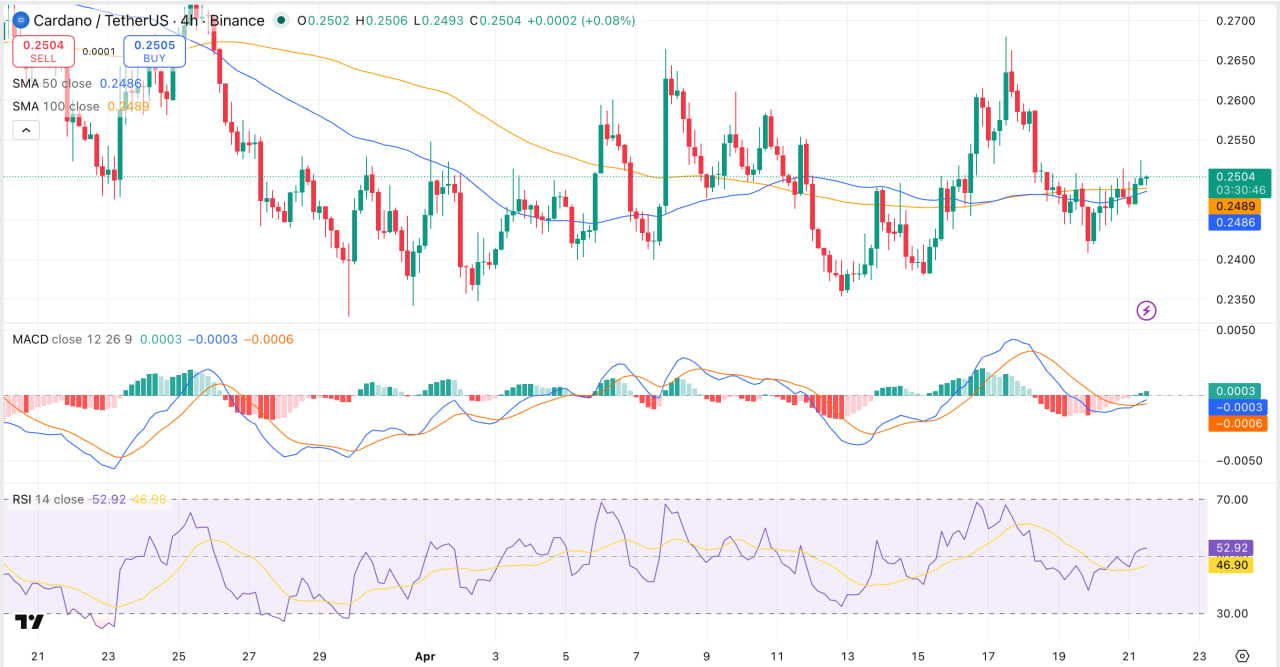
Technical Picture (4H): ADA is trading around $0.2504, clustered tightly with SMA 50 ($0.2486) and SMA 100 ($0.2489) – all three compressed together, which typically precedes a directional move. RSI at 52.92 is neutral. The MACD line (0.0003) has crossed above the signal line (-0.0003) but the histogram remains near zero. A confirmed move above $0.255 would open room toward $0.27.
Chainlink (LINK): Institutional Layer With Real Volume Behind It
On April 12, Chainlink expanded its Data Streams to include real-time pricing for US stocks and ETFs – a direct bridge between DeFi protocols and $80 trillion in traditional equity markets. Shortly before that, SIX – the operator of the Swiss and Spanish stock exchanges – integrated more than €2 trillion in market capitalization data into Chainlink’s DataLink infrastructure.
JPMorgan and UBS are running live settlement pilots on Chainlink. CME Group launched LINK futures in Q1 2026. This is not roadmap planning – these are production deployments by regulated financial institutions operating under real compliance constraints.
CCIP v1.5, the next version of the Cross-Chain Interoperability Protocol, is aimed at self-service integration, allowing token issuers to onboard assets without manual overhead. Monthly cross-chain volume processed through CCIP is currently around $18 billion. Weekly inflows into LINK-specific investment products reached approximately $5.3 million as of April 20.
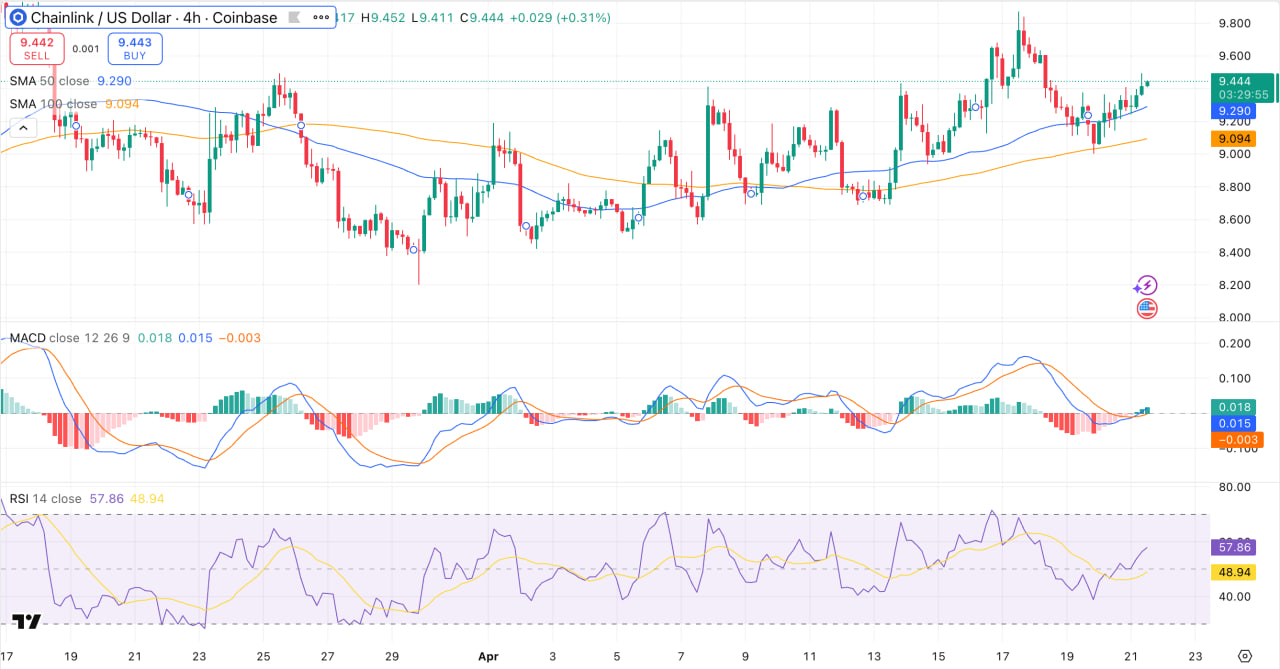
Technical Picture (4H): LINK trades near $9.44, above SMA 50 ($9.29) and SMA 100 ($9.09). RSI at 57.86 is moderately bullish. The MACD line ($0.018) sits above the signal line ($0.015), though the histogram is slightly negative (-0.003), suggesting a brief pause in momentum rather than a reversal. Key support sits between $9.09 and $9.20.
Other Market Events to Track (Late April – May)
- April 27-29 – Bitcoin 2026 Conference (Las Vegas): Historically a source of major industry-wide announcements that move the broader market.
- April 28-29 – FOMC Meeting: The rate decision is one of the few macro events with a documented short-term effect on crypto volatility across the top 100 assets.
- April 29-30 – TOKEN2049 Dubai: Draws institutional liquidity providers and core protocol teams – consistently a venue for significant partnership announcements and capital commitments.
- May 5-7 – Consensus Miami: Focused this year on AI-Web3 convergence, with direct relevance for infrastructure projects like Chainlink.
The three assets represent three different phases of blockchain maturity. Polygon is building infrastructure for real-world payments and enterprise adoption. Cardano is betting on governance and regulatory compatibility through privacy-focused tooling. Chainlink is already embedded in the production systems of traditional financial institutions. Technically, all three show a moderately bullish profile for the period – none are clearly overbought, none are in distress. The upcoming FOMC decision and the cluster of industry conferences through the end of the month will clarify whether current positioning translates into sustained directional movement.



Alex is Editor-in-Chief of Coindoo and co-founder of Millennial Media Group, with nearly a decade of experience covering financial markets - crypto first, then everything else. It started in 2016 with Bitcoin. Like most people at the time, he didn't fully understand it - so he kept digging. Blockchain, tokenomics, the projects, the cycles. That curiosity never stopped, and eventually pulled him into traditional markets too: equities, commodities, macro. Not because he left crypto behind, but because you can't properly understand one without the other. What drives him is straightforward: he wants to know why something is happening, not just that it's happening. Most market coverage stops at the headline - price up, price down, here's a chart. Alex finds that kind of reporting actively unhelpful. If you walk away from an article without understanding the mechanism behind the move, what did you actually learn? He holds a degree in Tourism from New Bulgarian University - not the most obvious path into financial markets, but markets have a way of pulling in people who are simply too curious to stay out. He has authored over 200 in-depth analyses and more than 10,000 articles across crypto and traditional finance. He still thinks every day in markets teaches him something new. That's probably why he hasn't stopped.