Strategy and Metaplanet Could Lose Index Eligibility Under New Rules

Strategy and Metaplanet survived MSCI's attempt to create a special index rule for digital asset treasury companies earlier this year. A broader replacement now puts both on the wrong side of the proposed eligibility test.
Key Takeaways
- Strategy and Metaplanet fall into MSCI’s deletion group.
- The new methodology applies beyond crypto.
- Existing members face a two-year review test.
- Final methodology is due in October.
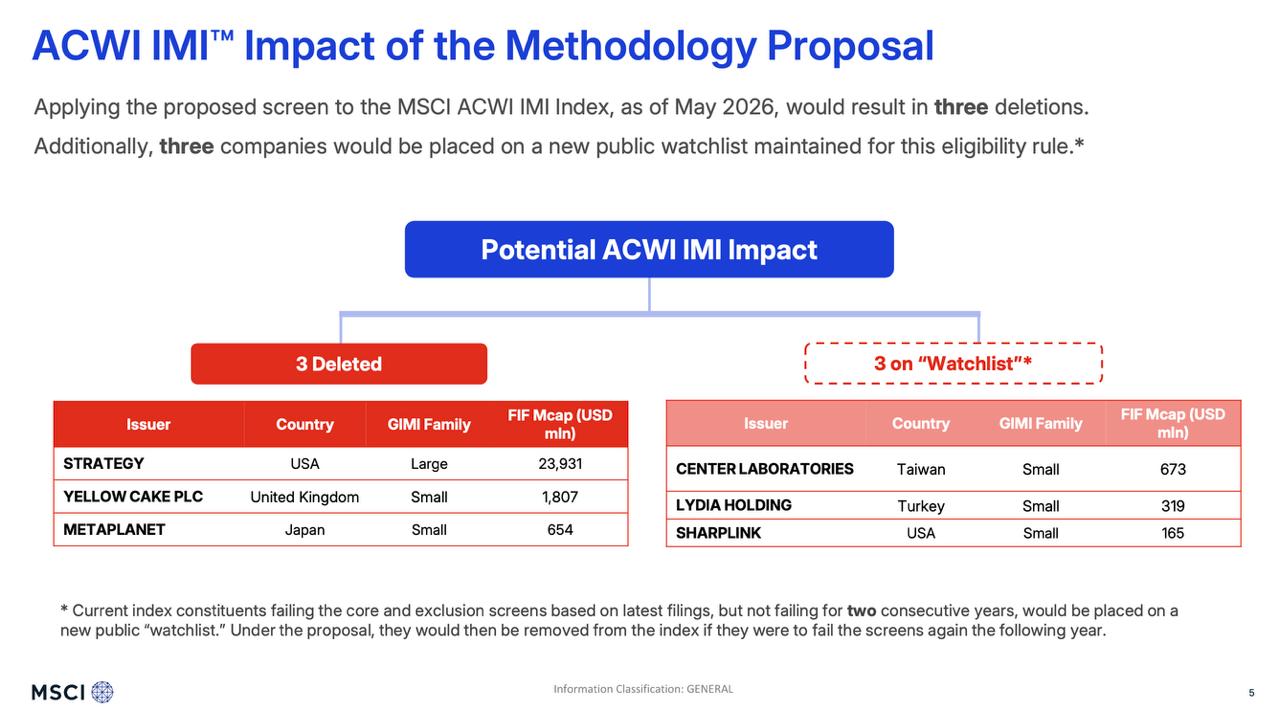
In its August consultation on non-operating companies, MSCI applies a new methodology across asset classes rather than focusing specifically on Bitcoin. Using May 2026 data, Strategy and Metaplanet appear among three existing constituents that would be deleted under the proposed rules.
MSCI is still consulting on the methodology, with a final decision expected in October.
How MSCI Moved From a Bitcoin Rule to a Broader Test
The debate began in September 2025 after Metaplanet announced a 385 million-share offering and said 95% of the proceeds would go toward Bitcoin purchases.
MSCI responded with a review of digital asset treasury companies and later proposed excluding firms whose digital assets represented at least 50% of total assets.
Strategy opposed the crypto-specific approach, arguing that index eligibility should be determined consistently across asset classes.
MSCI dropped that proposal in January 2026 but kept the underlying question alive: when does a listed company begin to resemble an investment vehicle more than an operating business?
The August methodology answers that question without referring to Bitcoin as a special category.
How MSCI’s New Test Works
Companies with operating assets above 50% of total assets remain eligible. Those below the threshold face five additional tests:
- ▪Operating asset intensity: Measures the capital deployed directly into productive operational assets.
- ▪Operating expenses relative to assets: Evaluates ongoing cost efficiency compared to the underlying asset base.
- ▪Operating cash flow: Tracks the actual cash generated from core business operations.
- ▪Fair-value changes relative to the business: Assesses how valuation shifts impact overall business health.
- ▪Dependence on external capital for asset accumulation: Gauges reliance on outside funding sources to build and scale assets.
Failing at least four of those five would make a company ineligible.
Existing constituents are given more time before removal. MSCI generally requires failure across two consecutive annual filing reviews; a company failing only on its latest review goes onto a watchlist instead.
That persistence rule helps explain why SharpLink appears on the watchlist while Strategy and Metaplanet fall into the deletion group.
MSCI also includes Yellow Cake PLC, a company whose principal exposure is uranium, among the three deletions. Its presence makes the scope of the proposal clearer: the methodology is aimed at investment-heavy corporate structures, not digital assets alone.
Strategy’s Balance Sheet Puts It Squarely in the Debate
Strategy still runs an enterprise analytics software business, but Bitcoin now represents the dominant asset on its balance sheet.
Its 2025 annual report says Bitcoin constitutes the “vast bulk” of company assets and that substantially all Bitcoin purchases have been financed with proceeds from equity and debt offerings.
Those characteristics overlap with several areas MSCI now evaluates, particularly operating-asset intensity and dependence on outside financing.
Fair-value accounting can also cause Bitcoin price movements to flow through Strategy’s reported results, which is relevant to MSCI’s fair-value test. But MSCI does not disclose which individual tests Strategy failed, so no single factor can be identified as the reason for its placement in the deletion group.
The scale is substantial. MSCI lists Strategy at approximately $23.93 billion in free-float-adjusted market capitalization in its impact analysis.
Metaplanet’s Treasury Model Faces the Same Classification Question
Metaplanet has built its corporate strategy increasingly around Bitcoin accumulation financed through public markets.
That model puts the company directly inside the type of analysis MSCI is proposing: how much of the business is supported by operating assets and cash flows versus the accumulation of investment assets financed externally.
MSCI does not publish Metaplanet’s individual test results either. What the consultation does show is that the company meets the proposed criteria for deletion under the May simulation.
Its free-float-adjusted market capitalization is much smaller than Strategy’s at approximately $654 million, highlighting how differently the same methodology could affect companies of very different scale.

$23.93 Billion Does Not Mean $23.93 Billion of Selling
The free-float figures in MSCI’s table are inputs used in index construction and weighting. They are not forecasts of passive fund outflows.
A larger free-float-adjusted capitalization can translate into a larger weight in an index, but the amount that passive funds would ultimately trade depends on several other factors: which MSCI benchmarks hold the company, its weight within each benchmark and how much capital tracks those indexes.
MSCI provides no estimate in the consultation for how many Strategy or Metaplanet shares index funds would have to sell.
The more interesting consequence could come after the rebalance. Both companies use public equity markets as part of their Bitcoin strategies, so any change in passive ownership, liquidity or valuation could affect the economics of future fundraising.
Index exclusion would not prevent either company from issuing securities or buying Bitcoin. It could, however, alter the market conditions under which that capital is raised.
The Decision Comes in October
Market participants can submit feedback to MSCI through September 30. The index provider expects to announce the consultation results by October 16, with any adopted methodology proposed for the November 2026 Index Review.
The change since January is no longer about whether Bitcoin deserves special treatment.
MSCI is now asking whether a public company still qualifies as an operating business when investment assets and the financing used to accumulate them dominate its economic profile. Strategy and Metaplanet are two of the clearest examples of where that line may be drawn.
- Update 13:50 UTC, August 14, 2026
Strategy pushed back publicly against the proposal. In a post on X, the company argued that digital assets should be treated like other corporate assets and that index providers should measure markets rather than determine what companies are allowed to own.
Digital assets are assets. Index providers should measure markets, not decide which assets companies are allowed to own. MSCI’s proposal puts it out of step with regulators, markets, and its own customers. Bitcoin doesn’t need MSCI. Neither does Strategy. $BTC $MSTR
— Strategy (@Strategy) August 14, 2026
- Disclaimer: The MSCI methodology discussed above remains under consultation. Any future impact on Strategy, Metaplanet or index-linked investment flows will depend on the final rules, affected benchmarks and subsequent index reviews. This article is for informational purposes only and does not constitute investment advice.



Kosta has reported on cryptocurrency markets and blockchain infrastructure since 2020, bringing over six years of hands-on experience in the crypto industry built through daily tracking of markets, trends, and emerging blockchain developments. Specializing in Bitcoin on-chain analysis, institutional ETF flows, and digital asset price action, his work at Coindoo has been cited by other news agencies and consistently covers market developments with a focus on data-driven reporting across Bitcoin, Ethereum, Solana, and XRP. Over the years, Kosta has contributed to multiple crypto media outlets in different regions, authoring over 6,000 articles across the sector. His reporting spans cryptocurrency markets and the broader fintech industry, tracking not only price action but also the technological and regulatory forces shaping the ecosystem. To support his analysis, Kosta actively leverages on-chain data and metrics from leading platforms such as Santiment, Glassnode, and CryptoQuant, enabling deeper, evidence-based market insights. He believes in the power of transparency and the data that underpins the blockchain ecosystem. His academic background in Marketing Management from Denmark further complements his analytical approach, adding a strong understanding of communication strategy and content positioning to his work.