Record 16.8M BTC Held Long Term as Macro Risks Build

A record amount of Bitcoin is now sitting in the hands of long-term holders, even after months of volatility and a sharp decline from the market’s earlier highs.
Key Takeaways
- The increase suggests that more Bitcoin is being retained rather than returned to the liquid market.
- Bitcoin still needs to reclaim key Fib level before the current rebound gains stronger confirmation.
- Weakness in major technology stocks could eventually redirect some capital toward BTC, but no clear rotation is visible yet.
According to Bitbo data, long-term holder supply has reached 16.83 million BTC, the highest level recorded by the metric.
Bitcoin was trading near $65,400 at the time of writing, up approximately 1% on the daily candle. The move follows another rejection near $67,270, where the 0.236 Fibonacci retracement continues to block the recovery.
The record holder supply gives Bitcoin a tighter supply backdrop, but it does not prove that new demand has already arrived.
What the 16.83 Million BTC Record Shows
Long-term holder supply increases when coins remain inactive for at least 155 days. Once they cross that threshold, they enter a group generally considered less likely to sell during ordinary market fluctuations.
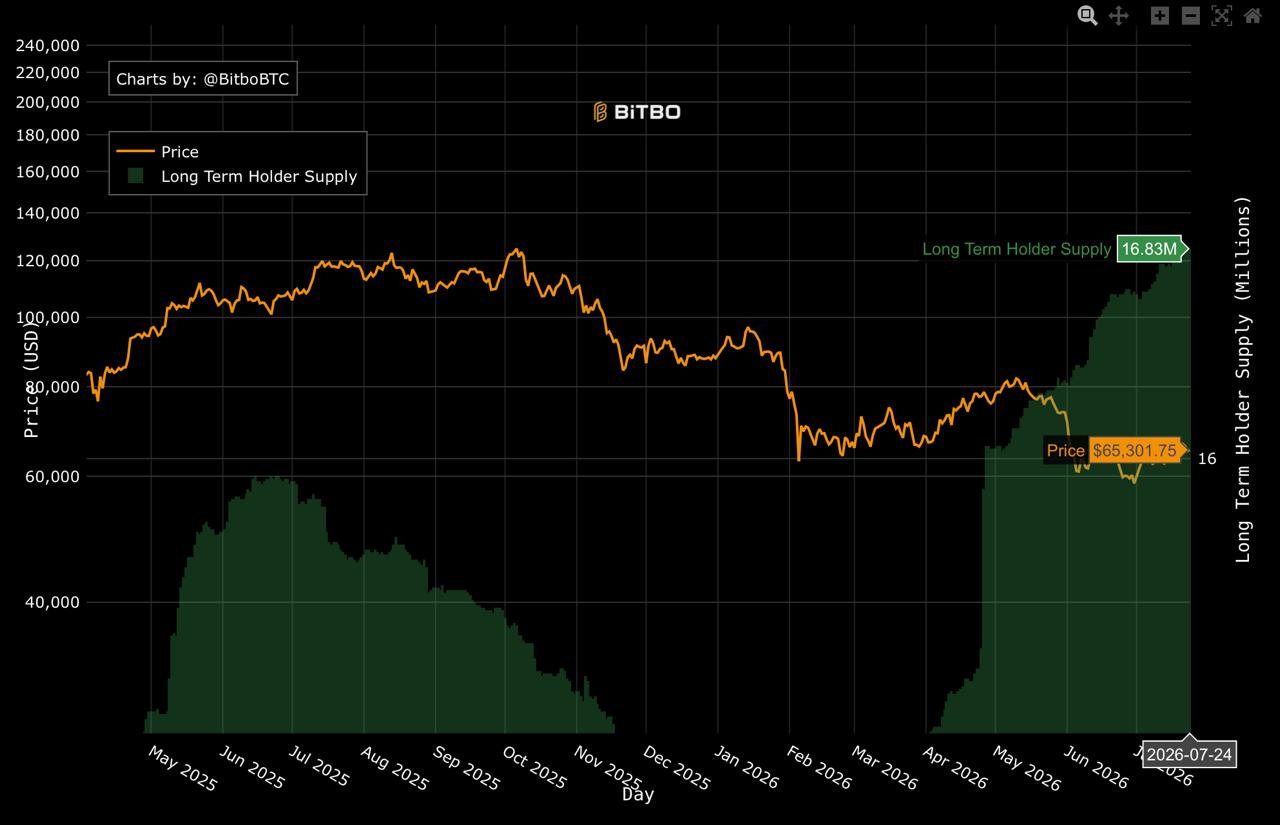
The latest record therefore shows that a growing share of Bitcoin is being retained rather than frequently traded. That can reduce the amount of supply readily available to exchanges, market makers and short-term buyers.
There is an important limitation. The increase does not mean investors recently purchased many new coins. Some coins enter the category simply because they have aged past the 155-day mark without moving.
The metric is better understood as evidence of retention than as a direct measure of new accumulation. Even so, reaching an all-time high after Bitcoin’s recent volatility shows that many holders have not been pushed into selling.
This could become more important if demand strengthens later. When fewer coins are available for sale, new inflows may have a larger effect on price than they would in a market with abundant liquid supply.
Bitcoin Still Needs to Recover $67,270
The supply signal is constructive, but the daily price structure remains unfinished.
Bitcoin recently tested the 0.236 Fibonacci retracement near $67,270 on the daily chart and was rejected. That level now represents the first major barrier separating the current rebound from the moving averages above it.
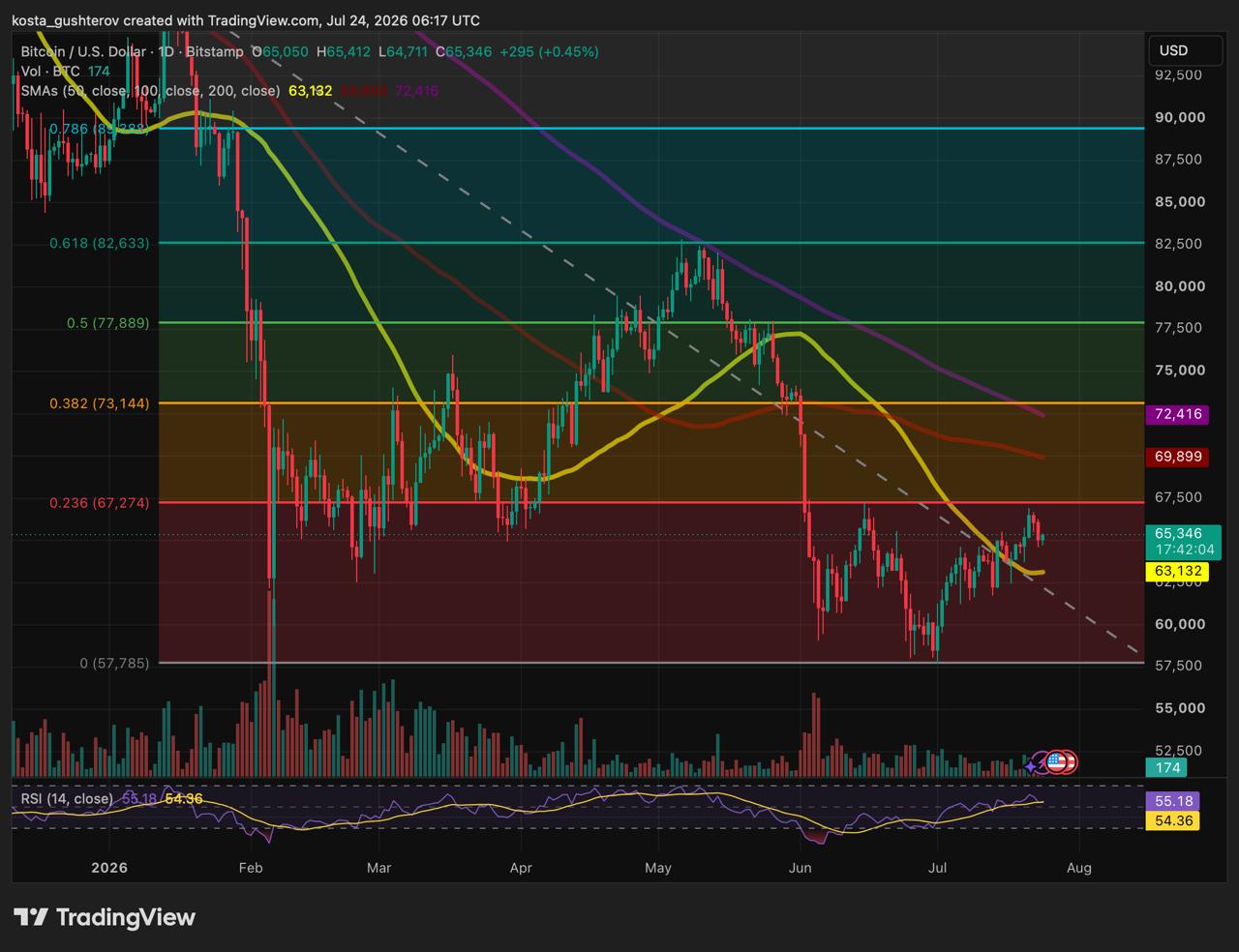
If BTC returns to $67,270, breaks through it and then holds the level during a retest, attention would likely move toward the 100-day simple moving average near $69,900.
That would be a more difficult test. The 100-day average is still falling, which means it could attract sellers looking to exit after the earlier decline. A recovery above it would not complete a wider reversal, but it would provide stronger evidence that Bitcoin is moving beyond a temporary bounce.
Daily RSI is near 55, showing that momentum has improved without reaching overbought territory. There is room for another attempt higher, but momentum alone will not confirm the move while price remains below $67,270.
If the recovery weakens, the first nearby support sits around $64,600. The next level is the 50-day simple moving average near $63,100.
| Bitcoin Level | Why It Matters |
|---|---|
| $67,270 | The 0.236 Fibonacci retracement and immediate resistance blocking the rebound. |
| Approximately $69,900 | The falling 100-day moving average and the next major test after a confirmed breakout. |
| $64,600 | The first nearby support if Bitcoin loses its current momentum. |
| Approximately $63,100 | The 50-day moving average and a deeper test of the improving short-term structure. |
Tech Weakness Raises a Future Rotation Question
The Magnificent Seven suffered their largest one-day decline since the tariff-driven selloff in April 2025, wiping almost $800 billion from the group’s combined market value, per Yahoo Finance.
Bitcoin was trading higher during the same session, but that divergence does not show that investors have already moved money from AI-linked and mega-cap technology stocks into BTC.
One trading day is not enough to establish a rotation. Bitcoin and technology shares can still fall together if investors broadly reduce exposure to risk assets.
However, if weakness in heavily concentrated technology positions continues, some investors may eventually look for alternatives with stronger relative momentum. Bitcoin could benefit from that search, particularly if it remains resilient and reclaims the $67,270 resistance level.
Evidence of a genuine rotation would require the divergence to continue across several sessions. Stronger Bitcoin volume, sustained inflows and technical progress above resistance would provide more convincing evidence than one positive daily candle.
Tariffs, War and Oil Prices Keep Risk Elevated
The possibility of future inflows must also be weighed against a difficult macroeconomic backdrop.
The Trump administration’s latest tariff measures add uncertainty around trade, business costs and inflation. The duties range from 10% to 12.5% and apply to countries responsible for the vast majority of US imports, including the UK, China, the European Union, Canada, Japan and India. The administration says the measures respond to concerns that these trading partners have not done enough to address forced labour.
The tariffs could raise costs for imported goods, parts and raw materials, with some of that pressure potentially passed on to businesses and consumers. The ongoing war involving Iran and rising oil prices add another layer of inflation risk by increasing energy, transport and production expenses.
Higher inflation expectations can keep interest rates and bond yields elevated, reducing the appeal of assets that depend on abundant market liquidity. Under that scenario, investors may reduce exposure to Bitcoin alongside equities rather than treat it as a destination for capital leaving technology stocks.
The opposite argument is that concern about trade policy, currencies and traditional financial markets could strengthen interest in Bitcoin as an asset outside the banking system.
Both outcomes remain possible. Tariffs and geopolitical instability do not automatically produce demand for BTC. They can support Bitcoin’s alternative-asset narrative while making investors less willing to take risk at the same time.

The Supply Is Tightening Before Demand Is Confirmed
The next meaningful signal probably would come from price rather than the supply data alone. A sustained move above $67,270 would show that the tighter market is beginning to meet stronger demand, while continued rejection would leave Bitcoin vulnerable to another test of nearby support.
The macro backdrop makes that confirmation more difficult. Weakness in technology stocks could eventually encourage investors to consider alternatives, but tariffs, rising oil prices and geopolitical risk could just as easily reduce demand for risk assets across the board.
Bitcoin therefore enters the next test with less readily available supply, but without a confirmed catalyst. Whether that imbalance becomes supportive will depend on buyers proving they can absorb the remaining supply above resistance.
The information provided in this article is for educational purposes only and does not constitute financial, investment, or trading advice. Coindoo.com does not endorse or recommend any specific investment strategy or cryptocurrency. Always conduct your own research and consult with a licensed financial advisor before making any investment decisions.



Kosta has reported on cryptocurrency markets and blockchain infrastructure since 2020, bringing over six years of hands-on experience in the crypto industry built through daily tracking of markets, trends, and emerging blockchain developments. Specializing in Bitcoin on-chain analysis, institutional ETF flows, and digital asset price action, his work at Coindoo has been cited by other news agencies and consistently covers market developments with a focus on data-driven reporting across Bitcoin, Ethereum, Solana, and XRP. Over the years, Kosta has contributed to multiple crypto media outlets in different regions, authoring over 6,000 articles across the sector. His reporting spans cryptocurrency markets and the broader fintech industry, tracking not only price action but also the technological and regulatory forces shaping the ecosystem. To support his analysis, Kosta actively leverages on-chain data and metrics from leading platforms such as Santiment, Glassnode, and CryptoQuant, enabling deeper, evidence-based market insights. He believes in the power of transparency and the data that underpins the blockchain ecosystem. His academic background in Marketing Management from Denmark further complements his analytical approach, adding a strong understanding of communication strategy and content positioning to his work.