Ripple Launches Mint to Make RLUSD Easier to Use

Ripple has launched a new platform that could make its RLUSD stablecoin easier for financial firms to use as part of their everyday operations.
Key Takeaways
- The platform is designed to reduce the operational work involved in moving between dollars and RLUSD.
- Easier issuance could support RLUSD’s growth, but only when customer demand exceeds redemptions.
- Recent partnerships have expanded access to RLUSD, although detailed usage data remains limited.
Ripple Mint gives approved institutional customers a direct way to issue, redeem and manage RLUSD through either a web interface or an application programming interface, commonly known as an API.
The launch is not aimed at changing what RLUSD is. It changes how institutions gain access to it. Instead of handling each request through a largely manual process, a fintech, exchange or market maker can connect RLUSD operations to the software it already uses.
That could matter more than the addition of another trading platform. Stablecoins become more useful to financial firms when they can be obtained, moved and redeemed without creating a separate operational process for every transaction.
What Minting and Redeeming RLUSD Actually Means
RLUSD is designed to maintain a value of approximately one US dollar. New tokens are normally issued when an approved customer sends dollars to the issuer and requests the equivalent amount of RLUSD.
For example, if an institution transfers $10 million and receives 10 million RLUSD, the stablecoin’s circulating supply should increase by approximately $10 million.
Redemption reverses that process. The customer returns RLUSD, receives dollars and the redeemed tokens are removed from circulation.
Ripple Mint brings those actions into one system. Customers can initiate requests, check balances, follow a transaction from the arrival of fiat currency through onchain settlement and receive automated notifications when important steps are completed.
It also supports moving RLUSD across compatible blockchains. That could help a market maker or exchange respond when demand appears on one network while most of its available liquidity is held on another.
Why Ripple Is Launching the Platform Now
RLUSD has expanded into more markets and financial channels during the past two months. That wider distribution creates a need for better access to the underlying supply.
The timing also reflects a wider institutional shift toward stablecoins as tools for settlement, liquidity and treasury management. Recent surveys covered by our team suggest that financial institutions increasingly view stablecoins as tools for working capital and settlement, rather than only as payment tokens.
In June, Mastercard said it would support RLUSD among the regulated stablecoins available for onchain settlement across its network.
RLUSD also entered another tightly regulated market in June, when Ripple’s stablecoin became legally available in Japan through SBI VC Trade. The launch gives both institutional and retail customers access through a locally licensed platform.
Ripple also expanded its relationship with Bitso around enterprise settlement between the United States and Latin America. Under the arrangement, RLUSD and Bitso’s Mexican peso-backed MXNB are intended to support dollar-to-peso liquidity and settlement flows.
Those developments increase the number of places where institutions may need RLUSD. Ripple Mint addresses the next step: helping approved firms obtain and return the stablecoin when their own customers or settlement operations require it.
How Ripple Could Benefit
Ripple Mint moves the company closer to being an infrastructure provider rather than only the developer of a stablecoin.
A financial firm that connects RLUSD issuance to its treasury, payment or trading software is building Ripple deeper into its internal operations. Replacing that connection later could require new technical work, compliance reviews and liquidity arrangements.
That may make institutional relationships more durable, particularly when the same customer also uses Ripple for payments, custody or treasury services.
The platform could also give Ripple a clearer view of when customers need additional liquidity, which blockchains they use and how frequently RLUSD returns for redemption. That information could help the company decide where additional banking, exchange and market-making support is needed.
Ripple has not disclosed a public fee schedule for Ripple Mint or provided enough information to calculate how much direct revenue it may generate. Claims about its financial impact on the company would therefore be premature.
What Customers Gain From the New System
The main benefit for customers is operational rather than speculative.
An exchange can request more RLUSD when customer withdrawals reduce its available balance. A payments company can issue tokens when settlement demand rises. A corporate treasury can redeem balances that are no longer needed instead of keeping excess capital onchain.
Through an API, those actions can be connected to internal rules. A company might request more RLUSD when its available balance falls below a certain level, while still requiring human approval before the transaction is completed.
Automated notifications and shared transaction references can also make accounting easier. The same request can be followed across the bank transfer, issuance and blockchain stages rather than being reconciled through several disconnected records.
Ripple Mint is available to existing RLUSD customers, not to every retail wallet. Institutions must still complete the necessary onboarding and compliance process before they can issue or redeem directly.
The need for that liquidity is already visible on trading platforms. OKX has made RLUSD available across more than 280 spot pairs and as margin collateral for derivatives. In that environment, direct minting and redemption could help exchanges and market makers replenish balances as trading and collateral demand changes.
Could Ripple Mint Increase RLUSD’s Market Cap?
It could make growth easier, but it cannot create demand by itself.
Because RLUSD is designed to remain near $1, its market capitalization is largely determined by how many tokens are in circulation. Net issuance increases the market cap, while net redemptions reduce it.
Ripple reported approximately $1.5086 billion of RLUSD in circulation and $1.6191 billion in reserve funds as of July 16.
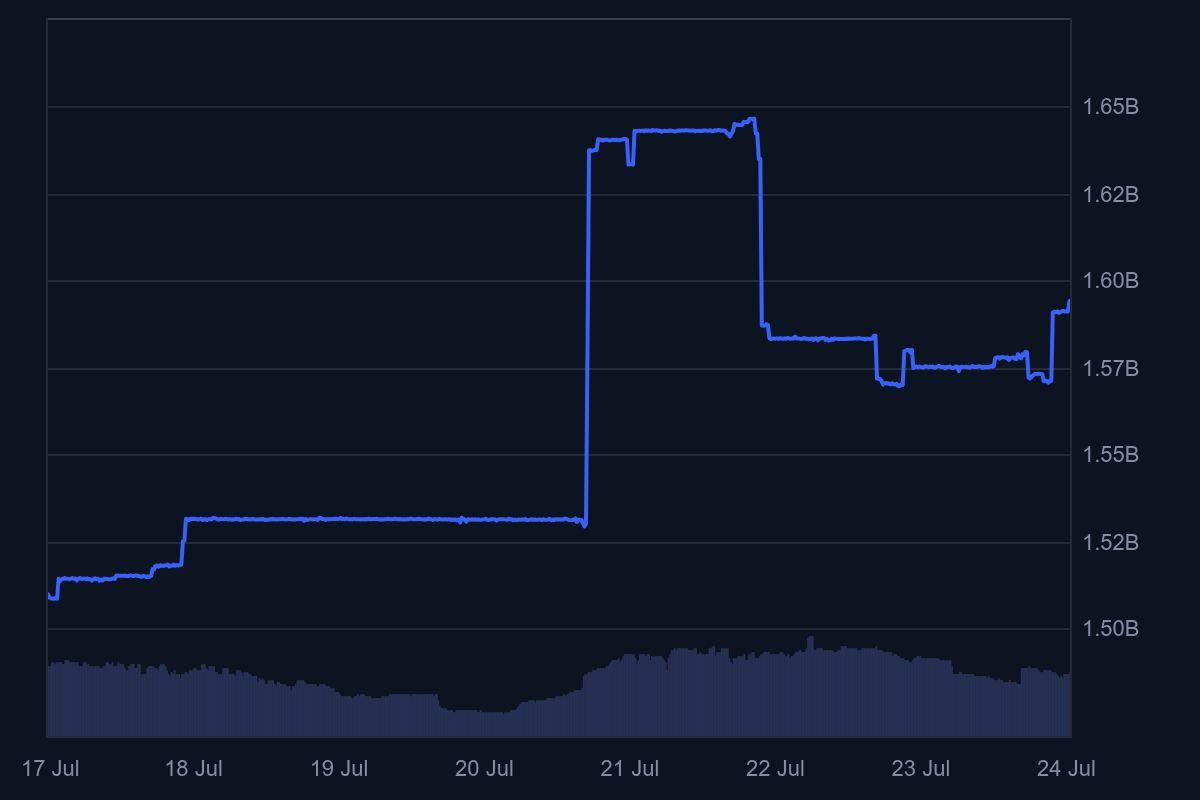
The accompanying seven-day chart shows RLUSD’s market capitalization rising from roughly $1.51 billion, briefly approaching $1.65 billion and then settling near $1.59 billion. That indicates that the circulating supply can change noticeably over a short period.
However, the chart does not identify who issued or redeemed the tokens. It also would be inaccurate to attribute the earlier increase to Ripple Mint because the platform was announced afterward.
Over time, easier access could encourage institutions to hold more RLUSD for trading, payments or treasury purposes. The effect would only be lasting if those firms keep more tokens in circulation than they return for dollars.

Distribution Is Growing, but Usage Remains Hard to Measure
The Mastercard, SBI and Bitso announcements show that RLUSD is becoming available through more regulated financial channels.
RLUSD is also moving beyond crypto-native exchanges. Interactive Brokers now allows eligible clients to convert cash into RLUSD and transfer it to an external wallet, creating another connection between traditional financial accounts and onchain liquidity.
They do not yet show how much the stablecoin is being used.
The recent announcements do not disclose RLUSD payment volume, the number of active institutional customers or the value of settlement flows processed through the stablecoin. They should therefore be viewed as evidence of expanding access rather than proof of adoption at scale.
More useful evidence would include sustained net issuance, growth in active wallets, deeper exchange liquidity and disclosed payment or settlement volumes.
Ripple Mint Removes Friction, Not Market Risk
Ripple Mint solves a practical problem for firms that already want to use RLUSD. It creates a more direct connection between traditional bank dollars and the stablecoin while making transactions easier to track and automate.
That could help Ripple integrate RLUSD into more payment, trading and treasury systems. It could also improve liquidity for users by making it easier for approved institutions to issue tokens when demand rises and redeem them when demand falls.
The launch should not be treated as proof that RLUSD’s market capitalization will continue climbing. Ripple has improved the route institutions use to access the stablecoin. The next question is whether enough of them will use that route regularly.
The information provided in this article is for educational purposes only and does not constitute financial, investment, or trading advice.



Kosta has reported on cryptocurrency markets and blockchain infrastructure since 2020, bringing over six years of hands-on experience in the crypto industry built through daily tracking of markets, trends, and emerging blockchain developments. Specializing in Bitcoin on-chain analysis, institutional ETF flows, and digital asset price action, his work at Coindoo has been cited by other news agencies and consistently covers market developments with a focus on data-driven reporting across Bitcoin, Ethereum, Solana, and XRP. Over the years, Kosta has contributed to multiple crypto media outlets in different regions, authoring over 6,000 articles across the sector. His reporting spans cryptocurrency markets and the broader fintech industry, tracking not only price action but also the technological and regulatory forces shaping the ecosystem. To support his analysis, Kosta actively leverages on-chain data and metrics from leading platforms such as Santiment, Glassnode, and CryptoQuant, enabling deeper, evidence-based market insights. He believes in the power of transparency and the data that underpins the blockchain ecosystem. His academic background in Marketing Management from Denmark further complements his analytical approach, adding a strong understanding of communication strategy and content positioning to his work.