MANTRA Halts Chain After Upstream Dependency Exploit

MANTRA Chain slammed the brakes on its mainnet after detecting an exploit linked to an upstream software dependency, bringing all network transactions, public endpoints, and bridge operations to a sudden halt.
The project’s official status page confirmed that validators and infrastructure were taken offline as an emergency precaution. Migrate bridge operations and MANTRA-managed IBC relays are frozen, while centralized exchange partners have locked down deposits and withdrawals for the native token.
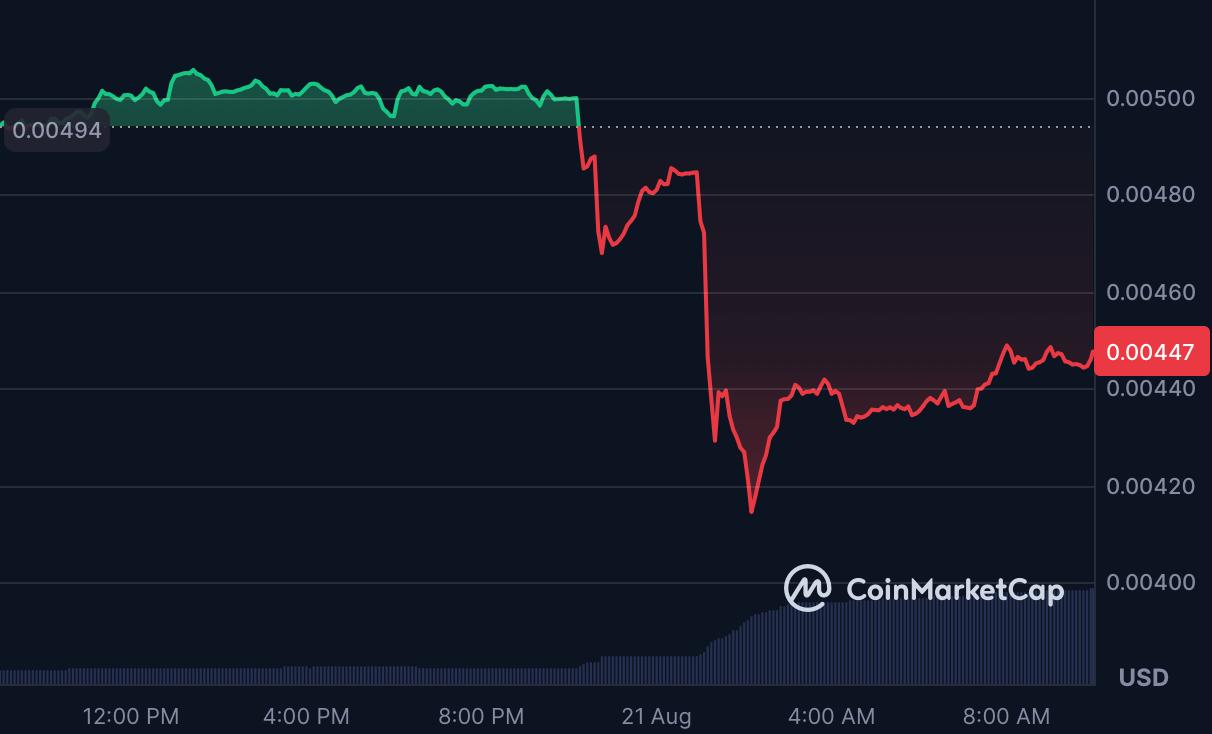
The sudden shutdown triggered immediate market panic, sending the token down roughly 10% for the past 24H on high volume to a record low near $0.0041 before a slight recovery. With foundational questions swirling around the scope of the breach, the incident places heavy pressure on the network’s leadership.
What the network freeze means for users
A hard chain halt locks the ecosystem in place. Asset transfers cannot settle, cross-chain bridge routes are severed, and exchange gateways remain dark until validators safely bring the network back online.
While the lockdown is designed to contain further damage and prevent unauthorized asset movement, it leaves token holders in a holding pattern. The team has issued strict warnings for users to ignore unverified recovery links or support offers circulating on social channels. For now, the safest stance is absolute inaction: keep assets parked, ignore unsolicited DMs, and wait for verified updates from exchanges or the core team.
An upstream vulnerability, not core code
According to MANTRA’s disclosures, the attacker exploited a weakness residing in an “upstream dependency”, external software utilized by the chain rather than a flaw in MANTRA’s native architecture.
That distinction offers little immediate comfort. Modern blockchains inherit risk from every underlying library, tool, and infrastructure package they integrate. The ultimate test isn’t just patching the dependency, but coordinating a decentralized validator set to verify and deploy the fix without triggering secondary failures during the restart. MANTRA developers are actively drafting a patched release, though no hard timeline for mainnet resumption has been locked in.

Stakes are higher for a tokenized RWA platform
Because MANTRA markets itself as a compliance-focused Layer 1 built explicitly for real-world asset (RWA) tokenization, operational reliability is everything.
Institutional participants, asset issuers, and corporate partners require absolute certainty around settlement finality, data availability, and transparent crisis communication. While a swift chain halt is standard emergency protocol, long-term confidence will hinge on the aftermath: a transparent post-mortem, verifiable security audits, and a full accounting of any financial losses.
The timing is particularly sensitive. The network disruption follows the painful legacy OM token collapse in 2025, and arrives right as strategic backer Inveniam Capital Partners prepares to close its acquisition of the platform in the third quarter. While entirely separate events, the convergence makes flawless transparency non-negotiable for MANTRA’s market standing.
Unanswered questions hanging over the network
While containment has stopped the bleeding, critical details remain missing:
- The Exact Vector: Which specific dependency and version were compromised, and how did the attacker weaponize it?
- Financial Toll: Did funds escape the ecosystem permanently, and which asset pools were impacted?
- Restart Parameters: What are the precise validation steps and validator consensus thresholds required to lift the mainnet freeze?
- Bridge Integrity: How will pending cross-chain transfers and IBC channels be reconciled once services resume?
- Independent Oversight: Will an external security firm audit the remediation patch before deployment?
Until management publishes concrete answers, the network remains in a state of managed containment. The emergency shutdown successfully barred the door against further exploitation, but the true cost of the attack won’t be known until the ledger starts turning again.
This article is provided for informational purposes only and does not constitute legal, financial, or investment advice.



Alexander Zdravkov is a market analyst and crypto journalist with interests in economics, broader financial markets and digital assets. His journey into crypto began more than four years ago, driven by a fascination with the rapid evolution of blockchain technology and the transformative potential of decentralized finance. He began analyzing market cycles and identifying emerging trends before they reach the mainstream. He holds a degree in International Relations - a background that helped shape his broader perspective on global economics, geopolitics, and the interconnected nature of modern financial markets. Whether covering the latest developments in the crypto sector or exploring broader macroeconomic themes, Alexander focuses on giving readers context rather than simply repeating headlines. During his career, he has authored more than 5,000 articles covering cryptocurrencies, traditional finance, and global market developments. His work spans everything from Bitcoin and altcoins to macroeconomic trends influencing risk assets worldwide.