France’s 192% Stablecoin Jump Has a Tax Angle

French crypto users pulled stablecoins off exchanges faster than the rest of Western Europe last year, and part of the explanation sits in the tax code rather than the bond market.
Key Takeaways
- Stablecoins made up 54.2% of French exchange withdrawals.
- French stablecoin wallets rose from 3,577 to 12,255.
- Self-custody balances grew 192%; bank deposits grew 2%.
- Budget revenue section rejected 458 votes to 0.
The figures come from Chainalysis’s Western Europe report, published on November 9 and covering July 2025 to June 2026. Chainalysis reads the French data as users “diversifying how they hold and access their funds”, and rules out any wider loss of confidence in the euro. What it does not discuss is a rule in French tax law that makes a stablecoin the only exit from bitcoin that carries no tax bill. That rule, and the attempt in parliament to remove it, is where the French story becomes different from the rest of Europe’s.
Three signals that moved together
Chainalysis tracks France through three measures, and all three point the same way.
The first is what leaves exchanges. By 2026, stablecoins accounted for 54.2% of French withdrawals from centralised services, which put France first among Western Europe’s large markets on that measure, up from tenth place in 2023. The value moving from exchanges to French wallets grew 12%, against 7% for the rest of the region.
The second is how many wallets receive it. The number of French personal wallets holding stablecoins rose from 3,577 in June 2025 to 12,255 in June 2026, a 3.4-fold increase that Chainalysis contrasts with a 1.7-fold rise across the rest of Western Europe. The count rose every month, but not at an even pace. Chainalysis puts monthly growth at about 6% in mid-2025, 18% by the end of 2025 after that autumn’s bond-market stress, and 5% by June 2026 as markets settled.
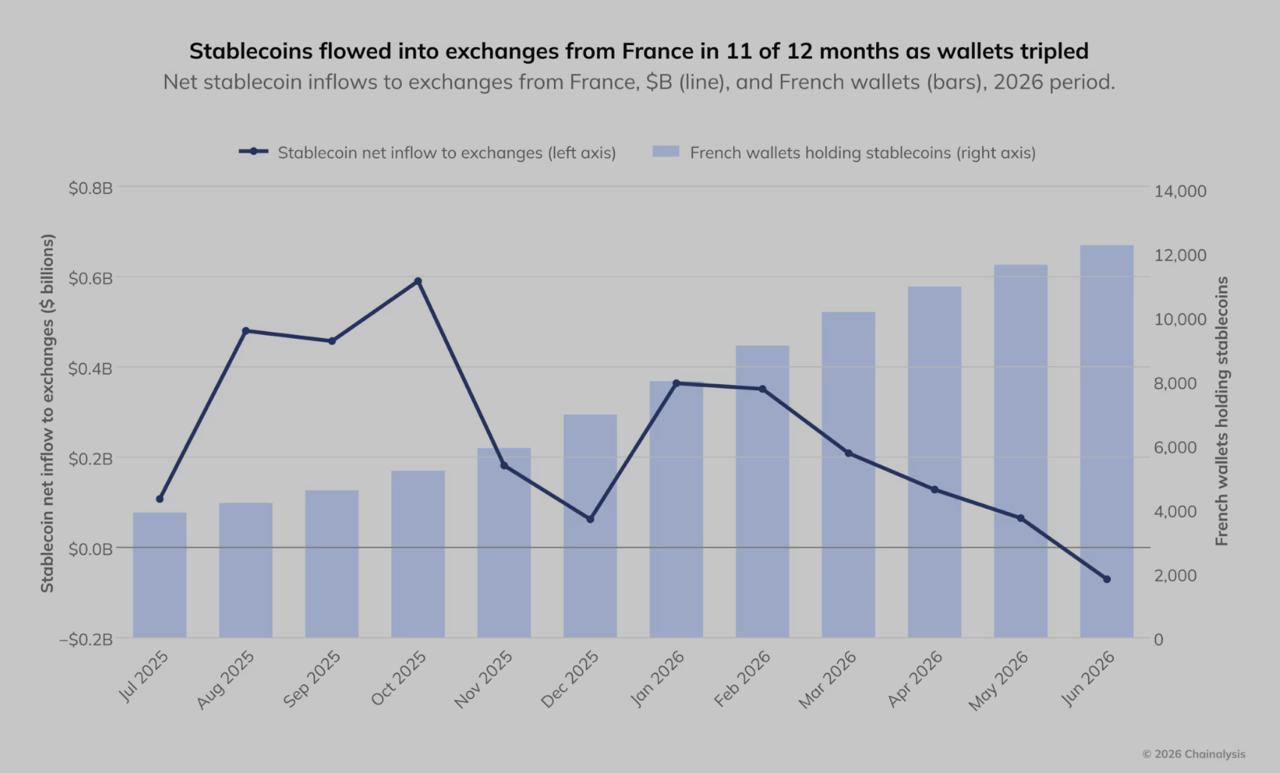
The third is how much those wallets hold. Self-custodied stablecoin balances grew 192% over the twelve months. Chainalysis sets that against French bank deposits, which it says grew 2% in the same period, while noting that the stablecoin sum remains small next to traditional savings.
The window closes in June. France’s ten-year borrowing cost crossed 5% in late October, a level last seen in 2002, according to CNBC. Whether that episode produced a second wallet surge like the one after autumn 2025 is not something the current data can show.
The rule Chainalysis didn’t mention
French law taxes crypto gains only at the point where a digital asset is sold for legal tender, or used to buy a good or service. Swapping one digital asset for another is treated as a deferral: no tax is due and, as the tax administration’s own BOFiP guidance confirms, the swap does not even need to be declared. The gain is taxed later, when euros finally arrive, at 12.8% income tax plus social levies, around 30% in total.
A stablecoin counts as a digital asset. For a French holder sitting on a bitcoin gain, that creates a choice with very different consequences: sell to euros and pay roughly a third of the profit this year, or swap to USDC or EURC and pay nothing until a later sale. The market value is parked either way. Only one route triggers the tax.
Route 1
Bitcoin → euros
Taxable sale. Declared on the annual return.
Route 2
Bitcoin → stablecoin
Deferred. No tax, no declaration, under current law.
Route 2, if amended
Bitcoin → stablecoin from 2027
Taxable sale, if the Assembly’s October text returns.
Put that rule next to the year Chainalysis measured. The global crypto market lost half its value. French holders who wanted out of bitcoin had a tax-free way to do it, as long as they stayed inside crypto. Withdrawing the result to a personal wallet costs nothing extra and removes the exchange from the picture. The 54.2% withdrawal share, the wallet count and the balance growth all fit that sequence without needing fear of the euro to explain them.
Fear does not disappear from the story. The growth curve still accelerated after the autumn 2025 bond scare and slowed when it passed. The tax rule explains why the exit took the form of stablecoins rather than cash; the bond market helps explain when people took it.
Parliament has already tried to close it
French lawmakers noticed the same route. On October 16, the National Assembly adopted amendment I-3898 to the 2027 finance bill by 38 votes to 37. It would have made any swap from a crypto asset into an electronic money token, MiCA’s term for a single-currency stablecoin, a taxable disposal from January 1, 2027. The committee version of the text describes the current deferral as “a hole in the legislation”.
On November 3 the Assembly went further, adopting an amendment from Charles de Courson by 150 votes to 44 that would require taxpayers to declare self-custodied crypto wallets worth at least €100,000 at year-end, with a fine of up to €10,000 for not doing so. The two measures target exactly the behaviour in the Chainalysis data: swapping into stablecoins, then holding them outside any platform.
Neither survived the week. On November 4 the Assembly rejected the entire revenue section of the 2027 budget by 458 votes to none, with two abstentions. Every amendment adopted in the chamber fell with it, and the government’s original text, without the crypto provisions, moves to the Senate. Senators begin their examination on November 20 and are scheduled to vote on December 9. They can table their own versions of the stablecoin and wallet measures; whether they do is an open question, not a forecast this article makes.
The timing matters for reading the data. The 192% growth happened under the old rule, in a period when no one in parliament had yet voted to change it. If the swap tax returns in some form, the next year’s figures would be produced under a different incentive.
How big is it, really
Chainalysis does not publish the absolute size of French self-custodied stablecoin balances, so the 192% cannot be converted into euros. What can be measured is the pool it is being compared with. Banque de France data for August 2026 put household bank deposits at €1,889 billion. Of that, €405 billion sits in the Livret A, which has paid 1.70% since August, and €555 billion sits in current accounts earning an average of 0.04%.
Those current-account balances are the relevant benchmark. French households already keep more than half a trillion euros in a form that pays nothing, so a stablecoin balance that pays nothing is not an exotic choice for them. The question is whether it is a better one, and on three points it is not obviously so.

What holding your own keys changes, and what it doesn’t
Moving a balance off an exchange removes one dependency: the holder no longer needs the platform to process a withdrawal. The European supervisory authorities’ warning describes the trade: lose the keys and there is no one to call.
The issuer stays in the picture. Circle’s USDC terms keep the right to block transfers involving addresses it designates, whoever holds the private key. Getting back to euros runs through Circle’s EEA redemption policy, which requires identity checks and a receiving bank account, with a stated turnaround of up to five business days, or through an exchange at whatever price it offers. Coindoo has covered the gap between a stablecoin and bank money before; self-custody does not narrow it.
And the balance earns nothing. The ESAs’ MiCA factsheet notes that electronic money tokens cannot pay interest to holders. A dollar token also carries exchange-rate risk against the euro that a Livret A does not. Euro-denominated options exist, and the supply is growing, as Coindoo’s reporting on MiCA’s authorised issuers and Société Générale’s EURCV shows, but Chainalysis gives no currency breakdown for France, so the share held in dollars is unknown.
The case against the tax explanation
The tax rule cannot be isolated from the bond market in this data, because both pointed the same way at the same time. A holder who swapped into USDC in October 2025 may have done so to avoid a tax bill, to avoid the euro, or simply to stop watching a falling chart. Chainalysis sees the transaction, not the reason.
The wallet count also overstates headcount. One person can run several wallets, and Chainalysis’s methodology assigns wallets to countries by behaviour, such as interaction with a domestic exchange, rather than by any verified identity. Twelve thousand wallets is a floor on activity and a ceiling on people.
Finally, the deferral has existed since 2019. If tax alone drove stablecoin accumulation, the surge should have come earlier. What changed in 2025 was the combination: a large gain to protect, a market falling fast enough to make protecting it urgent, and a domestic political backdrop that made the exchange look like one more institution to step away from.
What could settle it
Three dates do the work. The Senate’s revenue debate opens on November 23 and ends with the December 9 vote; if a stablecoin swap tax or a wallet-declaration threshold reappears there, the incentive behind the 2026 data changes from January. Chainalysis’s next reporting window, covering July to December 2026, captures the October bond spike and would show whether French wallet growth reacted to it the way it reacted in autumn 2025. And Banque de France’s quarterly household savings statistics show whether the 2% deposit growth Chainalysis cites held through the second half of the year.
Until those arrive, the 192% is best read as what it is: a tax-efficient exit from a falling market, taken by a growing number of French users, during the year before their parliament tried to tax it.



Kosta has reported on cryptocurrency markets and blockchain infrastructure since 2020, bringing over six years of hands-on experience in the crypto industry built through daily tracking of markets, trends, and emerging blockchain developments. Specializing in Bitcoin on-chain analysis, institutional ETF flows, and digital asset price action, his work at Coindoo has been cited by other news agencies and consistently covers market developments with a focus on data-driven reporting across Bitcoin, Ethereum, Solana, and XRP. Over the years, Kosta has contributed to multiple crypto media outlets in different regions, authoring over 6,000 articles across the sector. His reporting spans cryptocurrency markets and the broader fintech industry, tracking not only price action but also the technological and regulatory forces shaping the ecosystem. To support his analysis, Kosta actively leverages on-chain data and metrics from leading platforms such as Santiment, Glassnode, and CryptoQuant, enabling deeper, evidence-based market insights. He believes in the power of transparency and the data that underpins the blockchain ecosystem. His academic background in Marketing Management from Denmark further complements his analytical approach, adding a strong understanding of communication strategy and content positioning to his work.