What is Liquid Staking? Liquid Staking Explained for Beginners
Liquid staking gives holders a tradable token linked to staked crypto. Understanding its reward accounting, withdrawal conditions and additional uses helps explain what holders gain and what they risk.
A quoted staking rate describes only part of the product. The token may change your wallet balance, increase the amount of crypto represented by each unit or provide access to lending applications. Those features depend on the protocol and the token you receive.
What Is Liquid Staking?
Liquid staking issues a liquid staking token, or LST, representing a staking position while the deposited assets support proof-of-stake validation. The holder’s rights, including redemption access, depend on the protocol and applicable terms.
On a proof-of-stake blockchain, validators help maintain the ledger and receive rewards for performing their duties. Staked assets remain subject to the network’s withdrawal and penalty rules. Selling the LST transfers the associated staking exposure under the protocol’s rules.
This also allows participation without operating validator hardware. On Ethereum, activating your own validator requires at least 32 ETH, whereas pooled services can accept smaller deposits. Each service sets its own minimums and conditions. Ethereum’s staking overview compares the available participation methods.
An LST also differs from a protocol’s governance token. For example, holding a token used to vote on a project’s decisions does not automatically create a claim on its pooled stake. Check which asset you are acquiring and which rights it carries.
What Happens When You Deposit?
In a typical pooled Ethereum service, you deposit ETH and receive its LST at the applicable issuance rate. The protocol allocates ETH to participating node operators, who run validators. Some deposits can remain in a buffer or activation process before entering active validation.
The point at which your token begins reflecting rewards depends on the product’s accounting rules. A pooled token can share the performance of existing validators, so a new holder’s reward allocation need not follow the activation of a particular deposit.
Deposit ledger: a simplified example
| Record | Change | Meaning |
|---|---|---|
| Wallet ETH | −10 ETH | Deposited into the protocol |
| Wallet LST | +10 tokens | Receipt issued to the holder |
| Protocol assets | +10 ETH | Available for allocation under protocol rules |
The example excludes gas costs. The receipt and deposited ETH describe the same economic exposure, not two independent holdings.
You can also acquire an existing LST through a market purchase. In that case, you buy from another holder rather than necessarily causing a new deposit into the staking protocol.
How Do Liquid Staking Rewards Accumulate?
Two common accounting models explain why liquid staking tokens behave differently in a wallet. A rebasing token adjusts the number of units held. An exchange-rate token keeps the unit balance unchanged while the underlying asset represented by each unit changes.
Lido’s stETH uses rebasing, while wrapped stETH, or wstETH, uses a non-rebasing form. Wrapping changes the accounting format; it creates no additional staking reward stream. Lido’s stETH and wstETH guide explains the relationship.
Two ways to reflect the same hypothetical growth
Generic token models, continuing the 10 ETH example. Actual conversion rates differ; the assumed 3% growth has no specified time period.
| Model | Starting position | After the assumed growth |
|---|---|---|
| Rebasing | 10 tokens representing 10 ETH | 10.3 tokens representing 10.3 ETH |
| Exchange-rate | 10 tokens at 1 ETH per token | 10 tokens at 1.03 ETH per token |
Both examples represent 10.3 ETH before exit costs. Accounting values are separate from market sale prices.
Actual staking returns vary with network conditions, validator performance and the provider’s fee structure. Check whether a displayed rate is gross or net of service fees, and whether an APY assumes compounding. Temporary incentives and points should be identified separately from network staking rewards.
Rewards and losses can change a rebasing balance or the amount of ETH represented per token. Returns also depend on the currency used to measure them: an increase in ETH can coincide with a dollar loss if ETH’s price falls.
How Do You Get the Underlying Asset Back?
Where supported, you can sell an LST through a market or redeem it through the protocol. Access can depend on the asset, venue, participant eligibility and whether withdrawals or transfers are restricted.
Sell through a market
- Price
- The executable quote, including fees and price impact.
- Timing
- Depends on market access, liquidity and transaction processing.
- Main trade-off
- An earlier exit can involve accepting a discount to the protocol’s accounting value.
Redeem through the protocol
- Amount
- Determined by redemption rules, accounting and applicable costs or losses.
- Timing
- Depends on available underlying assets and any withdrawal or validator exit queue.
- Main trade-off
- You may need to wait before claiming the underlying asset.
For example, Lido provides a withdrawal queue as well as the option of selling stETH through secondary markets. Its withdrawal documentation explains that waiting times depend on queue size, available ETH and validator exits. The rules for rewards and loss exposure during a pending withdrawal also need checking.
A market discount does not, by itself, prove that the underlying assets are missing. It can reflect demand for an immediate exit or concerns about the protocol. Equally, a quoted conversion rate does not guarantee a buyer willing to pay that amount for your full order.
What Can You Do With an LST?
An LST can remain in your wallet while its accounting reflects staking performance. DeFi applications offer further uses, each with a different source of income or borrowing obligation.
Supported applications may accept LSTs for lending, borrowing or liquidity provision. Lending income comes from borrowers, while liquidity-pool income can come from trading fees and incentives. These differ from the validator rewards underlying the LST. The sources of cryptocurrency income should be assessed separately.
Using an LST as collateral allows borrowing against the position, but the debt accrues its own costs. A fall in collateral value, a change in the LST’s relative price or accumulating interest can put the position at risk of liquidation.
Collateral worksheet: a hypothetical price decline
- Initial borrowing: $8,000 debt ÷ $20,000 collateral = 40%.
- After a collateral decline: $8,000 debt ÷ $12,000 collateral ≈ 66.7%.
- Liquidation check: compare that ratio with the specific market’s liquidation threshold.
The example holds debt constant and excludes interest and fees. Actual liquidation depends on the price oracle and lending rules, even while the LST continues to reflect staking rewards.
What Are the Main Risks?
Validator performance and penalties
The position remains exposed to the performance of the validators supporting it. On Ethereum, ordinary downtime leads to missed rewards and inactivity penalties. Slashing concerns specific violations, such as conflicting signatures, and can force a validator’s exit. Ethereum’s penalty rules distinguish these outcomes.
Protocols differ in how they allocate losses, maintain reserves or arrange coverage. An insurance or protection label needs to be read alongside its limits, exclusions and funding.
Contract, oracle and administrative risk
Liquid staking relies on software to issue tokens, account for staking performance and process withdrawals. Bugs, compromised permissions or faulty reporting can affect the position. Some systems also depend on oracles to report validator balances.
Review who can upgrade contracts, change fees or pause operations. Audits provide evidence about specific code and scope; they cannot guarantee future operation. Coindoo’s explanation of smart contracts covers how these controls work.
Concentration and control
A large provider may distribute stake across multiple operators while those operators still share software, infrastructure or service dependencies. Assess the operator set and withdrawal controls rather than assuming that a high TVL demonstrates diversification.
Liquid staking and restaking are different arrangements
Restaking commits stake or supported staking tokens to additional security arrangements beyond the base blockchain. Liquid restaking products can issue another token representing that position. They add contracts, operators and potentially additional slashing conditions; an ordinary LST should not automatically be described as a liquid restaking token.
Examples of Liquid Staking Arrangements
The following examples illustrate different token designs and access arrangements. They are not a ranking, and their availability, fees and terms should be checked through current official documentation.
Lido: stETH and wstETH
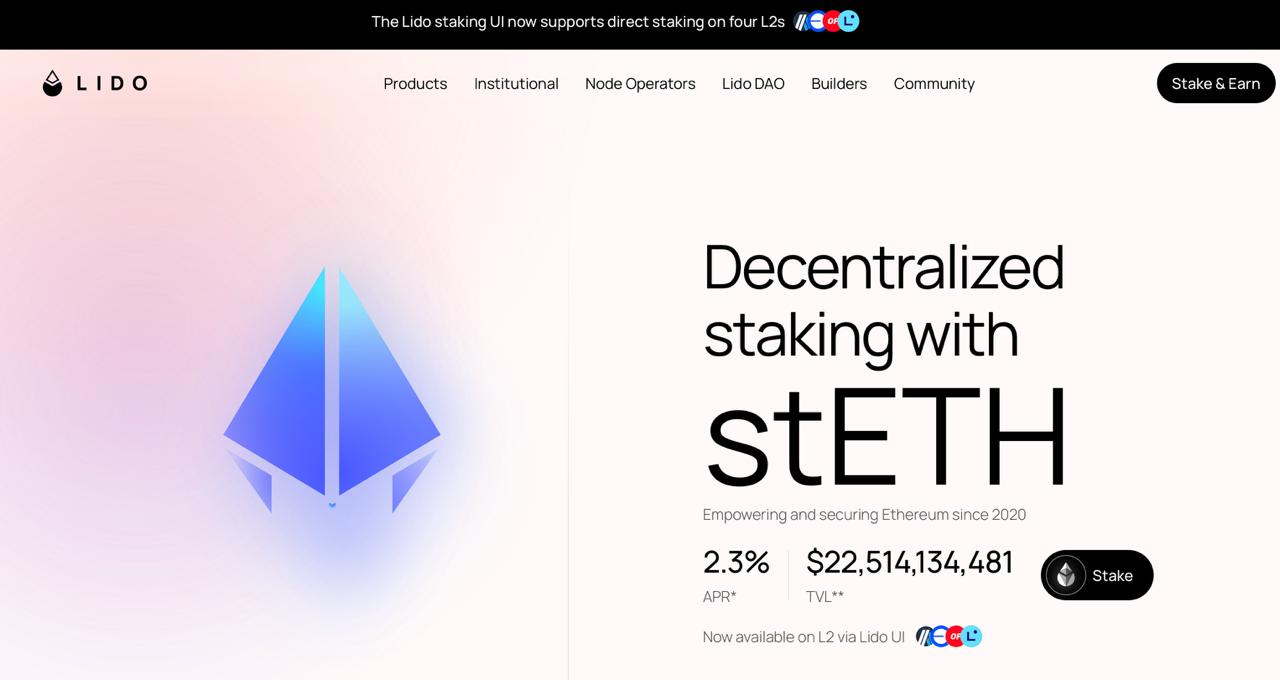
Lido illustrates why the accounting format matters for applications. Some applications support rebasing balances; others use wstETH to work with a stable number of units. Choose the version accepted by the application rather than assuming both are interchangeable within its contracts.
Lido’s former Polygon and Solana staking services were sunset. An Ethereum staking token available on another network still represents Ethereum staking exposure.
Rocket Pool: rETH

Rocket Pool separates liquid staking participation from running validator infrastructure. Its liquid staking documentation specifies a minimum direct deposit of 0.01 ETH for rETH participation. A holder relies on the protocol’s operator network; a node operator must meet separate capital and technical requirements and perform validator duties.
Liquid Collective through Coinbase Prime: LsETH

Coinbase Prime provides eligible institutional clients with access to Liquid Collective’s LsETH. The platform, staking protocol and receipt token have separate roles. Coinbase’s documentation describes LsETH’s conversion-rate model, service charges and participation requirements.
Provider reference
| Protocol | Token | Accounting model | Access described |
|---|---|---|---|
| Lido | stETH / wstETH | Rebasing / wrapped exchange-rate form | Protocol deposit and supported markets |
| Rocket Pool | rETH | Exchange-rate | Protocol deposit and supported markets |
| Liquid Collective | LsETH | Exchange-rate | Eligible institutional clients through Coinbase Prime |
What to Check Before Participating
Start with the official protocol and the exact token contract on the network you intend to use. Then inspect four parts of the arrangement:
- Participation: deposit minimums, account eligibility, supported wallets and required fee funding.
- Accounting: the reward model, provider deductions, displayed-rate assumptions and treatment of losses.
- Exit: redemption conditions, estimated queues, claim steps and executable market quotes for your intended amount.
- Control: withdrawal authority, upgrade permissions, operator dependencies and the scope of security reviews.
Before using the LST elsewhere, check the receiving application’s accepted contract and network. A bridged representation introduces another dependency. Review any spending approval and retain enough native currency for later transactions, including a withdrawal claim.
FAQ
Does every staking service issue an LST?
No. A service can stake assets on your behalf without providing a transferable token. Check whether you receive an on-chain LST, an internal account balance or another form of receipt, and what each allows you to do.
Why is my LST missing from the wallet display?
Wallet displays do not always add a received token automatically. Check the relevant network explorer for the balance and transaction status. If the balance appears there, use the wallet provider’s instructions to display the token.
Is liquid staking available only on Ethereum?
No. Other proof-of-stake networks also have liquid staking arrangements. Their validator rules, token accounting, penalties and exit processes can differ, so Ethereum examples should not be applied automatically to another chain.



With over 6 years of experience in the world of financial markets and cryptocurrencies, Teodor Volkov provides in-depth analyses, up-to-date news, and strategic forecasts for investors and enthusiasts. His professionalism and sense of market trends make the information he shares reliable and valuable for everyone who wants to make informed decisions.