Japan Decides on Rates – How It Can Affect Bitcoin

The Bank of Japan holds its next monetary policy meeting on July 30 and 31, six weeks after raising its policy rate to 1%, the highest level in 31 years.
Key Takeaways
- BOJ meets July 30–31, after the Fed.
- Markets expect rates to remain at 1%.
- The Outlook Report is the main variable.
- Faster hikes would strengthen the yen.
- Government pressure complicates the policy path.
- Bitcoin’s risk comes through carry trades.
Markets place little probability on another immediate hike. The focus is whether Governor Kazuo Ueda and the Policy Board encourage investors to expect the following move earlier than the current consensus.
The Bank of Japan’s published schedule lists the monetary policy statement, quarterly Outlook Report and Ueda’s press conference, with no mention of cryptocurrency.
The connection is indirect. A more restrictive policy path strengthens the yen, raises Japanese bond yields and makes borrowing in Japan to finance investments elsewhere less attractive. A rapid reduction in those positions puts pressure on Bitcoin alongside equities and other liquid risk assets.
BOJ Guidance Has Already Moved the Yen
On July 22, Bloomberg reported that BOJ officials were open to raising rates faster than economists anticipated if continued yen weakness added to inflation risk. Policymakers reportedly saw growing evidence that companies were passing higher costs on to consumers.
The yen strengthened and short-term Japanese government bond yields rose after the report. USD/JPY fell towards 162.65 from above 163, despite the bank making no official policy announcement.
That reaction shows how sensitive markets are to the timing of the next move. Most BOJ watchers expect another hike in December, while a Reuters poll conducted before the June decision found that 86% of economists put the rate at 1.25% by the end of 2026. October and December were the most common forecasts.
The July Outlook Report will test that timetable. Language supporting a faster pace pulls the next hike forward, while a more cautious assessment reverses some of the yen strength and bond-market repricing already in place.
A Hold at 1% Remains the Base Case
Financial markets have most likely largely priced out a July move. The BOJ raised rates by 25 basis points in June, while Japan’s core consumer inflation remained at 1.6% that month, below the 2% target for a fifth consecutive reading.
Tokyo inflation data, published before the national figures, remains one of the earliest signals capable of shifting rate expectations.
The tightening cycle likely has further to run. In a June 3 speech, Ueda said the bank would continue raising rates if economic activity, prices and financial conditions developed in line with its outlook.
The BOJ’s April projections placed inflation between 2.5% and 3% for fiscal 2026. The bank also warned that yen weakness raises the cost of imported fuel, food and raw materials.
Reuters sources indicate that the July report may lift the fiscal 2026 growth forecast while retaining the warning about an inflation overshoot. Import costs and strong demand linked to artificial intelligence investment offset some of the relief created by lower oil prices.
The likely outcome is an unchanged rate accompanied by guidance that keeps another hike firmly under consideration.
The Government Wants Lower Rates and a Stronger Yen
Domestic politics complicate the BOJ’s position.
Prime Minister Sanae Takaichi entered office promising investment-led growth supported by heavy public spending, an agenda that benefits from lower borrowing costs. Reuters reported in June that her government was trying to restore a more dovish balance on the BOJ board. Her first appointee, Toichiro Asada, voted against the June hike.
Former BOJ board member Makoto Sakurai described personnel appointments as the administration’s strongest lever, since direct public criticism of monetary policy risks unsettling markets. The government’s first economic blueprint also calls for policy to support its growth programme.
Yet further yen weakness raises import prices and household expenses. Toshihiro Nagahama, a government panel member and economic adviser to Takaichi, said in July that the BOJ should continue raising rates gradually to correct excessive currency depreciation.
The government therefore favours slower tightening while also wanting relief from a weak yen. That conflict makes a surprise move less attractive, and it also limits the bank’s ability to signal that the hiking cycle is finished.
The Federal Reserve Sets the Backdrop First
The Federal Open Market Committee meets on July 28 and 29, two days before the BOJ decision. Its target range currently stands at 3.5% to 3.75%.
Markets are not fully committed to a hold. CME FedWatch put the probability of an unchanged range at 62.1%, leaving 37.9% odds of a hike to 3.75%-4%.
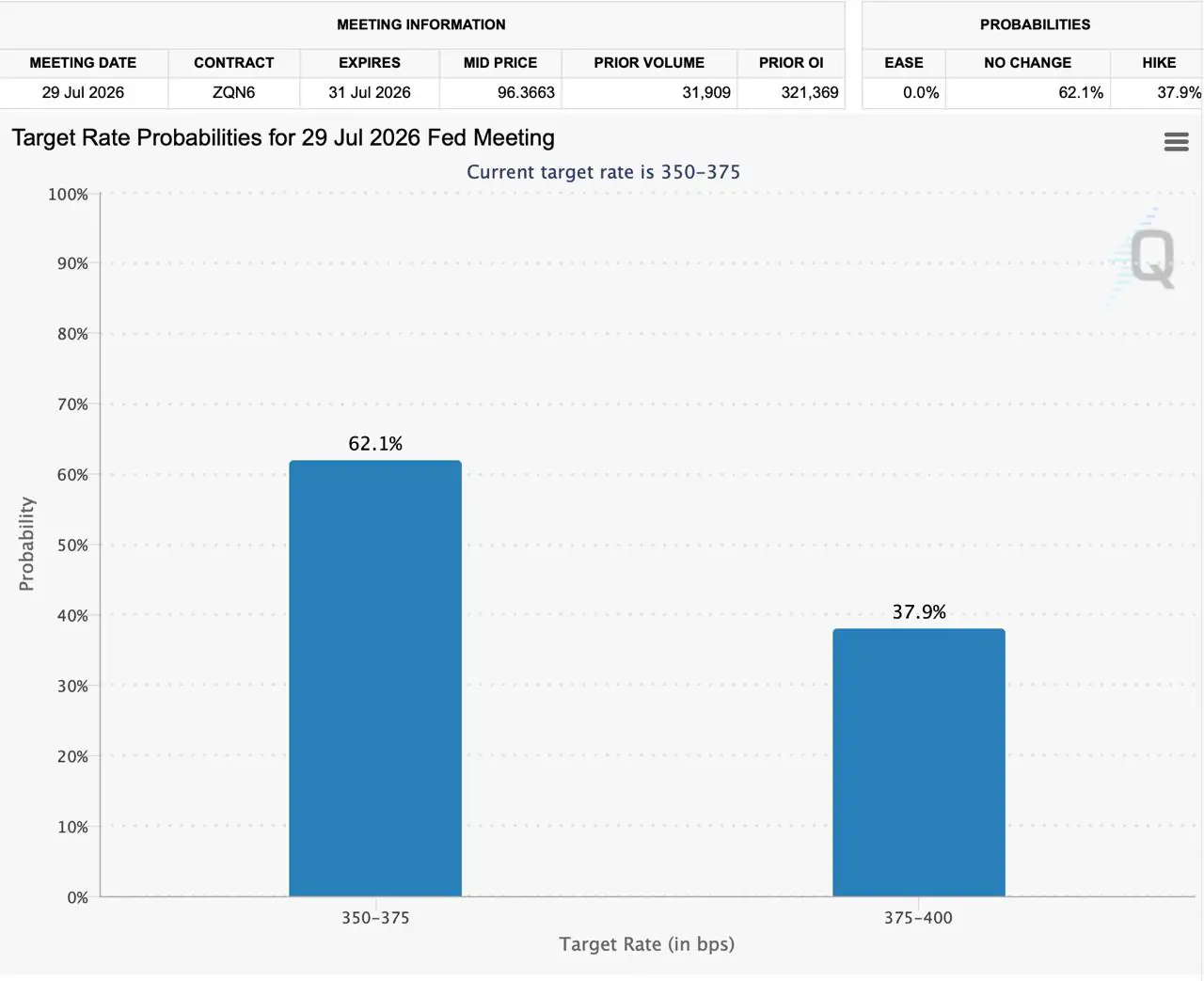
That pricing matters for how the BOJ decision lands. A US hike would widen the rate gap and cushion the yen against hawkish Japanese guidance two days later. A hold accompanied by softer language would leave the yen more exposed to whatever the BOJ signals.
July is a non-projection meeting, so there will be no updated dot plot. Markets will instead focus on the statement and Chair Kevin Warsh’s press conference.
The wide gap between US and Japanese rates helps preserve the appeal of borrowing in yen and investing in higher-yielding dollar assets. USD/JPY responds to expectations for both central banks, and yen weakness through 2026 has tracked the US path as closely as the Japanese one.
A hawkish Fed supports the dollar and softens the effect of stricter BOJ guidance. A more dovish Fed makes a hawkish signal from Japan more powerful by favouring yen appreciation from both sides of the exchange rate.
How the Yen Carry Trade Reaches Bitcoin
The yen carry trade involves borrowing in Japan at comparatively low rates, converting the funds into another currency and investing in assets offering higher potential returns.
The position remains attractive while Japanese funding stays cheap and the yen fails to strengthen enough to erase the investment gain. When rate expectations rise or the currency appreciates sharply, those trades become less profitable and often need to be reduced.
Bitcoin feels the effect without ever being purchased with borrowed yen. Such financing is used across equities, bonds, currencies and derivatives, so when losses or margin requirements increase, funds sell liquid assets across their portfolios.
Institutional carry positions take days or weeks to unwind. Crypto derivatives react faster, since leveraged perpetual positions are liquidated within hours once prices move against crowded traders. We documented that pattern in March, when a single risk-off session wiped out $588 million in crypto positions, roughly $493 million of it long.
Bitcoin is particularly exposed during those periods because it trades continuously and can be sold while traditional markets are closed. James Butterfill, CoinShares’ head of research, described carry-trade reversals as global liquidity shocks rather than isolated currency events.
The greatest risk emerges when Japanese rate expectations rise, the yen strengthens and leveraged investors begin cutting positions at the same time.
Four Ways the BOJ Decision Could Play Out
BOJ Outcomes and the Likely Bitcoin Impact
| Scenario | Likelihood | Policy Outcome | Yen / Bond Reaction | Bitcoin & Risk Asset Impact |
|---|---|---|---|---|
| Balanced Hold | Most likely | Rates at 1%; future moves left dependent on inflation, wages and growth | Reverses part of the recent yen strength and bond-yield rise | Neutral; Fed decision, ETF flows and market structure take over |
| Hawkish Hold | Live risk | Rates at 1%; growth forecast lifted, inflation-overshoot warning retained | Yen strengthens; next hike priced forward from December to October or September | Negative if derivatives leverage is elevated when the report lands |
| Surprise Hike | Least likely | Rates unexpectedly raised to 1.25% | Rapid yen rally; Japanese bond yields move sharply higher | Clearest downside; forced selling appears fast in round-the-clock crypto markets |
| Dovish Hold | Possible | Rates at 1%; weak consumption and softer core inflation emphasised | Yen weakens; cheap funding preserved | Short-term support, with higher intervention risk later |
Rates Stay at 1% With Balanced Guidance
This probably remains the most likely and least disruptive result.
The BOJ leaves future moves dependent on inflation, wages and growth without indicating that the next hike is imminent. A cautious Outlook Report would probably reverse part of the yen strength and bond-yield rise seen this week.
Bitcoin then might respond more to the Federal Reserve’s decision, ETF flows and its own market structure than to Japan.
Rates Stay at 1% With a Hawkish Outlook
An unchanged rate still pressures risk assets if the BOJ lifts its growth forecast, retains its inflation-overshoot warning or suggests that the interval between hikes may shorten.
Traders would pull expectations for the next move forward from December towards October or September. That supports the yen and raises the cost of maintaining short-yen positions.
An official BOJ document carries more weight than a report based on unnamed sources, so the reaction would likely exceed what markets showed on July 22. Bitcoin’s response depends heavily on how much leverage sits in derivatives markets when the announcement arrives.
The BOJ Unexpectedly Raises Rates to 1.25%
This is the least likely outcome and the clearest short-term downside risk.
Markets have largely priced out a July move, the bank acted only in June, and BOJ decisions are normally prepared through public communication. Political pressure for a gentler path further reduces the incentive to surprise investors.
That positioning is what would make an unexpected hike disruptive. Markets would need to reassess both the current rate and the timing of future tightening, producing a rapid yen rally and higher Japanese bond yields.
Forced selling might appear quickly in Bitcoin because crypto markets remain open around the clock.
A Dovish Hold Delays the Next Move
The BOJ emphasises weak consumption, economic uncertainty or the recent softening in core inflation.
That could weaken the yen and preserve cheap funding, offering short-term support to Bitcoin and other risk assets.
Further currency depreciation carries a later cost. Higher import prices increase political pressure and raise the probability of a stronger response from either the BOJ or Japan’s Ministry of Finance.
Currency Intervention Remains a Separate Risk
Foreign-exchange intervention is authorised by the Ministry of Finance and executed by the BOJ as its agent. It requires no monetary policy meeting and arrives without advance notice.
Finance Minister Satsuki Katayama has repeatedly warned against excessive currency moves as the yen weakened during 2026. A confirmed intervention would produce a sharp appreciation within minutes.
For Bitcoin, the immediate effect resembles a surprise rate hike. A sudden yen rally places pressure on leveraged carry positions even while the policy rate stays unchanged.
A dovish BOJ decision therefore lowers the immediate rate risk while raising the chance of intervention if USD/JPY climbs further.
July 2024 Shows How an Unwind Can Escalate
The BOJ raised its policy rate to 0.25% on July 31, 2024, alongside a plan to reduce purchases of Japanese government bonds.
The yen had already begun strengthening, and the decision accelerated the change in rate expectations. Investors started cutting leveraged positions financed in the Japanese currency.
Pressure intensified days later when weak US employment data triggered the Sahm Rule recession indicator, alongside soft manufacturing figures. Bitcoin fell more than 15% on August 5 and briefly traded below $50,000, while equities and other cryptocurrencies also declined.
Describing the event as a BOJ-driven Bitcoin crash would leave out important causes. The rate hike, yen appreciation, US recession fears and crowded positioning arrived within the same period.
Bitcoin’s worst week of 2026 followed the same shape, with ETF outflows, forced liquidations and a macro rotation hitting at once.
The broader crypto sell-off reflected a global retreat from risk, with the carry-trade reversal amplifying pressure that weak US data had already created.
January 2025 Shows Why Expectations Matter
The BOJ raised its policy rate to 0.5% on January 24, 2025. Unlike the July 2024 move, the increase had been clearly signalled and was widely anticipated.
The yen strengthened while global risk markets absorbed the decision without widespread forced selling. Bitcoin traded near $105,000 and was approximately 1.8% higher later that day, according to Reuters market data.
Changes in US cryptocurrency policy also supported Bitcoin, so the BOJ decision worked alongside other influences. The comparison still holds: a Japanese rate rise on its own rarely produces a crypto sell-off. Our review of how Bitcoin reacted through the 2022-2023 Fed hiking cycle found the same pattern in the United States, where positioning ahead of each meeting shaped the response more than the policy outcome itself.
The result depends on how much of the move has already been priced, how strongly the yen responds and whether leveraged positions are forced to close.
What to Watch During the Meeting
- USD/JPY: A sharp decline would signal yen strength and pressure on short-yen positions.
- Japanese two-year yields: These reflect expectations for the BOJ’s near-term policy path.
- Bitcoin open interest: Elevated positioning would increase the risk of forced liquidations.
- Funding rates: Extreme readings would reveal crowded directional exposure.
- Global equities: A simultaneous decline would support a broader deleveraging explanation.
A Bitcoin decline accompanied by falling open interest suggests positions are being closed or liquidated. Weakness with open interest still rising indicates traders adding new bearish exposure.
What Determines the Reaction
July 2024 showed how a yen rally amplifies broader selling when leverage is high and other macroeconomic concerns are already present. January 2025 showed that a well-telegraphed hike passes without a Bitcoin decline.
This meeting arrives with the yen near multi-decade lows, a Fed decision two days earlier, fresh reporting that the bank may move faster than expected, a government pulling against the pace, and an intervention risk that needs no meeting at all. Whether July 31 registers as a routine policy update or a broader liquidity shock depends on the surprise, the yen’s response and the leverage built around the decision.
- Disclaimer: This article is for informational and analytical purposes only and does not constitute financial or investment advice. Central-bank decisions can produce sudden volatility, while historical market reactions do not guarantee similar future results.
- Methodology: Meeting dates, policy rates and official guidance are sourced from the Bank of Japan and the Federal Reserve. The July 22 report on the BOJ’s openness to faster tightening is based on Bloomberg reporting using unnamed sources and has not been confirmed by the bank. Political context and market expectations use Reuters reporting, while the crypto liquidity assessment references CoinShares research. Market levels are stated as of July 27, 2026.



Kosta has reported on cryptocurrency markets and blockchain infrastructure since 2020, bringing over six years of hands-on experience in the crypto industry built through daily tracking of markets, trends, and emerging blockchain developments. Specializing in Bitcoin on-chain analysis, institutional ETF flows, and digital asset price action, his work at Coindoo has been cited by other news agencies and consistently covers market developments with a focus on data-driven reporting across Bitcoin, Ethereum, Solana, and XRP. Over the years, Kosta has contributed to multiple crypto media outlets in different regions, authoring over 6,000 articles across the sector. His reporting spans cryptocurrency markets and the broader fintech industry, tracking not only price action but also the technological and regulatory forces shaping the ecosystem. To support his analysis, Kosta actively leverages on-chain data and metrics from leading platforms such as Santiment, Glassnode, and CryptoQuant, enabling deeper, evidence-based market insights. He believes in the power of transparency and the data that underpins the blockchain ecosystem. His academic background in Marketing Management from Denmark further complements his analytical approach, adding a strong understanding of communication strategy and content positioning to his work.