Gold Bubble Is Growing – Here’s When It Might Burst

Gold’s record-breaking surge has turned into one of the most puzzling stories in global markets this year. Every possible risk seems to push investors toward the yellow metal.

Whether it’s talk of a U.S. government shutdown, growing expectations of rate cuts by the Federal Reserve, or the ongoing conflicts reshaping global trade, gold has become the universal answer to uncertainty. Even crypto traders – once devoted to digital assets as the ultimate hedge – are now diversifying into gold and silver, believing that whatever happens, these metals remain the safest bet in a chaotic world.
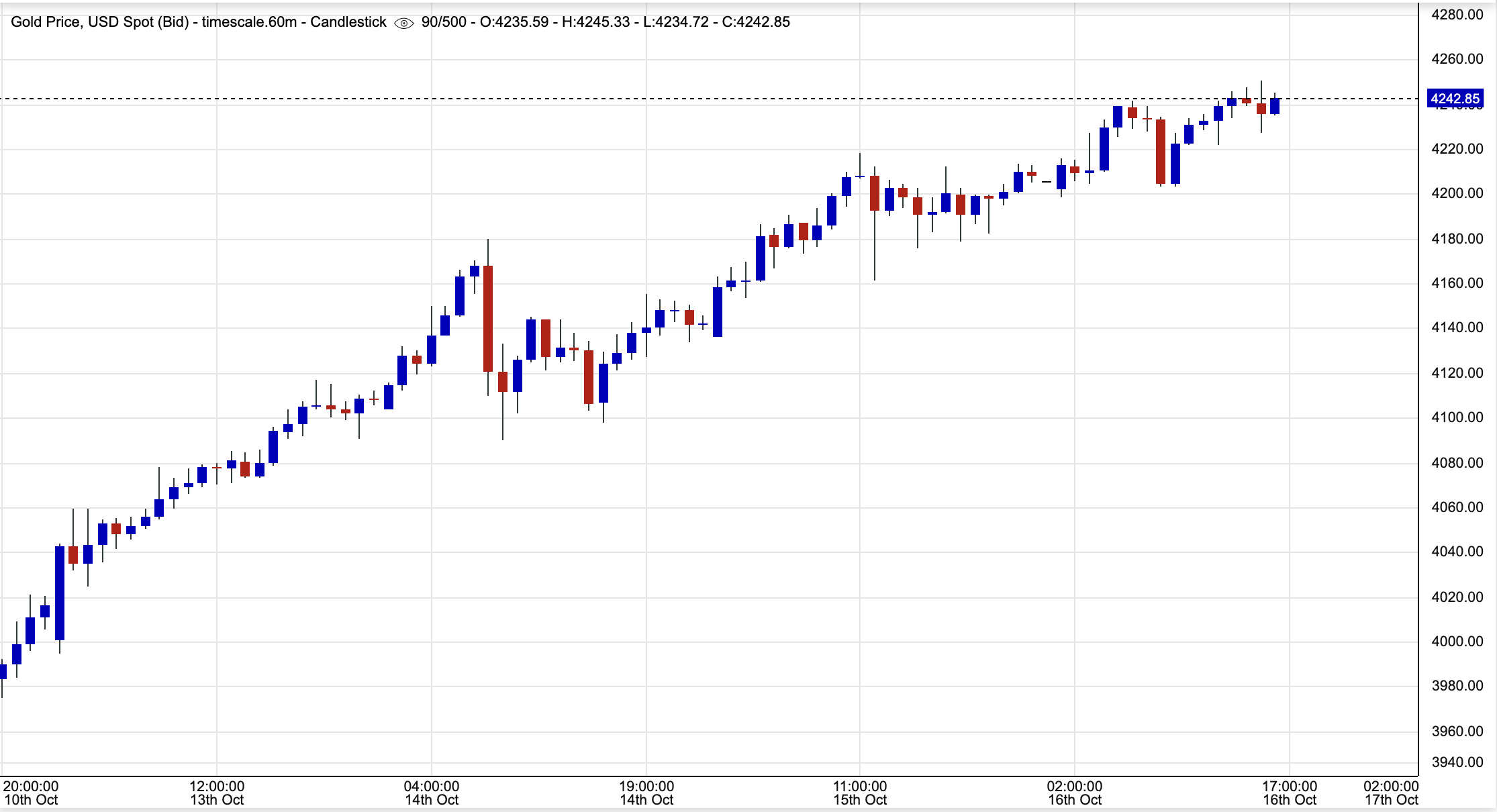
The problem is that this kind of confidence often marks the late stages of a boom. Gold has torn past previous milestones, now trading around $4,300 an ounce — a level once thought unreachable. No one seems entirely sure what’s fueling the rally anymore. Traditional correlations such as interest rates cuts or oil prices no longer explain the movement. Analysts and investors have created their own stories – “debasement trade,” “systemic insurance,” “AI uncertainty” – all trying to rationalize a price that may have escaped fundamental gravity.
From Safe Haven to Speculative Frenzy
Every gold rush begins with a genuine reason to seek safety. In the late 1970s, it was inflation and political upheaval. In 2008, it was the global financial crisis. Today, it’s a mix of geopolitical tension, technological anxiety, and monetary fatigue. Central banks have kept liquidity flowing for years, governments are piling up debt, and the fear of systemic failure lingers in the background. Against that backdrop, owning gold feels like owning peace of mind.
But markets are built on psychology, not peace. As prices climb, more investors join simply because “number go up.” Bloomberg’s analysis describes this perfectly – the higher gold rises, the more creative the explanations become, until eventually investors are buying the narrative itself rather than the asset. Once that happens, the line between protection and speculation disappears, and what began as insurance becomes a bubble.
The Third Great Gold Bubble
History has seen this pattern twice before. The first gold bubble in 1980 ended with a violent collapse that took two decades to recover. The second, which peaked in 2011, was followed by years of stagnation. Many now suspect we’re witnessing the third act. The latest rally began in 2018, cooled briefly, and then reignited with unstoppable force in 2024, boosted by central bank purchases and global instability.
What makes this moment unique is the breadth of belief. Retail investors, sovereign funds, and even digital-asset enthusiasts are all convinced that gold can only go higher. It’s not just a hedge anymore – it’s become a symbol of resilience. But bubbles thrive on collective conviction, and the stronger that belief grows, the more fragile it becomes when conditions shift.
Warning Signs From Market Analysts
Not everyone sees gold’s rally as sustainable. Prominent market analyst Michaël van de Poppe recently pointed out that gold’s current chart resembles Bitcoin’s parabolic surges in 2017 and 2021 – both of which ended in brutal corrections. He noted that retail investors are now piling into gold with the same mindset crypto traders had at Bitcoin’s peaks: convinced that prices can’t fall, until they suddenly do.
Van de Poppe described the current trend as “absolutely beyond insanity,” highlighting how the gold chart has gone “literally vertical.” According to him, this may well be the biggest bull run in history for the metal – and the most dangerous. His warning echoes the psychology of every speculative mania: when prices rise too far, too fast, and everyone starts believing this time is different.
When the Bubble Could Pop
Every mania eventually meets its turning point, and this one might hinge on geopolitics. A breakthrough in U.S.-China relations could serve as the pressure release. If trade negotiations calm global fears and restore faith in economic stability, investors will start moving back into risk assets. Similarly, if the U.S. government resolves its budget battles and fiscal confidence returns, the panic premium in gold could quickly erode.
Another warning sign may come from within the market itself. Veteran gold investors – the kind who held through past cycles – are already reducing exposure and taking profits on speculative positions. They see the rally as justified but overheated, and prefer to step aside before the inevitable correction. That doesn’t mean gold will collapse overnight, but the possibility of a sharp 20-30% retracement cannot be dismissed.
The Price of Fear
Gold has always been the ultimate reflection of anxiety. It rises when the world feels uncertain and stalls when optimism returns. Today’s environment, filled with political gridlock, economic slowdown fears, and endless conflict headlines, provides perfect fuel for the metal’s ascent. But once the fear begins to fade – once the trade war cools and governments prove functional again – the emotional charge that drives the market will fade too.
For now, the world’s favorite hedge remains on fire. Yet beneath the glitter, the warning signs are clear. Every investor who believes gold is infallible is helping build the very bubble that will one day burst. The question is not if that moment comes, but when stability finally becomes more valuable than fear.
The information provided in this article is for educational purposes only and does not constitute financial, investment, or trading advice. Coindoo.com does not endorse or recommend any specific investment strategy or cryptocurrency. Always conduct your own research and consult with a licensed financial advisor before making any investment decisions.



Alex is Editor-in-Chief of Coindoo and co-founder of Millennial Media Group, with nearly a decade of experience covering financial markets - crypto first, then everything else. It started in 2016 with Bitcoin. Like most people at the time, he didn't fully understand it - so he kept digging. Blockchain, tokenomics, the projects, the cycles. That curiosity never stopped, and eventually pulled him into traditional markets too: equities, commodities, macro. Not because he left crypto behind, but because you can't properly understand one without the other. What drives him is straightforward: he wants to know why something is happening, not just that it's happening. Most market coverage stops at the headline - price up, price down, here's a chart. Alex finds that kind of reporting actively unhelpful. If you walk away from an article without understanding the mechanism behind the move, what did you actually learn? He holds a degree in Tourism from New Bulgarian University - not the most obvious path into financial markets, but markets have a way of pulling in people who are simply too curious to stay out. He has authored over 200 in-depth analyses and more than 10,000 articles across crypto and traditional finance. He still thinks every day in markets teaches him something new. That's probably why he hasn't stopped.