Crypto Prices Fall After US Jobs Report – Bitcoin Dips Under $79.5K
Bitcoin fell below $80,000 and Ethereum slipped under $2,500 after unexpectedly strong US employment data increased the prospect of tighter Federal Reserve policy.
Key Takeaways
- US payroll growth sharply exceeded expectations.
- Bitcoin retreated below the $80,000 level.
- Ethereum fell back beneath $2,500.
- Stronger employment raised interest-rate risk.
- August inflation remains the decisive test.
Crypto reverses as payroll growth surprises markets
Crypto prices gave back part of their earlier advance after the latest US employment report challenged expectations that monetary policy could soon become less restrictive.
Bitcoin traded near $79,440 at the time of writing, according to CoinMarketCap data, putting it back below $80,000. Ethereum fell to approximately $2,454 and surrendered the $2,500 level.
Zcash fell below $1,000 after the sharp advance examined in this recent Zcash price analysis. XRP, Solana and Chainlink were also lower in CoinMarketCap’s short-term reading. However, Bitcoin, Ethereum and several other assets remained positive over the preceding 24 hours.
The market was therefore reversing part of an earlier advance rather than entering a full-day collapse. That distinction matters after the broad recovery examined in the recent crypto market rally analysis. Holding that recovery now requires Bitcoin to reclaim $80,000 despite the increase in expected borrowing costs.
US employers added 162,000 jobs in August
The US Bureau of Labor Statistics reported that nonfarm payroll employment increased by 162,000 in August. Economists surveyed by Reuters had expected an increase of only 56,000.
Earlier estimates were also revised upward. June’s gain increased from 20,000 to 31,000, while July changed from a reported loss of 23,000 jobs to a gain of 21,000. The revisions added a combined 55,000 positions to the previous two months.
Unemployment remained at 4.1%, and labor-force participation edged up from 61.4% to 61.6%. Together, those figures showed that the labor market had performed considerably better than investors anticipated.
Wages supplied the report’s main moderating detail. Average hourly earnings increased by 0.3% during August and 3.1% from a year earlier. Stronger hiring therefore did not arrive with a new acceleration in annual wage growth.
Why the payroll surprise pressured crypto
Employment data reach crypto through monetary policy rather than through Bitcoin’s underlying network or adoption. A resilient labor market gives the Federal Reserve more room to concentrate on inflation without needing to support employment by holding rates down.
That possibility can push short-term Treasury yields higher as traders demand greater returns from bonds maturing around future policy decisions. Higher yields make government debt more competitive with riskier assets, while tighter borrowing conditions increase the cost of maintaining leveraged positions.
The dollar can also strengthen when investors expect US rates to stay elevated. Because cryptocurrencies trade globally against the dollar, a stronger currency can make dollar-denominated assets more expensive for buyers outside the United States and produce less favorable liquidity conditions.
The synchronized decline across major tokens was consistent with a broader repricing of US interest-rate risk.

Warsh and Waller have left September unresolved
That repricing matters because Federal Reserve officials entered the employment report divided over whether persistent inflation justified another increase.
Chair Kevin Warsh placed a September hike firmly in consideration during his official Jackson Hole address. Warsh said policymakers must be confident that inflation is returning to the 2% objective at sufficient speed. Otherwise, he said, the Fed had “work to do.”
Governor Christopher Waller took a more patient position in his September 3 remarks. He said recent inflation readings showed signs of improvement and that he would be inclined to support holding rates steady if the trend continued.
Waller nevertheless left room to vote for a hike if the August inflation data showed that the improvement had been temporary. He also said inflation, rather than employment, would heavily influence his decision because economic activity and the labor market were already in satisfactory condition.
Argument for raising rates
Strong employment gives the Fed room to address inflation without responding to immediate weakness in the labor market.
Argument for holding rates
Continued progress on inflation could justify waiting another meeting instead of tightening policy immediately.
The employment release gives officials favoring tighter policy additional support, but it does not settle the meeting.
Futures markets nevertheless leaned toward a hike. At the time of writing, the CME FedWatch Tool assigned a 60.2% probability to a 25-basis-point increase on September 16, which would lift the target range from 3.50%-3.75% to 3.75%-4.00%. The remaining 39.8% pointed to no change, with no probability assigned to a rate reduction.
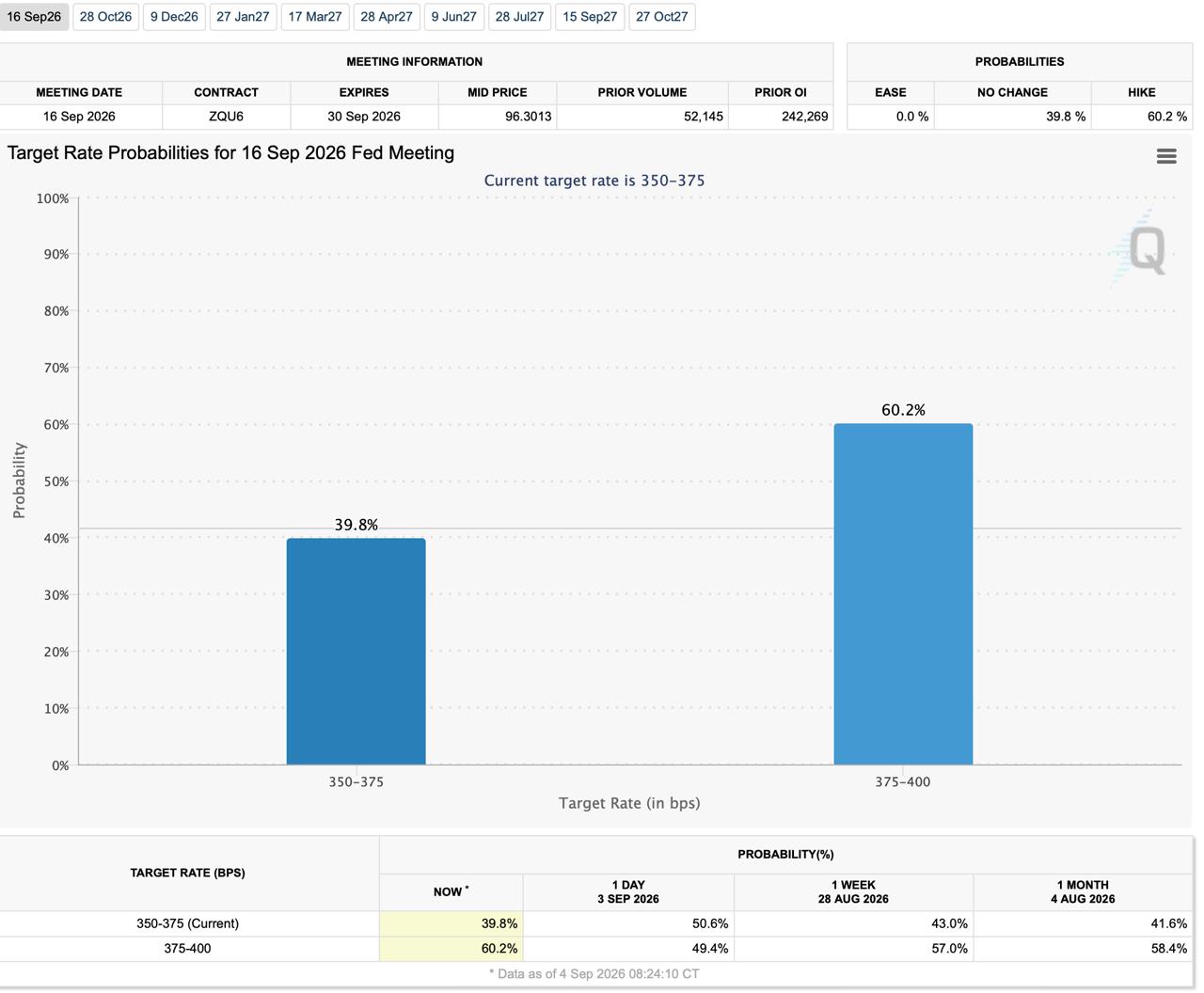
FedWatch calculates its probabilities from 30-day federal funds futures, so the figures reflect market positioning rather than a Federal Reserve forecast. The 60.2% reading is the market’s pre-CPI baseline and could change substantially after the August inflation report.
August CPI becomes the key remaining test
The next two dates
September 11: The Bureau of Labor Statistics publishes the August Consumer Price Index.
September 16: The Federal Reserve announces its decision after a two-day policy meeting.
A firm CPI reading would combine persistent price pressure with employment strong enough to give policymakers room to respond. That combination would reinforce expectations for a hike and could keep pressure on crypto through higher yields, a stronger dollar and more expensive leverage.
Softer inflation would weaken that interpretation. It would allow officials such as Waller to argue that price pressures are easing without help from another increase, even as employment remains stable.
Bitcoin’s first test is whether it can reclaim and hold $80,000 after the initial repricing. CPI will then show whether the 60.2% hike probability has room to rise or whether easing inflation can revive the interrupted crypto recovery.
The article is provided for informational purposes only and does not constitute investment advice.



Kosta has reported on cryptocurrency markets and blockchain infrastructure since 2020, bringing over six years of hands-on experience in the crypto industry built through daily tracking of markets, trends, and emerging blockchain developments. Specializing in Bitcoin on-chain analysis, institutional ETF flows, and digital asset price action, his work at Coindoo has been cited by other news agencies and consistently covers market developments with a focus on data-driven reporting across Bitcoin, Ethereum, Solana, and XRP. Over the years, Kosta has contributed to multiple crypto media outlets in different regions, authoring over 6,000 articles across the sector. His reporting spans cryptocurrency markets and the broader fintech industry, tracking not only price action but also the technological and regulatory forces shaping the ecosystem. To support his analysis, Kosta actively leverages on-chain data and metrics from leading platforms such as Santiment, Glassnode, and CryptoQuant, enabling deeper, evidence-based market insights. He believes in the power of transparency and the data that underpins the blockchain ecosystem. His academic background in Marketing Management from Denmark further complements his analytical approach, adding a strong understanding of communication strategy and content positioning to his work.