Zcash Price Jumps 16% as Rally Pushes Toward $1,000
Zcash is closing in on $1,000 after a sharp rally, but the scale of futures positioning raises a crucial question: can spot demand sustain the breakout?
Key Takeaways
- ZEC jumped 16% on September 3.
- Futures activity dwarfs spot volume.
- Open interest reaches $2.15 billion.
- Grayscale renews focus on privacy.
- $1,000 is the key test.
Zcash jumps 16% as ZEC nears $1,000
Zcash was among the strongest performers in the latest crypto rebound after ZEC jumped around 16% on September 3.
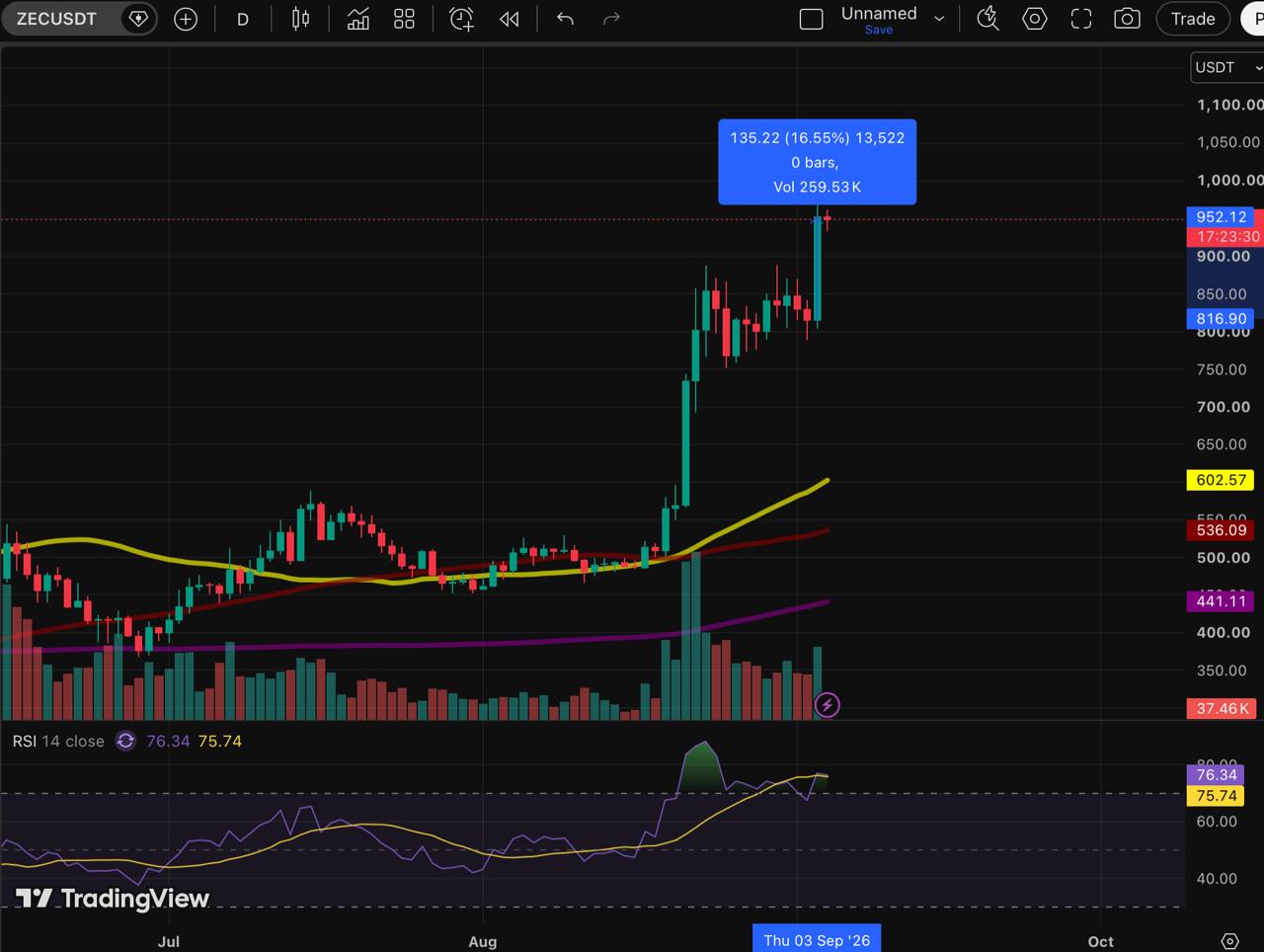
The token climbed from the low-$800s toward $950, with the latest chart showing a recent peak at $952. That level is now the immediate resistance to watch, as a clean break and close above it would put the psychological $1,000 mark firmly in focus.
The rally also has two important levels beneath it. The first is $850, which could offer some near-term support if ZEC pulls back modestly. Below that sits $815, the more important structural base where the price previously consolidated before the latest advance.
The broader market has also turned higher, as noted in our analysis of the crypto rebound, which highlights several levels now shaping market sentiment.
For ZEC, however, the immediate focus is narrower: whether buyers can push through $952 and keep the rally intact without giving up the support levels that have formed underneath it.
The other standout feature is the size of the derivatives market behind the rally.
Derivatives are driving most of the activity
Current market data shows that derivatives are playing a much larger role in the ZEC rally than spot trading. The difference is substantial, with futures turnover running more than 11 times above spot volume.
Spot volume
$570 million
Futures volume
$6.38 billion
Open interest
$2.15 billion
Open interest is the amount of futures exposure that remains open; it does not show whether traders are betting on higher or lower prices. Its size does, however, show that the rally is unfolding alongside significant derivatives positioning.
That makes spot demand important to watch from here. If buying in the underlying market picks up, the advance would have stronger confirmation. A sharp reversal could also force positions to be reduced, adding to price volatility.
Grayscale puts Zcash privacy back in focus
The derivatives data explains how much positioning sits behind ZEC’s move. Grayscale’s August 31 Zcash research note explains why the token’s privacy features have returned to the market’s attention.
Zach Pandl, Grayscale’s Head of Research, argued that artificial intelligence can make it faster and cheaper to connect pseudonymous blockchain addresses with exchange records, wallet behaviour and off-chain information. For users who prioritise financial privacy, he wrote, that could become a “must have” feature.
Zcash’s case is not that every transaction must be hidden. The network supports both transparent and shielded transfers. Its shielded option uses zero-knowledge proofs to verify that a transaction is valid without publicly revealing the sender, recipient or amount.
That gives users a choice that fully transparent ledgers do not: they can retain public transaction visibility when it is useful, or use shielded transfers when they need stronger privacy. It also helps explain why Zcash stands apart from a typical momentum trade, even though there is no evidence that Grayscale’s report directly caused the September 3 rally.
$1,000 is now the market’s test
ZEC is trading close enough to $1,000 for the next stage of the rally to depend on how the token handles that level.
A brief move above $1,000 would be less convincing than a breakout that holds after successful retes.
The spot-futures gap becomes especially important here. Futures turnover is already more than 11 times reported spot volume, while open interest remains near $2.15 billion.
A breakout backed by stronger spot trading would provide broader confirmation. A failure near $1,000, particularly with substantial positions still outstanding, could leave ZEC more exposed to sharp swings.
The article is provided for informational purposes only and does not constitute investment advice.



Alex is Editor-in-Chief of Coindoo and co-founder of Millennial Media Group, with nearly a decade of experience covering financial markets - crypto first, then everything else. It started in 2016 with Bitcoin. Like most people at the time, he didn't fully understand it - so he kept digging. Blockchain, tokenomics, the projects, the cycles. That curiosity never stopped, and eventually pulled him into traditional markets too: equities, commodities, macro. Not because he left crypto behind, but because you can't properly understand one without the other. What drives him is straightforward: he wants to know why something is happening, not just that it's happening. Most market coverage stops at the headline - price up, price down, here's a chart. Alex finds that kind of reporting actively unhelpful. If you walk away from an article without understanding the mechanism behind the move, what did you actually learn? He holds a degree in Tourism from New Bulgarian University - not the most obvious path into financial markets, but markets have a way of pulling in people who are simply too curious to stay out. He has authored over 200 in-depth analyses and more than 10,000 articles across crypto and traditional finance. He still thinks every day in markets teaches him something new. That's probably why he hasn't stopped.