Crypto and Gold Rise as US Treasury Doubles Long-Bond Buybacks

The US Treasury will at least double the maximum size of buyback operations for older long-dated bonds, expanding a programme designed to make that part of the government-debt market easier to trade.
Key Takeaways
- Treasury raises long-end buyback ceiling to $4B.
- Expanded operations begin on September 9.
- Bitcoin and Ethereum gained in supplied snapshot.
- Solana and Zcash led hourly gains.
- Gold’s daily chart gained 3.4%.
Treasury announced that it will raise the maximum purchase amount for 10-to-20-year and 20-to-30-year nominal coupon securities from $2 billion to at least $4 billion per operation. The expanded limits take effect on September 9 and remain in place through November 4.
CNBC reported that long-term yields fell after the news. The supplied market snapshots also showed broad crypto gains and a sharp daily rise in gold. The announcement offers one clear channel between those moves: lower Treasury yields can improve risk appetite while reducing the income investors give up by holding gold.
Treasury raised the ceiling for long-end buybacks
The change applies to outstanding nominal coupon bonds in the 10-to-20-year and 20-to-30-year maturity sectors. Treasury cited consistent market participation and a significant volume of high-quality offers in these operations as the reason for increasing the limit.
Its buyback framework is intended to support liquidity in off-the-run securities, older issues that can trade less actively than the newest benchmark bonds. A regular buyer gives dealers and investors another route to sell eligible holdings, which can make them more willing to trade those securities in the first place.
The announcement sets a maximum, not a guaranteed purchase amount. Treasury still decides which offers to accept and how much to buy in each operation.
These buybacks are Treasury debt-management operations. The release does not announce Federal Reserve asset purchases or a specific funding mix for the programme. The expanded limits therefore should not be treated as a new round of quantitative easing.
Why long-term yields fell before September 9
Markets did not need to wait for the first expanded operation to price in the change. The prospect of higher Treasury demand can support the prices of eligible long-dated bonds. Because bond prices and yields move in opposite directions, that expectation can push yields lower immediately.
The effect is concentrated in the securities Treasury can buy, but the long end of the yield curve influences borrowing costs and portfolio decisions across financial markets. A fall in those yields makes the return on government debt less competitive against assets that carry more risk or pay no income.
Crypto gains extended beyond Bitcoin
The supplied CoinMarketCap screen showed positive one-hour and 24-hour changes across the major crypto assets. The figures below are a market snapshot from the supplied image and will change as prices move.
| Asset | Price | 1h change | 24h change |
|---|---|---|---|
| Bitcoin | $65,8865 | +1.4% | +1.8% |
| Ethereum | $1,965 | +1.8% | +2.7% |
| XRP | $1.03 | +1.6% | +3.15% |
| Solana | $80.8 | +3% | +5.2% |
| Hyperliquid | $59.8 | +1.9% | +1% |
| Dogecoin | $0.07125 | +1.15% | +1.75% |
| Zcash | $539 | +4.5% | +6.5% |
Why gold joined the move
TradingView chart showed gold up 3.4% on the day, trading at $4,483 per ounce at 11:02 a.m. EDT on August 19.
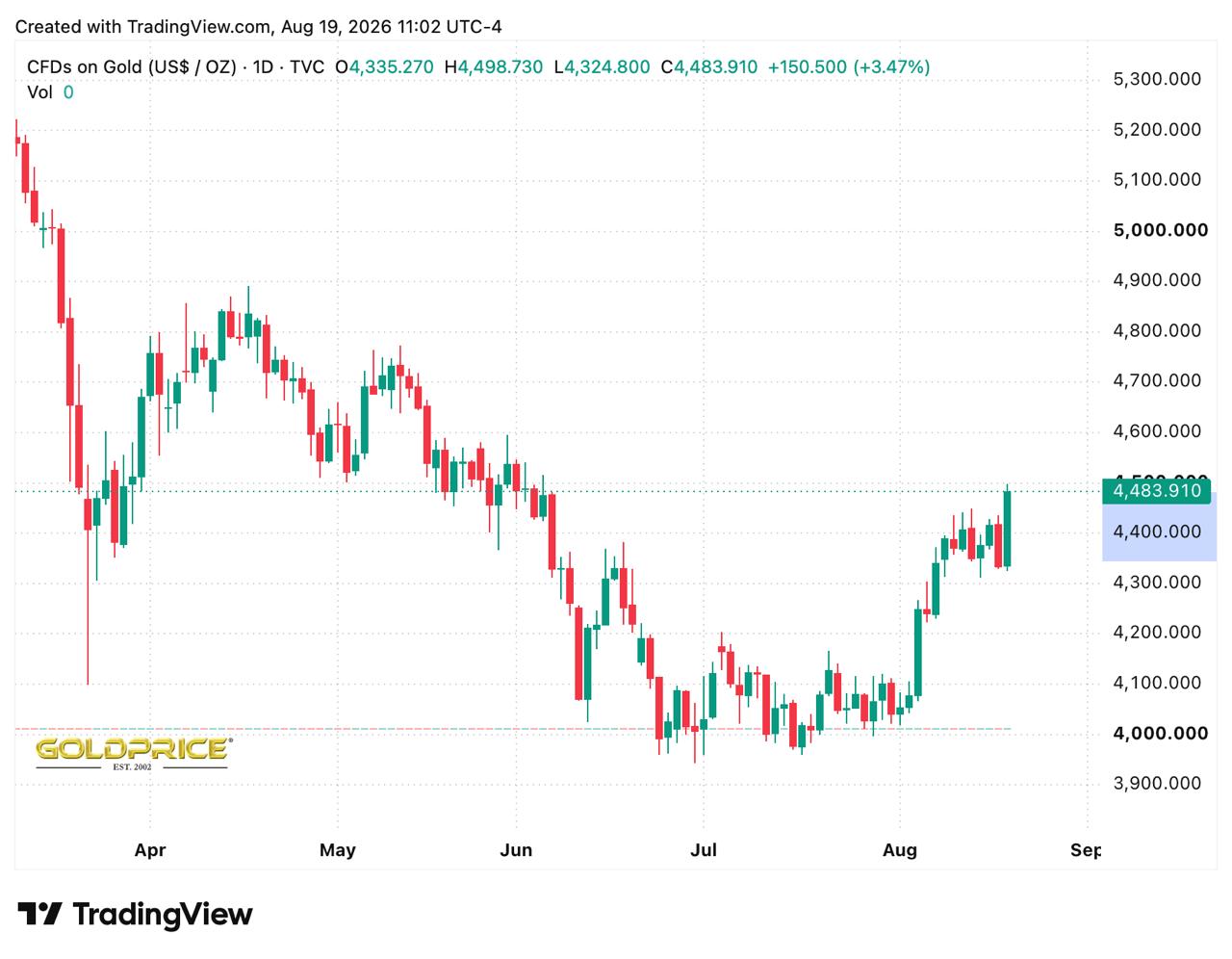
Gold does not pay interest. A decline in Treasury yields lowers the income an investor gives up by owning gold rather than government debt, which can make the metal more attractive.
Gold buyers may also be focused on the debt-market backdrop. Treasury is increasing support for trading older long-dated bonds at a time when the size, maturity and cost of US government borrowing remain central macroeconomic questions. That broader link between yields, fiscal concerns and Bitcoin demand was also explored in BlackRock’s explanation of the forces behind Bitcoin’s 53% decline.

Peter Schiff sees an inflation risk
Peter Schiff argued that Treasury is stepping in because private investors do not want to hold more long-term debt. He expects the eventual financing burden to raise interest costs, increase pressure for Federal Reserve money creation and fuel inflation. Schiff pointed to gold’s rise as evidence that the market shares that concern.
Treasury just announced that it will buy more long-term Treasuries private investors no longer want to hold to try to keep yields from rising. The money to pay for it will ultimately be created by the Fed, sending inflation soaring. That’s why gold is already up $125 on the news!
— Peter Schiff (@PeterSchiff) August 19, 2026
That is an interpretation, rather than a feature of the announced programme. Treasury did not disclose a new short-term issuance plan to finance these purchases, and a long-bond buyback by itself does not reveal how the department will manage future borrowing. Schiff’s view explains one reason gold investors may see the news differently from bond traders: the same policy can improve trading liquidity today while keeping attention on the longer-term cost of US debt.
The first enlarged operations are the next test
Treasury will release an updated schedule before the expanded operations begin. The useful evidence will come from what it actually accepts, how long-dated yields behave after September 9 and whether the market reaction holds once the headline has passed.
- Accepted buyback offers: The $4 billion figure is a ceiling; the amounts Treasury purchases will show how heavily the programme is used.
- Long-end yields: A sustained decline after the first operations would show that the additional capacity is affecting market conditions beyond the initial announcement.
- Crypto breadth: Continued strength in Bitcoin, Ethereum and the CMC20 index would be more meaningful than a move limited to a small group of high-volatility tokens.
- Gold’s follow-through: A persistent rally would suggest that lower yields and fiscal concerns are continuing to support demand for the metal.
The immediate reaction shows why Treasury-market operations can reach far beyond government bonds. Yields shape the return available from safe assets, which influences risk appetite in crypto and the appeal of gold. The next operations will show whether today’s move was a short-lived response to a headline or the start of a broader shift in financial conditions.
Source review: Treasury’s buyback terms are based on its August 19, 2026 release and official buyback FAQ. CNBC reported the immediate movement in long-term yields. Crypto figures are taken from the supplied CoinMarketCap snapshot, while gold figures are taken from the supplied TradingView chart. Peter Schiff’s comments are his opinion. The article is provided for informational purposes only and does not constitute investment advice.



Kosta has reported on cryptocurrency markets and blockchain infrastructure since 2020, bringing over six years of hands-on experience in the crypto industry built through daily tracking of markets, trends, and emerging blockchain developments. Specializing in Bitcoin on-chain analysis, institutional ETF flows, and digital asset price action, his work at Coindoo has been cited by other news agencies and consistently covers market developments with a focus on data-driven reporting across Bitcoin, Ethereum, Solana, and XRP. Over the years, Kosta has contributed to multiple crypto media outlets in different regions, authoring over 6,000 articles across the sector. His reporting spans cryptocurrency markets and the broader fintech industry, tracking not only price action but also the technological and regulatory forces shaping the ecosystem. To support his analysis, Kosta actively leverages on-chain data and metrics from leading platforms such as Santiment, Glassnode, and CryptoQuant, enabling deeper, evidence-based market insights. He believes in the power of transparency and the data that underpins the blockchain ecosystem. His academic background in Marketing Management from Denmark further complements his analytical approach, adding a strong understanding of communication strategy and content positioning to his work.