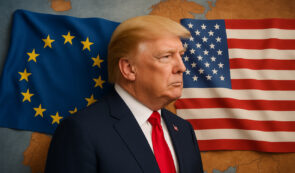
European lawmakers have put EU-United States trade talks on ice, escalating an already fragile transatlantic relationship after fresh political and tariff threats from Washington.

European lawmakers have put EU-United States trade talks on ice, escalating an already fragile transatlantic relationship after fresh political and tariff threats from Washington.
U.S. President Donald Trump also used his Davos remarks to outline plans targeting healthcare costs, housing market distortions, and the future of digital assets, signaling that domestic economic reform remains central to his broader power strategy.

U.S. President Donald Trump used his appearance in Davos to outline an expansive economic and geopolitical agenda, pairing strong domestic growth claims with a renewed focus on energy security, trade balances, and strategic resources.
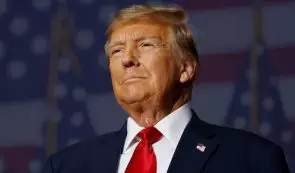
U.S. President Donald Trump is in Davos, ahead of a closely watched speech, as global political and economic tensions continue to rise.

Europe’s economic calm is being tested again, not by inflation or interest rates, but by politics.

A series of rapid-fire political and financial developments has intensified tensions between the United States and Europe, sending fresh shockwaves through diplomatic channels and global markets.
Japanese government bonds have come under heavy selling pressure as investors brace for a closely watched auction of 20-year debt, an event that has become a key barometer of market confidence ahead of next month’s election.

Japan’s fragile currency is rapidly becoming the key variable shaping monetary policy, with some market participants now warning that the Bank of Japan may be forced into a more aggressive tightening cycle than previously expected.

Prominent economist Steve Hanke, a professor of applied economics at Johns Hopkins University, is sounding the alarm about a significant change in U.S. monetary policy.
Russia closed last year with its public finances under visible pressure, as weaker energy income forced the government to tighten[…]
The Federal Reserve is preparing to inject a substantial amount of liquidity into the financial system over the coming weeks, according to its latest operational schedule.

Europe’s reaction to Washington’s latest tariff threat is revealing internal fault lines. German Chancellor Friedrich Merz said Berlin is pressing for restraint, even as French President Emmanuel Macron leans toward a harder response.


It offers developers, crypto enthusiasts, enterprise users, and analysts a unified way to query…

This trend has gained momentum in recent years as companies and even governments explore…

Crypto scams can come in many forms, from fraudulent investment schemes to phishing attacks…

The role of blockchain-based infrastructure in cross-border payments has undergone a dramatic shift in…