Bittensor TAO Price Surges After U.S. Government Weaponizes Centralized AI

A single government directive just reminded the world that centralized AI can be switched off. Bittensor's TAO token surged as capital looked for infrastructure that can't.
Key Takeaways:
- U.S. blocked foreign access to Anthropic’s top AI models – TAO jumped 23% in 24h
- Bittensor’s 128+ subnet network cannot be shut down by any single government
- First halving cut daily TAO supply by 50% – institutional buyers are tightening liquidity
- Grayscale and Bitwise spot ETF decisions expected August 2026.
TAO, the native token of the Bittensor decentralized AI network, climbed from around $210 to $261.64 within 24 hours on June 13 – a gain of over 23% – bringing its seven-day return to 35.8% and market capitalization to $2.88 billion. Spot trading volume surged 91% to $280 million. The immediate trigger was the U.S. Commerce Department ordering Anthropic to cut off all foreign nationals from its two most advanced AI models, Claude Fable 5 and Mythos 5, citing national security concerns over their cybersecurity capabilities. For traders who had been watching Bittensor, the directive made the argument for them: a government order applied to a single company had instantly cut off AI access for most of the world. Capital rotated accordingly.
Why Bittensor cannot be turned off the same way
Bittensor does not operate as a company with servers in one jurisdiction. It functions as an open, permissionless protocol where computation is distributed across thousands of independent nodes globally – miners who run machine learning models on their own hardware, validators who grade those outputs, and stakers who lock TAO to provide capital and voting weight. No single entity controls access. No cabinet secretary can send a letter that shuts it down.
The network is divided into more than 128 specialized subnets, each operating as an independent market for a specific type of AI output – text generation, protein folding, GPU inference, autonomous coding, and others. Each subnet runs its own miners and validators competing for TAO emissions based on output quality, as determined by the Yuma Consensus mechanism. When a subnet fails to generate real, verifiable output, it loses emissions and gets dissolved. This is not a policy choice by a management team – it is enforced automatically by the protocol itself.
In 2026, the network upgraded to “dynamic TAO” (dTAO), which routes inflation rewards strictly to the most productive subnets. A parallel protocol upgrade called Spec 413 stabilized staker payouts when underperforming subnets dissolve, by locking each subnet’s TAO reserves rather than instantly recycling them back into the broader supply – which had previously caused temporary dilution. An ongoing transition from Proof of Authority to Nominated Proof of Stake is also underway, allowing any TAO holder to nominate validators directly rather than deferring to a fixed group of early network gatekeepers.
The CLARITY Act and what it means for institutional crypto money
The political backdrop goes beyond one regulatory action against Anthropic. U.S. lawmakers are advancing the CLARITY Act – Creating Legal Accountability for Rogue AI Integrity – which explicitly names Bittensor among a short list of decentralized protocols recognized as foundational for auditable, open-source AI infrastructure. For institutional capital that has avoided TAO due to regulatory uncertainty, the distinction matters in a specific, practical way: money managers operating under legal investment mandates cannot deploy capital into an asset class that lacks regulatory classification, regardless of the investment thesis. The CLARITY Act would change that, moving compliant decentralized AI infrastructure from a gray zone into a defined category. The pattern is identical to what the SEC’s spot Bitcoin ETF approval did in early 2024 – once an asset class receives formal regulatory framing, pension funds, family offices, and corporate treasuries that were previously locked out gain a compliance pathway in. Decentralized AI would be next.

Three subnets generating real revenue
A persistent criticism of blockchain-based AI has been that the infrastructure exists but the commercial output does not. Three subnets push back against that argument with hard numbers. Chutes (SN64) runs AI model inference at roughly 85% lower cost than Amazon Web Services, undercutting the dominant cloud provider on raw price. Targon, a data querying and search routing subnet, is on an annual revenue run rate of $10.4 million. Ridges (SN62) deploys autonomous coding agents that write, test, and debug entire software repositories. Across the full network in Q1 2026, verified AI utilization generated $43 million in revenue – fees paid for computation delivered, not projected future value.
| Subnet | Function | Key metric |
|---|---|---|
| Chutes (SN64) | Serverless AI inference and GPU compute | 85% cheaper than AWS |
| Targon | Decentralized data querying and search routing | $10.4M annual run rate |
| Ridges (SN62) | Autonomous coding agents | Writes, tests and debugs full software repositories |
| Total network revenue — Q1 2026 | $43M | |
The consumer access layer is also expanding. TaonSquare, a polished application directory built on top of the subnet network, converts the raw outputs generated across 128+ subnets into a browsable suite of consumer applications – accessible without a command line or any direct interaction with the underlying token infrastructure.
Supply mechanics after the halving
Bittensor has a fixed supply cap of 21 million TAO, with no pre-mine and no insider token allocation at launch – the same architecture as Bitcoin. In December 2025, the network experienced its first halving, cutting daily emissions from 7,200 TAO to 3,600 TAO. As institutional buyers accumulate and stake tokens, liquid supply on spot markets is tightening rapidly.
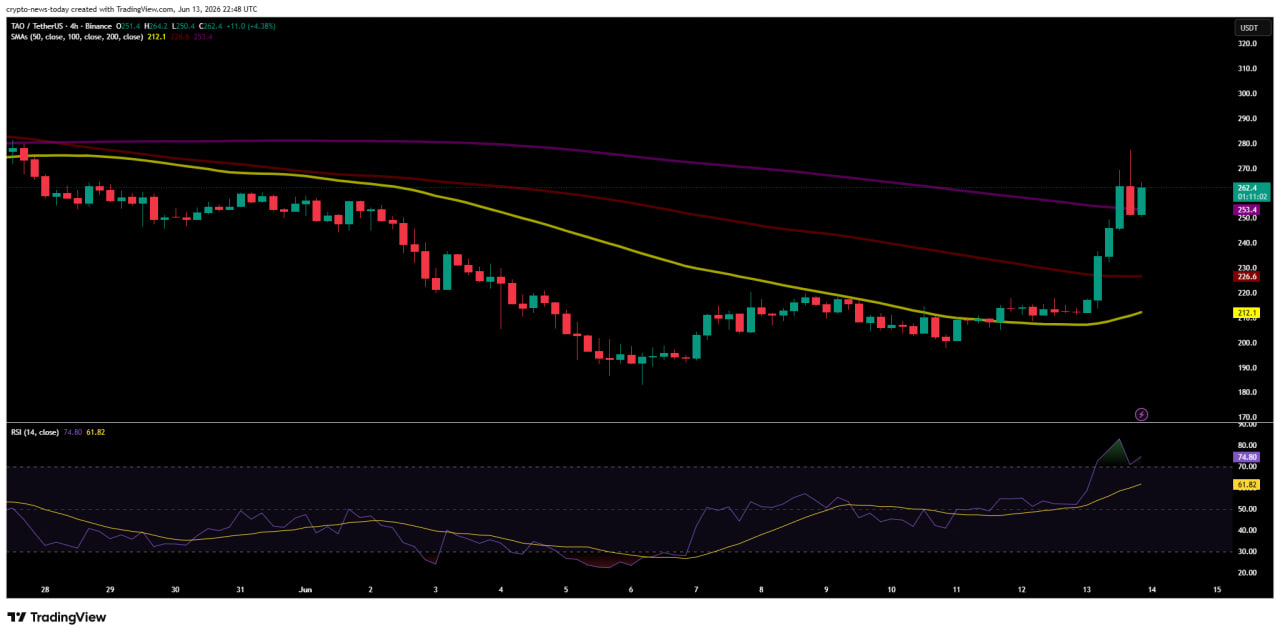
On the price chart, TAO broke out of a multi-week descending wedge and reclaimed $240 as support. The RSI on the four-hour timeframe hit 74.80 – above the 70 threshold that signals a fast, steep move – before pulling back to 61.82. An RSI above 70 does not mean an immediate reversal; it means the rally was quick and some consolidation is normal before any continuation. All three moving averages (50, 100, 200-period) are now sitting below the current price, meaning both the short-term and longer-term trend are aligned upward for the first time in weeks.
The institutional pipeline and the risks that come with it
Grayscale has filed a Form 10 with the SEC to convert its private Bittensor Trust into a spot TAO ETF under the proposed ticker GTAO. Bitwise has filed separately for a spot TAO ETF, targeting the same regulatory window. SEC decision windows for both are concentrated around August 2026 – and buyers who cannot legally hold digital tokens directly are reportedly positioning ahead of that window. Custodians including BitGo, Copper, and Crypto.com have established institutional staking infrastructure, allowing venture capital and corporate treasuries to gain exposure without self-custody.
Those risks are not hypothetical – they already cost TAO roughly $80 earlier this year. In Q2, Covenant AI, the team behind Bittensor’s most prominent 72-billion-parameter model, abruptly exited accusing the founders of manipulating emissions and deliberately deprecating their infrastructure – a dispute that triggered a sell-off from $341 to $260. Beyond the governance drama, roughly 15-20% of voting power sits with a handful of top validators, a concentration problem for a network selling decentralization. And distributed inference remains slower than centralized data centers, with no proof yet that a scattered global network can match a corporate compute cluster on speed or cost.
What this week demonstrated is that the political risk of centralized AI is no longer a theoretical concern. Whether Bittensor can convert that structural argument into durable network utility – rather than a trade that fades once Anthropic’s access restrictions are lifted – is the question the rest of 2026 will answer.
Disclaimer: This article is for informational purposes only and does not constitute financial or investment advice. Cryptocurrency markets are highly volatile. Always do your own research before making any investment decisions. The author and coindoo.com are not responsible for any financial losses. Price predictions and analyst estimates mentioned in this article are third-party opinions and not editorial recommendations.



Alex is Editor-in-Chief of Coindoo and co-founder of Millennial Media Group, with nearly a decade of experience covering financial markets - crypto first, then everything else. It started in 2016 with Bitcoin. Like most people at the time, he didn't fully understand it - so he kept digging. Blockchain, tokenomics, the projects, the cycles. That curiosity never stopped, and eventually pulled him into traditional markets too: equities, commodities, macro. Not because he left crypto behind, but because you can't properly understand one without the other. What drives him is straightforward: he wants to know why something is happening, not just that it's happening. Most market coverage stops at the headline - price up, price down, here's a chart. Alex finds that kind of reporting actively unhelpful. If you walk away from an article without understanding the mechanism behind the move, what did you actually learn? He holds a degree in Tourism from New Bulgarian University - not the most obvious path into financial markets, but markets have a way of pulling in people who are simply too curious to stay out. He has authored over 200 in-depth analyses and more than 10,000 articles across crypto and traditional finance. He still thinks every day in markets teaches him something new. That's probably why he hasn't stopped.