Bitcoin’s Bottom Signals Are Back, but Something’s Missing

Bitcoin's derivatives data shows traders under stress, with short sellers now paying to stay in, yet none of it shows buyers ready for the coins reaching exchanges.
Key Takeaways
- Dollar open interest fell $2.54B in 30 days
- Binance funding turned negative as Bitcoin hit lows
- 92,100 BTC reached exchanges at a loss
- Spot buying is the missing piece of evidence
In a CryptoQuant analysis published on November 22, contributor Amr Taha reported that the 30-day decline in Bitcoin open interest across Binance, Gate and Bybit reached $2.54 billion on November 21, the same day short-term holders sent 92,100 BTC to exchanges at a loss. A day earlier, fellow contributor Darkfost flagged that Binance funding rates had turned negative.
Both analysts read their data as a bullish setup. Taha says the conditions are consistent with potential capitulation and may come before a local bottom, though he adds that they do not confirm selling pressure is exhausted. Darkfost treats the funding flip as a contrarian signal, because this kind of bearish consensus has tended to form after deep corrections rather than near highs.
Both cases rest on positioning: traders closing bets and shorts crowding in. A bottom also needs someone to buy what sellers offer, and so far that side of the market is the hardest to see in the data. The test starts with the backdrop those buyers face.
A Sell-Off That Reaches Well Beyond Crypto
Darkfost places the funding flip inside a broad retreat across financial markets. Bitcoin had just set a new low when he wrote, and November was down 17.4% at that point.
Bitcoin from ATH
−56.3%
Nasdaq from ATH
over −20%
S&P 500 from peak
about −12%
Gold from ATH
−34.7%
Silver from ATH
−66%
Darkfost also points to persistently high inflation, with market pricing implying an 88.6% probability of a 25-basis-point rate hike at the Federal Reserve’s December meeting. The question of who buys Bitcoin is therefore being asked while stocks and metals are under pressure too, not during a crypto-only shakeout.
For a longer view of earlier Bitcoin drawdowns, Coindoo has examined Jack Mallers’ historical case for Bitcoin.
How Much of the $2.54 Billion Is Price?
Taha’s headline figure measures open interest, the derivatives positions still open. It is not trading volume, and it is not a liquidation total: a decline can come from traders closing voluntarily, from forced closures, or from both. The reported drop was spread unevenly across the three exchanges.
Binance · $1.3B · deeper than June 28 by 19.3%
Gate · $750M · deeper than June 28 by 33.9%
Bybit · $491M · deeper than June 28 by 34.5%
Bar length shows each exchange’s share of the 30-day contraction. Data: Amr Taha, CryptoQuant.
Because the figure is in dollars, price moves alone can shrink it. CME’s explanation of notional value sets out the arithmetic: contract size multiplied by the current price. If traders held exactly the same bitcoin exposure through a 17% fall like November’s, its dollar value would also drop 17% without a single position being closed.
Taha addresses part of this. The current contraction is 26.1% larger than the $2.015 billion recorded on June 28, while Bitcoin, near $58,850, was trading only 1.7% below its price at that time. On his reading, that points to a broad reduction in exposure rather than a price effect alone.
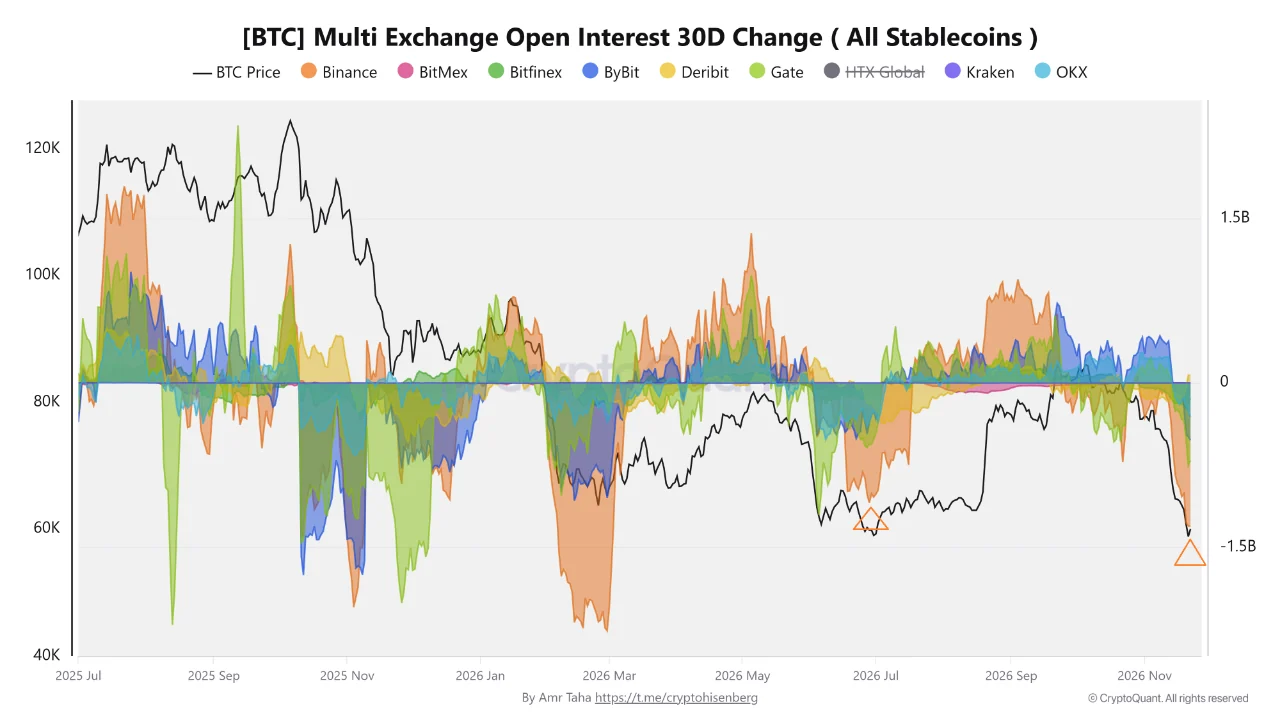
The comparison matches the price level on each date, though, not the price path within each 30-day window, and the post does not give the price change across either window. Separating closures from repricing requires open interest counted in bitcoin rather than dollars, and Taha’s series covers only stablecoin-margined contracts, leaving out coin-margined ones whose collateral is itself bitcoin.
Negative Funding: Shorts Pay, but Nobody Has to Buy
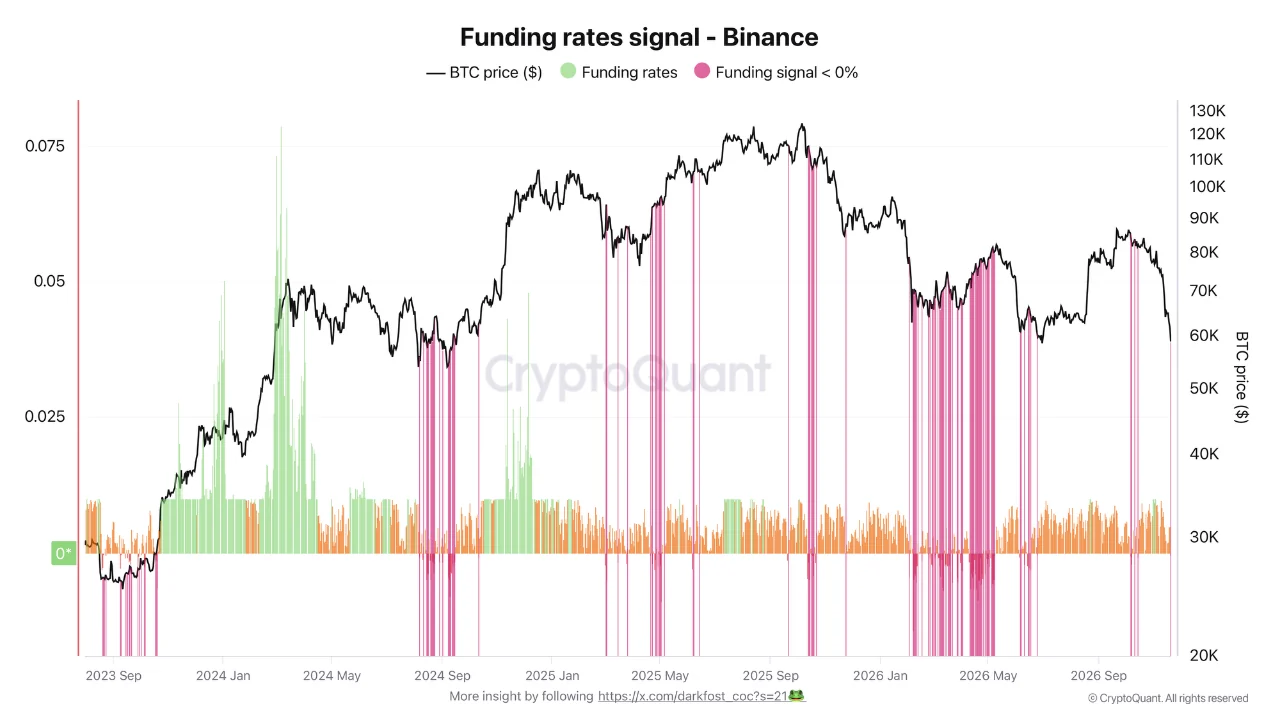
Darkfost’s signal comes from a different part of the same market. Perpetual futures have no expiry date; instead, periodic funding payments keep their price close to the spot market. Under Binance’s funding mechanism, a negative rate means short positions pay long positions. That is a transfer between holders of an existing contract, and no one has to buy a bitcoin for it to happen.
A negative rate also does not mean shorts outnumber longs. As CME’s open-interest guidance explains, every open contract has a buyer and a seller. What negative funding shows is that traders are paying up to hold short exposure, sometimes as one leg of a hedge rather than an outright bet against Bitcoin.
If those shorts close, the buying happens in the futures contract, and arbitrage can carry that pressure into spot prices. A rally built that way can fade once the closures run out. Darkfost’s chart of Binance funding marks several earlier negative stretches across 2024, 2025 and the first half of 2026, and he notes that some of them led only to short-lived rebounds.
92,100 BTC at a Loss: Supply Within Reach
Taha’s second data point moves from derivatives to the coins themselves. It tracks short-term holders, meaning wallets that acquired their coins relatively recently. The 92,100 BTC they sent to exchanges at a loss within 24 hours on November 21 was worth about $5.34 billion, only 1.5% below the 93,540 BTC recorded on February 6. Binance alone received 18,600 BTC at a loss, worth about $1.09 billion, 15.7% above the 16,082 BTC it took on June 2.
“At a loss” means the coins moved at a price below the one at which they last changed hands on-chain. The $5.34 billion is the value of the coins, not the amount their holders lost. The on-chain record also cannot see a holder’s full cost history, and an exchange deposit can serve as trading collateral or sit unsold.
What the inflow does show is that a large block of coins held by recent buyers, many of them under water, has moved to where it can be sold quickly. Whether any of it has been sold, and who bought it, has to be checked elsewhere.

Where Buying Would Show Up
US spot Bitcoin ETFs are the most visible channel for outside demand, and they pointed the other way through midweek. Farside Investors’ flow data shows net outflows of about $538 million from Monday to Wednesday, November 16–18, followed by $582.3 million on Thursday, November 19. ETF flows count new money entering or leaving the funds, not shares changing hands between investors, so a turn would need several days of net subscriptions to mean much.
Exchange trade data offers a second check. If trades executed by buyers hitting sellers’ offers repeatedly outweigh trades in the opposite direction across several venues, that is evidence of demand willing to pay up, not just bids waiting below the market.
Those waiting bids are the third check. Glassnode’s November 17 report found resting bids on Binance and Coinbase outweighing asks by about 2.3 times within 5% of the price, with the largest single Binance bid level since August near $60,000. It warned that such orders can be pulled at any time and matter most once filled. Bitcoin has since traded below $60,000, so the useful question now is whether that level was filled or withdrawn, and whether bids have rebuilt underneath.
Price itself is the last check: whether fresh exchange inflows of this size stop producing new lows. Until buying shows up in executed trades, fund flows and price, the derivatives data describes sellers and short traders under strain. It does not show who is taking the other side.
Disclaimer: This article is for information only and is not financial, investment or trading advice. Views attributed to CryptoQuant contributors, Glassnode and other sources are their own and do not represent Coindoo’s position. Market data is drawn from third-party providers at a specific point in time and may since have changed. Cryptocurrencies and derivatives such as perpetual futures are highly volatile, and leveraged positions can lose more than the initial margin, depending on the platform. Do your own research and consider independent professional advice before making any investment decision.



Kosta has reported on cryptocurrency markets and blockchain infrastructure since 2020, bringing over six years of hands-on experience in the crypto industry built through daily tracking of markets, trends, and emerging blockchain developments. Specializing in Bitcoin on-chain analysis, institutional ETF flows, and digital asset price action, his work at Coindoo has been cited by other news agencies and consistently covers market developments with a focus on data-driven reporting across Bitcoin, Ethereum, Solana, and XRP. Over the years, Kosta has contributed to multiple crypto media outlets in different regions, authoring over 6,000 articles across the sector. His reporting spans cryptocurrency markets and the broader fintech industry, tracking not only price action but also the technological and regulatory forces shaping the ecosystem. To support his analysis, Kosta actively leverages on-chain data and metrics from leading platforms such as Santiment, Glassnode, and CryptoQuant, enabling deeper, evidence-based market insights. He believes in the power of transparency and the data that underpins the blockchain ecosystem. His academic background in Marketing Management from Denmark further complements his analytical approach, adding a strong understanding of communication strategy and content positioning to his work.