Bitcoin Holds Near $79,000 as Altcoin Rally Cools

Bitcoin remained near $79,000 as most major altcoins retreated. Several of the week’s strongest performers recorded the largest daily losses and kept much of their recent rise.
Pasted text(20260826-062157).txt
Key Takeaways
- Bitcoin recorded a relatively mild daily decline.
- Every tracked asset retained a weekly gain.
- Recent market leaders suffered steeper daily pullbacks.
- HYPE was the session’s clear exception.
The daily decline reached almost every major asset
The August 26 data from CoinMarketCap placed Bitcoin at $79,100 at the time of writing, down 2% over 24 hours and up 23% for the week. The daily move was mild compared with the wider group.
Fifteen of the 16 non-stable assets from top 18 cryptos by market cap declined during the same period. Their median move was approximately -3.8%. Ether traded at $2,465 after a 1.7% daily decline and remained 29% higher for the week.
Those figures describe broad short-term selling with limited damage to the week’s performance. Every asset in the group still carried a positive seven-day return.
The size of each giveback tells a different story
Daily percentages can exaggerate the damage after a rapid rise. The final column below compares each 24-hour decline with the asset’s seven-day gain. It shows how deeply the latest move cut into the rally.
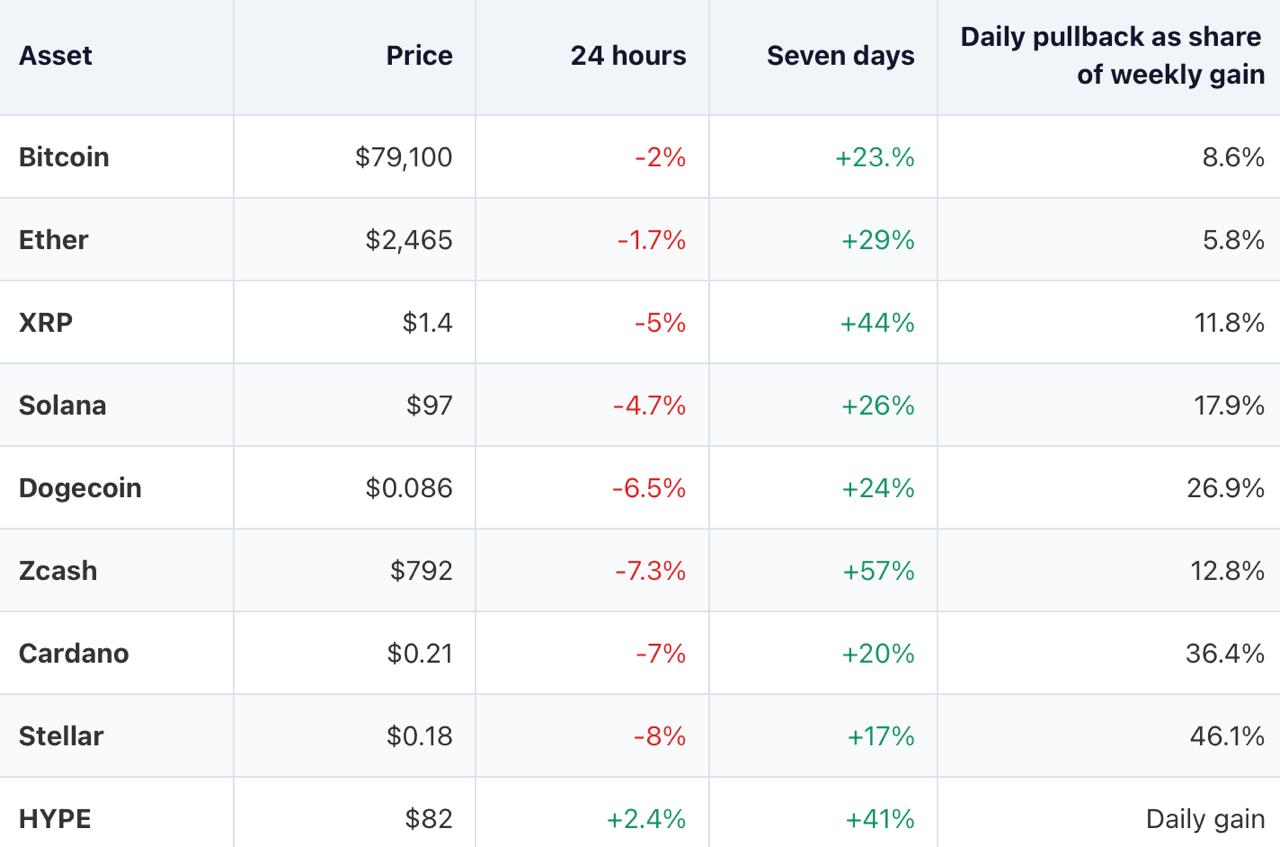
The final column is an editorial comparison calculated by dividing the 24-hour decline by the seven-day gain. The periods overlap, so the result is approximate.
Bitcoin and Ether registered the shallowest givebacks in the table. Their daily declines represented 8.6% and 5.8% of their respective weekly gains. XRP also kept most of its rise after a 5.2% daily fall.
Stellar faced greater damage to its short-term momentum. Its daily loss equaled 46% of the seven-day gain. Cardano reached 36.4%, and Dogecoin reached 26.9%. Another session of similar losses would consume a meaningful part of their remaining weekly cushion.
Zcash recorded one of the largest daily declines in the group. Its 57% weekly surge gave it a much larger cushion, leaving the latest loss equal to 12.8% of that rise. Similar red daily figures can therefore carry very different weight.
Several quieter assets experienced smaller declines after weaker weekly performances. UNUS SED LEO slipped 0.5% after gaining 0.8% for the week. Monero declined 1.20% with a 7.8% weekly rise, and TRON lost 1.6% after advancing 1.8%. Their lower daily volatility came with limited prior momentum.
HYPE broke the wider market pattern
Almost every major crypto asset moved lower while HYPE gained 2.4% to reach $82 and extended its seven-day rise to 41%.
That strength points to concentrated demand in one part of the market. A single outperformer gives little information about overall breadth, so any explanation for HYPE’s move requires a verified token-specific catalyst.
Fast weekly gains create a late-entry risk
Strong seven-day returns often become most visible after much of the move has already occurred. Traders entering near the end of that run face a thinner cushion once momentum slows.
The latest session illustrates that risk. Cardano, Stellar and Dogecoin had already posted substantial weekly gains before recording some of the deepest daily pullbacks in the group. A large weekly percentage describes past performance. It provides no guarantee that the same pace can continue.
Position size and entry discipline become especially important for traders after a rapid rally. A modest Bitcoin decline can coincide with much larger altcoin moves because smaller assets generally carry higher volatility. A leverage-driven explanation still requires open-interest, funding and liquidation data.

Three checks could clarify the next phase
1. Retention of weekly gains
The weekly return provides a simple measure of the remaining cushion. Cardano and Stellar have already used a larger portion of that cushion. Bitcoin, Ether, XRP and Zcash retained considerably more.
2. Participation in the next recovery
Count how many major assets join the next rebound. Participation across Ether, Solana, XRP, Dogecoin and other recent leaders would show renewed demand across the market.
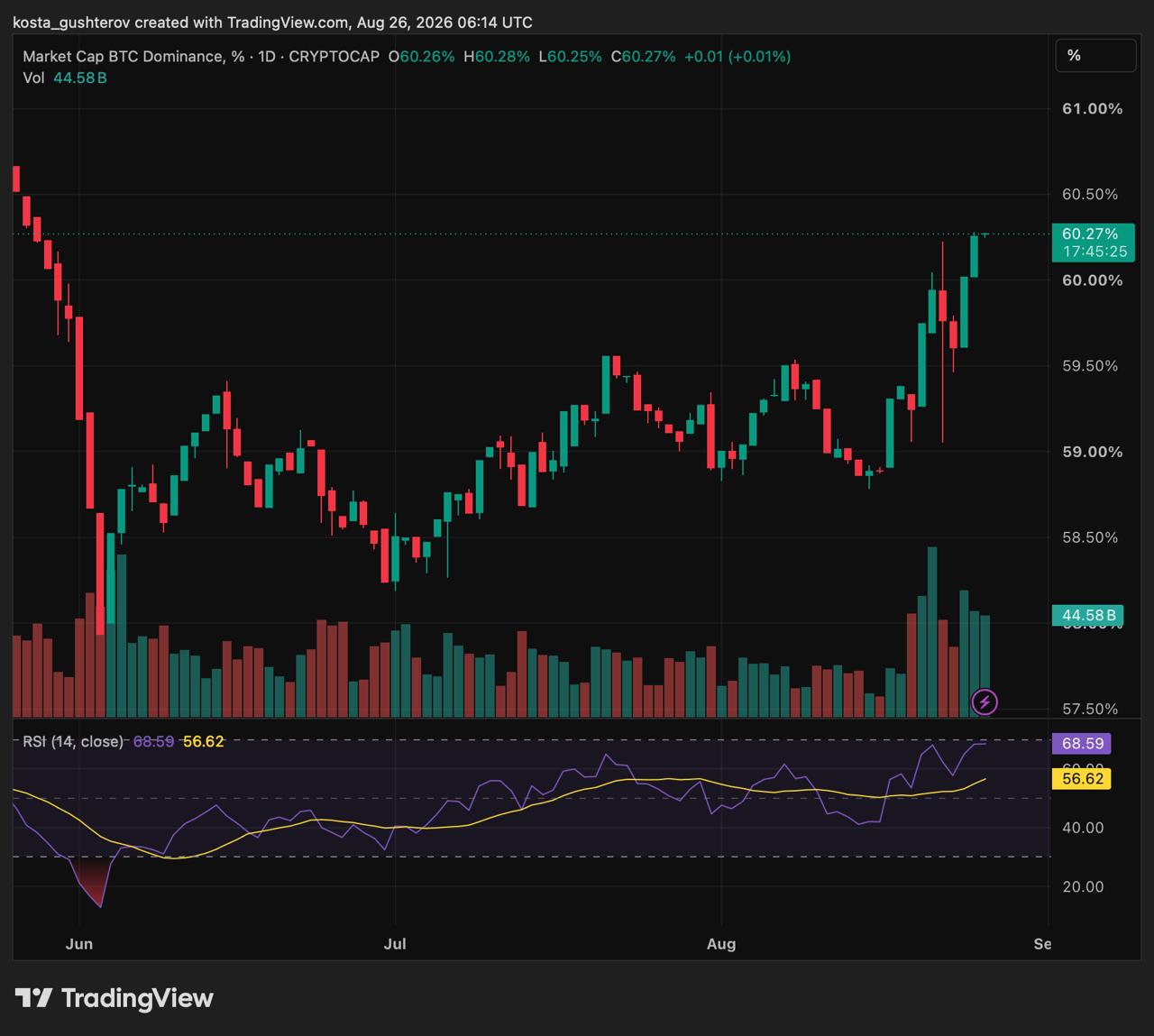
Bitcoin dominance can add context. A higher reading shows relative Bitcoin strength. Stablecoin dominance and broad altcoin performance complete that picture.
It stood at 60.27% at 06:14 UTC on August 26, its strongest area since early June. The index has gained roughly 1.4 percentage points since its mid-August low and has reclaimed the 60% level as altcoins pull back. This confirms that Bitcoin is gaining market-cap share during the current cooling period.
3. Trading volume and derivatives positioning
Price data identify the pullback; they cannot identify its cause. Spot volume, open interest and funding rates are needed before describing it as profit-taking, deleveraging or forced liquidation.
Cooling open interest and calmer funding would support a reduction in leveraged exposure. Persistent spot selling and repeated failures to recover would place greater pressure on the weekly gains.
The weekly structure remains positive
The August 26 data show a short-term pullback inside a strong week. Bitcoin and Ether kept most of their gains. Recent altcoin leaders absorbed more damage, and HYPE kept moving higher.
The breadth of the next rebound will matter. Participation across several large-cap assets would keep the weekly structure on solid ground. Continued losses among Cardano, Stellar and Dogecoin would leave those assets with a much smaller cushion.



Alexander Zdravkov is a market analyst and crypto journalist with interests in economics, broader financial markets and digital assets. His journey into crypto began more than four years ago, driven by a fascination with the rapid evolution of blockchain technology and the transformative potential of decentralized finance. He began analyzing market cycles and identifying emerging trends before they reach the mainstream. He holds a degree in International Relations - a background that helped shape his broader perspective on global economics, geopolitics, and the interconnected nature of modern financial markets. Whether covering the latest developments in the crypto sector or exploring broader macroeconomic themes, Alexander focuses on giving readers context rather than simply repeating headlines. During his career, he has authored more than 5,000 articles covering cryptocurrencies, traditional finance, and global market developments. His work spans everything from Bitcoin and altcoins to macroeconomic trends influencing risk assets worldwide.