Bitcoin Falls to $74,500 as Iran Rejects US Talks and Ceasefire Clock Runs Out

Bitcoin slipped below $75,000 on April 20 as Iran's rejection of a second round of nuclear negotiations with the United States injected fresh uncertainty into global markets, pushing risk assets lower across the board.
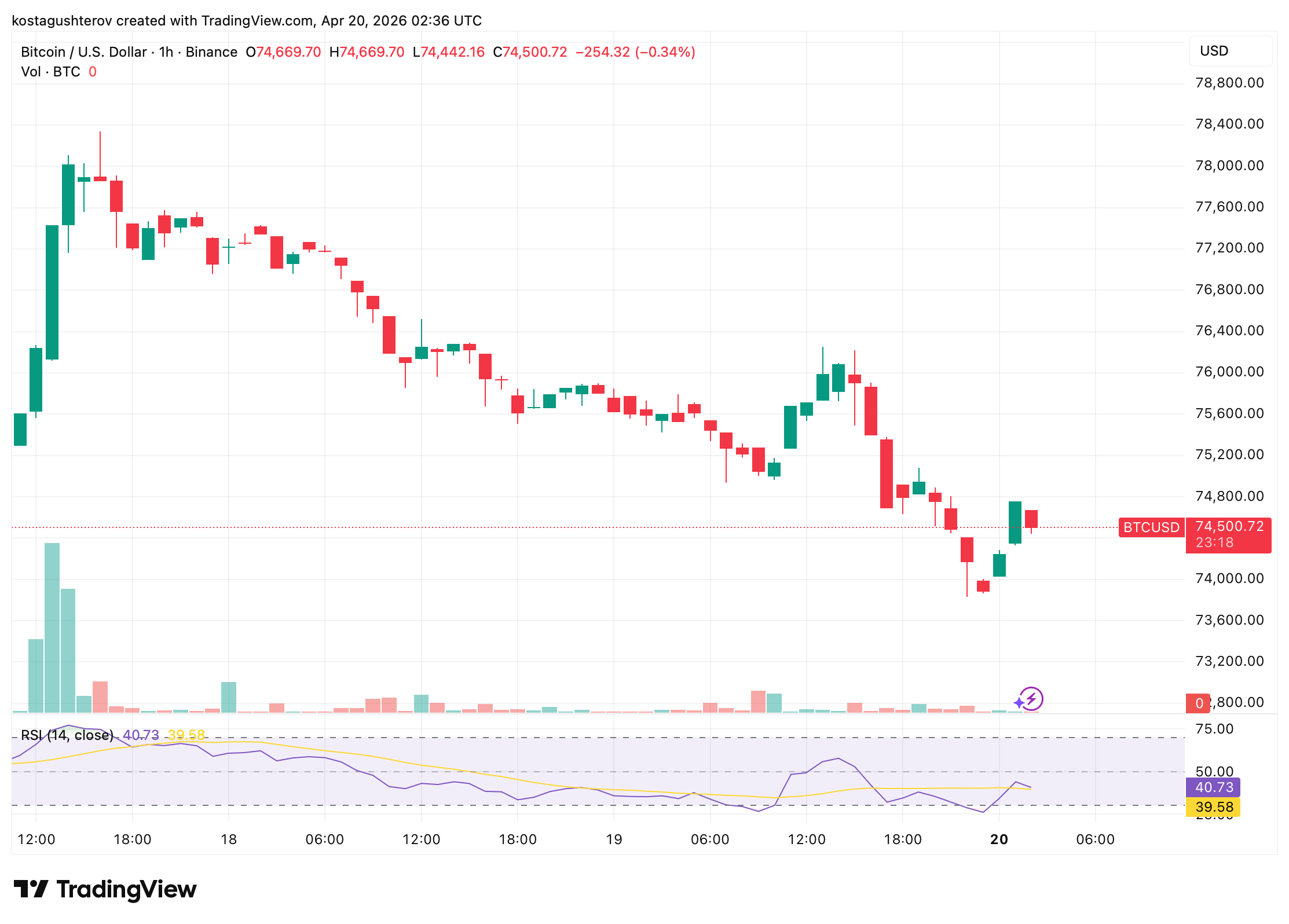
- BTC down from $78,200 to $74,500 in 72 hours.
- Iran officially rejects second round of US talks.
- Ceasefire expires Wednesday April 22.
- US seized Iranian cargo ship Touska on Sunday.
- Trump threatens to target Iranian civilian infrastructure.
- RSI at 39.58.
- $74,500 horizontal support now the line to watch.
The 1-hour chart tells the story cleanly. BTC reached on April 18 near $78,000, then spent the following 72 hours in a steady, low-volume bleed that brought price to $74,500 by early April 20.
RSI on the 1-hour sits at 39.58, below its signal line at 40.73, and approaching oversold territory without yet triggering the kind of extreme reading that has historically preceded short-term relief bounces.
The macro trigger is clear. According to TheGuardian, Iran’s state news agency IRNA confirmed on April 19 that Tehran sees “no plans” for further negotiations, directly contradicting President Trump, who had ordered a high-level US delegation, reportedly including Vice President JD Vance, Steve Witkoff, and Jared Kushner, to arrive in Islamabad on Monday.
Iran cited the ongoing US naval blockade of its ports as a “criminal” act violating the existing ceasefire, and condemned the seizure of the Iranian-flagged cargo ship Touska on Sunday as “armed piracy,” vowing retaliation.
The timing is what markets are pricing. The current ceasefire, established after the large-scale conflict that began in February 2026, expires on Wednesday April 22. With talks collapsed, no replacement framework in place, and Trump warning the US is prepared to target Iranian civilian infrastructure if a deal is not reached, the probability of ceasefire extension dropped sharply over the weekend. Bitcoin, which had already been sensitive to geopolitical headline risk throughout April, reflected that repricing immediately.
READ MORE:

Charles Hoskinson: The Clarity Act Is Structurally Broken and a Bad Bill Is Worse Than No Bill
The $74,500 level now becomes the line the market is watching. A horizontal support zone visible on the chart sits just below current price, and RSI nearing oversold suggests the selling momentum is not infinitely sustainable at this pace. But oversold does not mean bottomed — it means the move has been extended, not that it is finished. Any further escalation before Wednesday’s ceasefire deadline, or a formal US military posture shift, removes the technical argument entirely.
The relief scenario is equally specific: a ceasefire extension, a resumption of talks under a different format, or a de-escalation signal from either side would remove the dominant macro pressure that has driven three days of consecutive selling. In that scenario, the path back toward $76,500 to $77,000 opens quickly given how little spot resistance exists between current price and that range.
Until Wednesday, the chart is secondary. The ceasefire clock is the real indicator.
The information provided in this article is for educational purposes only and does not constitute financial, investment, or trading advice. Coindoo.com does not endorse or recommend any specific investment strategy or cryptocurrency. Always conduct your own research and consult with a licensed financial advisor before making any investment decisions.



Kosta has reported on cryptocurrency markets and blockchain infrastructure since 2020, bringing over six years of hands-on experience in the crypto industry built through daily tracking of markets, trends, and emerging blockchain developments. Specializing in Bitcoin on-chain analysis, institutional ETF flows, and digital asset price action, his work at Coindoo has been cited by other news agencies and consistently covers market developments with a focus on data-driven reporting across Bitcoin, Ethereum, Solana, and XRP. Over the years, Kosta has contributed to multiple crypto media outlets in different regions, authoring over 6,000 articles across the sector. His reporting spans cryptocurrency markets and the broader fintech industry, tracking not only price action but also the technological and regulatory forces shaping the ecosystem. To support his analysis, Kosta actively leverages on-chain data and metrics from leading platforms such as Santiment, Glassnode, and CryptoQuant, enabling deeper, evidence-based market insights. He believes in the power of transparency and the data that underpins the blockchain ecosystem. His academic background in Marketing Management from Denmark further complements his analytical approach, adding a strong understanding of communication strategy and content positioning to his work.