Arbitrum’s 45% Rally May Price In Revenue ARB Does Not Receive

ARB’s rebound raises an unresolved valuation question: can a governance token benefit when its ecosystem earns money but the token carries no direct claim on that income?
The $43 million total hides a slowing daily pace
Token Terminal attributed $43.2 million in revenue to Robinhood Chain during the 30 days ending September 18. The figure shows that a network built with Arbitrum technology can produce substantial revenue outside Arbitrum One.
The daily bars provide a less settled picture. Revenue accelerated at the end of August, briefly approached $8 million in early September and then fell below $1 million in the latest sessions shown on the chart.
The trailing total therefore shows what Robinhood Chain can generate during a surge, not what it will necessarily earn every month. A 30-day sum can remain elevated after the activity that produced it has already slowed.
JUST IN: Robinhood generated $43.2M in revenue from Robinhood Chain over the past 30 days. pic.twitter.com/UWOqjjDYxH
— Token Terminal 📊 (@tokenterminal) September 18, 2026
Another test is approaching. Robinhood has subsidized gas for eligible trades made through its official wallet, with that support reportedly scheduled to end around late September. Activity after the subsidy expires should offer a clearer indication of how much demand remains when users bear more of the transaction cost themselves.
Robinhood Chain revenue does not become ARB income
Robinhood Chain is built with Arbitrum Dedicated Blockchains, a framework that allows companies to launch customized Layer 2 networks using Arbitrum technology.
Under the Arbitrum Expansion Program, participating networks contribute 10% of their net protocol revenue to the Arbitrum ecosystem. Eight percentage points go to the DAO treasury and two support the developers maintaining the technology.
How the revenue connection works
The reported $43.2 million cannot simply be multiplied by 10% to calculate Arbitrum’s income. The agreement applies to net protocol revenue, while analytics providers may treat fees, operating costs and revenue differently.
Robinhood Chain also uses ETH as its gas token. More transactions can increase the network’s income without requiring users to buy ARB. The token’s connection comes through governance: ARB holders can vote on the use of the DAO treasury, but voting power is not the same as receiving cash flow.
Why traders may still connect the revenue to ARB
Arbitrum now has evidence for its business model
Robinhood Chain strengthens the case that Arbitrum can earn from companies using its technology to build separate networks. Income does not have to depend entirely on transactions taking place on Arbitrum One.
The treasury gives ARB an indirect link
Revenue paid to the DAO can finance development, incentives or investments intended to expand the ecosystem. If those decisions attract more projects and income, control over the treasury could become more valuable.
There is still no guarantee that a larger treasury will increase ARB’s price. Spending can fail to produce returns, and token holders cannot redeem ARB for a proportional share of treasury assets.
Traders may be anticipating a future mechanism
Standard Chartered placed the missing value connection at the center of its recent Arbitrum coverage. The bank reportedly set a $10 target for 2030 while also identifying ARB’s lack of direct revenue accrual as a risk to that forecast.
The report may have encouraged traders to price the possibility of a future buyback, distribution or another value-capture mechanism. None follows automatically from the existing agreement.
The timing also overlaps with a wider cryptocurrency rebound. The recent examination of why the altcoin rally had not yet become an altseason found improving participation across several sectors. Robinhood Chain may have strengthened the case for ARB, but the token was not rising in isolation.
The rally has reached the floor ARB lost
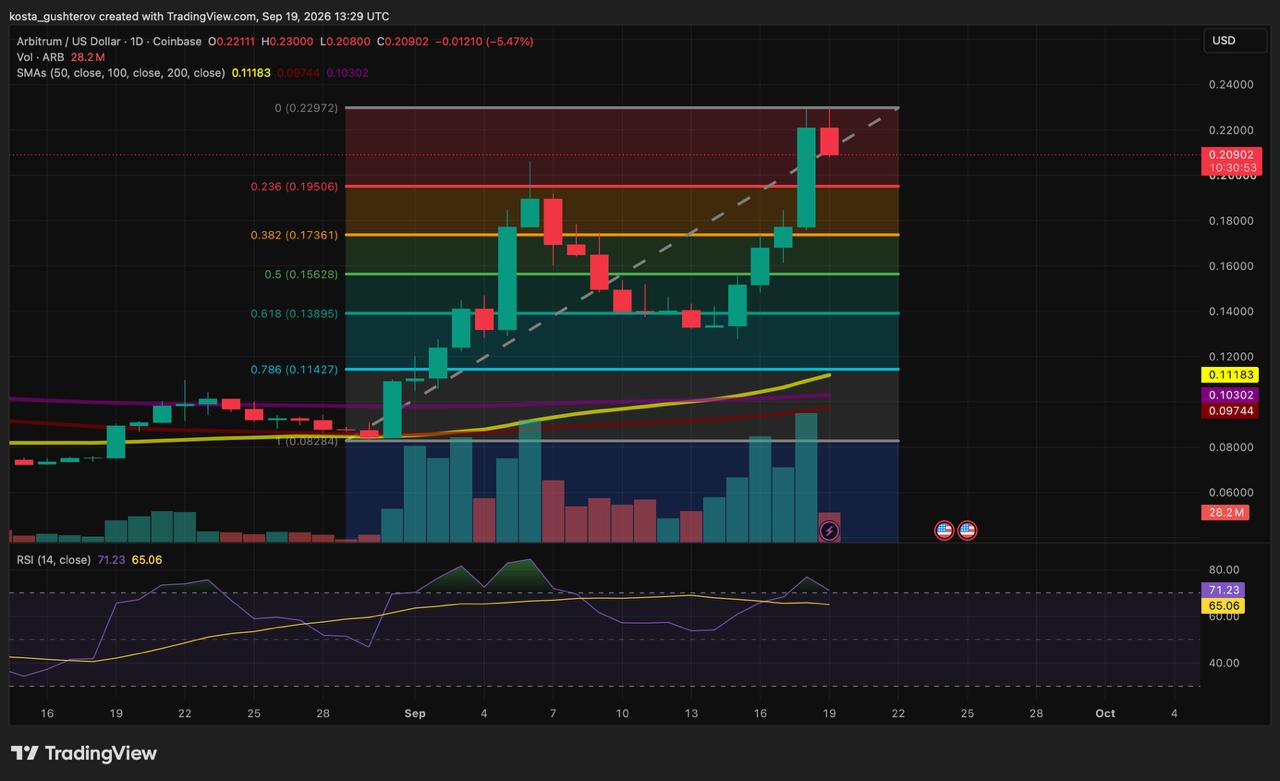
On September 19, ARB traded near $0.21 after gaining about 45% over seven days and briefly reaching $0.23 on the Coinbase ARB/USD chart.
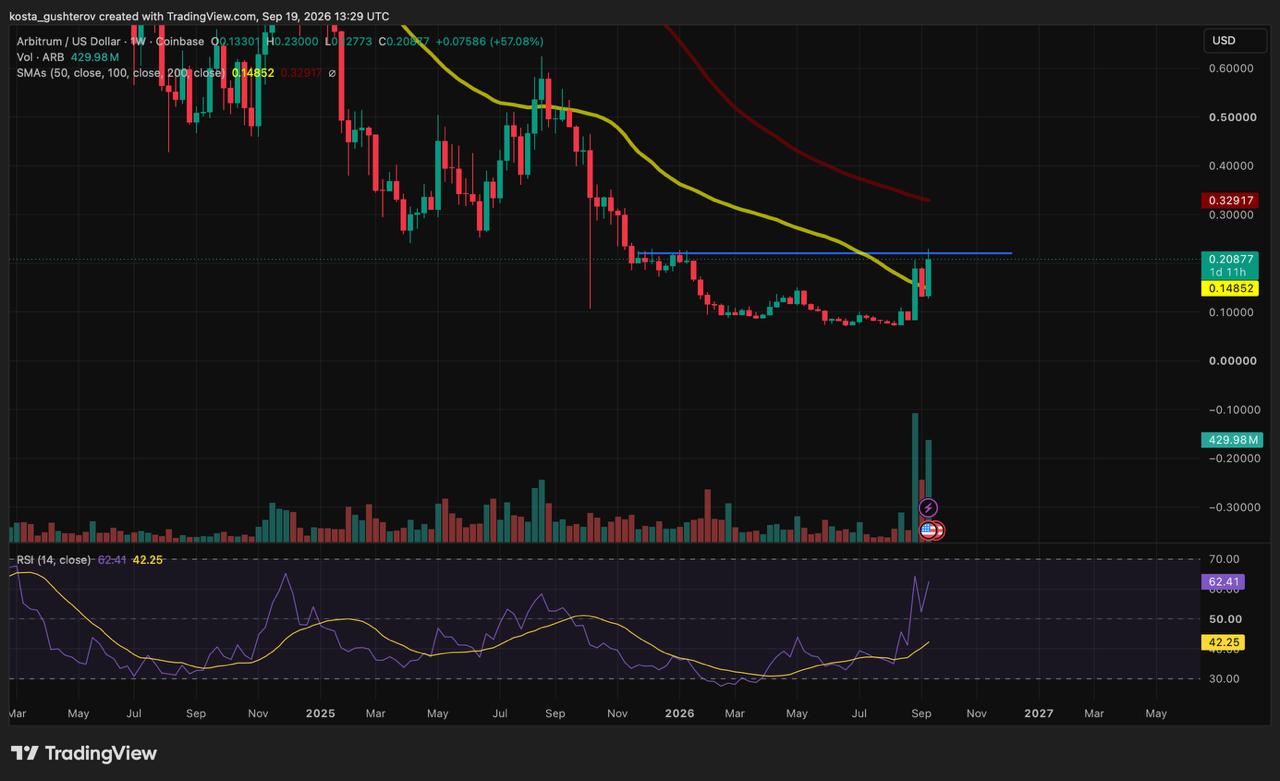
On the weekly chart, the $0.21-$0.23 area supported ARB during late 2025. Its breakdown was followed by a decline below $0.10 in 2026. Price is now approaching that former floor from below, which can turn it into resistance.
ARB has reclaimed its 50-week moving average near $0.15, but the 100-week average remains considerably higher around $0.33. Buyers first need to clear the former floor before that longer-term average becomes relevant.
$0.23 has triggered an intraday pullback
ARB touched $0.23 before retreating toward $0.21. Because the daily candle remained open, the move showed selling around resistance but not a confirmed rejection.
Daily RSI reached approximately 71, placing ARB in traditionally overbought territory as price encountered weekly resistance. The indicator also formed a lower high while ARB reached a higher price high, creating bearish divergence on the daily chart. This shows that momentum did not fully confirm the latest advance, although divergence alone does not guarantee a reversal. It becomes more significant if the pullback carries ARB below its first support near $0.20.
ARB is pricing a possibility, not receiving cash flow
Robinhood Chain has shown that Arbitrum’s technology can support a revenue-producing business. What remains unproven is whether that success will give ARB holders more than governance over a larger ecosystem treasury.
The more useful tests now are whether Robinhood Chain’s daily revenue stabilizes after its initial surge and whether the DAO creates a clearer connection between ecosystem income and the token. Until then, the reaction around $0.23 will show how much traders are prepared to pay for that possibility before ARB’s economics catch up.
This article is provided for informational purposes only and does not constitute financial or investment advice. Cryptocurrency prices, network revenue and technical indicators can change rapidly.



Alexander Zdravkov is a market analyst and crypto journalist with interests in economics, broader financial markets and digital assets. His journey into crypto began more than four years ago, driven by a fascination with the rapid evolution of blockchain technology and the transformative potential of decentralized finance. He began analyzing market cycles and identifying emerging trends before they reach the mainstream. He holds a degree in International Relations - a background that helped shape his broader perspective on global economics, geopolitics, and the interconnected nature of modern financial markets. Whether covering the latest developments in the crypto sector or exploring broader macroeconomic themes, Alexander focuses on giving readers context rather than simply repeating headlines. During his career, he has authored more than 5,000 articles covering cryptocurrencies, traditional finance, and global market developments. His work spans everything from Bitcoin and altcoins to macroeconomic trends influencing risk assets worldwide.