Arbitrum: Standard Chartered Sets $10 Target for 2030

Standard Chartered expects Arbitrum’s ARB token to reach $10 by the end of 2030, a forecast built around financial firms adopting Arbitrum technology rather than the token’s current momentum.
Key Takeaways
- Standard Chartered targets $10 ARB by 2030.
- Tokenization growth underpins the bank’s forecast.
- Robinhood Chain provides early revenue evidence.
- ARB still lacks direct value accrual.
- The daily chart is testing $0.137.
The target depends on institutional chains taking hold
Standard Chartered initiated coverage of ARB with targets of $0.50 for the end of 2026 and $10 for the end of 2030, according to The Block’s account of the bank’s client research note.
The bank also provided annual milestones, giving investors nearer checkpoints for evaluating the forecast. Even the first target of $0.50 would require ARB to rise about 265% from $0.137.
Geoff Kendrick, Standard Chartered’s global head of digital-assets research, bases the broader case on growth in tokenized assets. The bank estimates assets tokenized on public blockchains could rise from roughly $340 billion to $4 trillion by the end of 2028. That is the bank’s own estimate, and the total depends on which categories of assets it includes.
Robinhood Chain offers early evidence, not a direct token payout
The bank’s thesis has a live example in Robinhood Chain, which uses Arbitrum technology. Standard Chartered estimates the chain could generate about $5 million in Arbitrum Expansion Program fees during September at the prevailing run rate. The research note also put Robinhood Chain’s average daily fee revenue at $2.8 million during the first two weeks of the month and said Arbitrum’s monthly revenue had risen to more than five times its pre-launch level.
The $2.8 million figure should not be multiplied directly by 10%, because the Expansion Program contribution is calculated from protocol net revenue rather than the total fees generated by the chain.
Those figures describe ecosystem revenue, not income paid to ARB holders. Under the Arbitrum Expansion Program, chains built outside Arbitrum One and Nova contribute 10% of protocol net revenue to the Arbitrum ecosystem. As explained in the analysis of Robinhood Chain’s transaction growth, the money goes to the DAO treasury and Developer Guild rather than automatically funding token buybacks or distributions.
That is the gap investors need to keep in view. Arbitrum can earn more when a chain using its technology becomes successful, but ARB demand does not automatically rise with that revenue. The valuation case would need governance to create a durable link between ecosystem income and the token.
ARB is back at the midpoint of its September rally
ARB traded near $0.137 at 12:02 UTC on September 15, 2026, on the Bitstamp ARB/USD daily chart. That price sat almost exactly at the 50% Fibonacci retracement near $0.1374, measured from the late-June low around $0.0697 to the early-September high near $0.205.
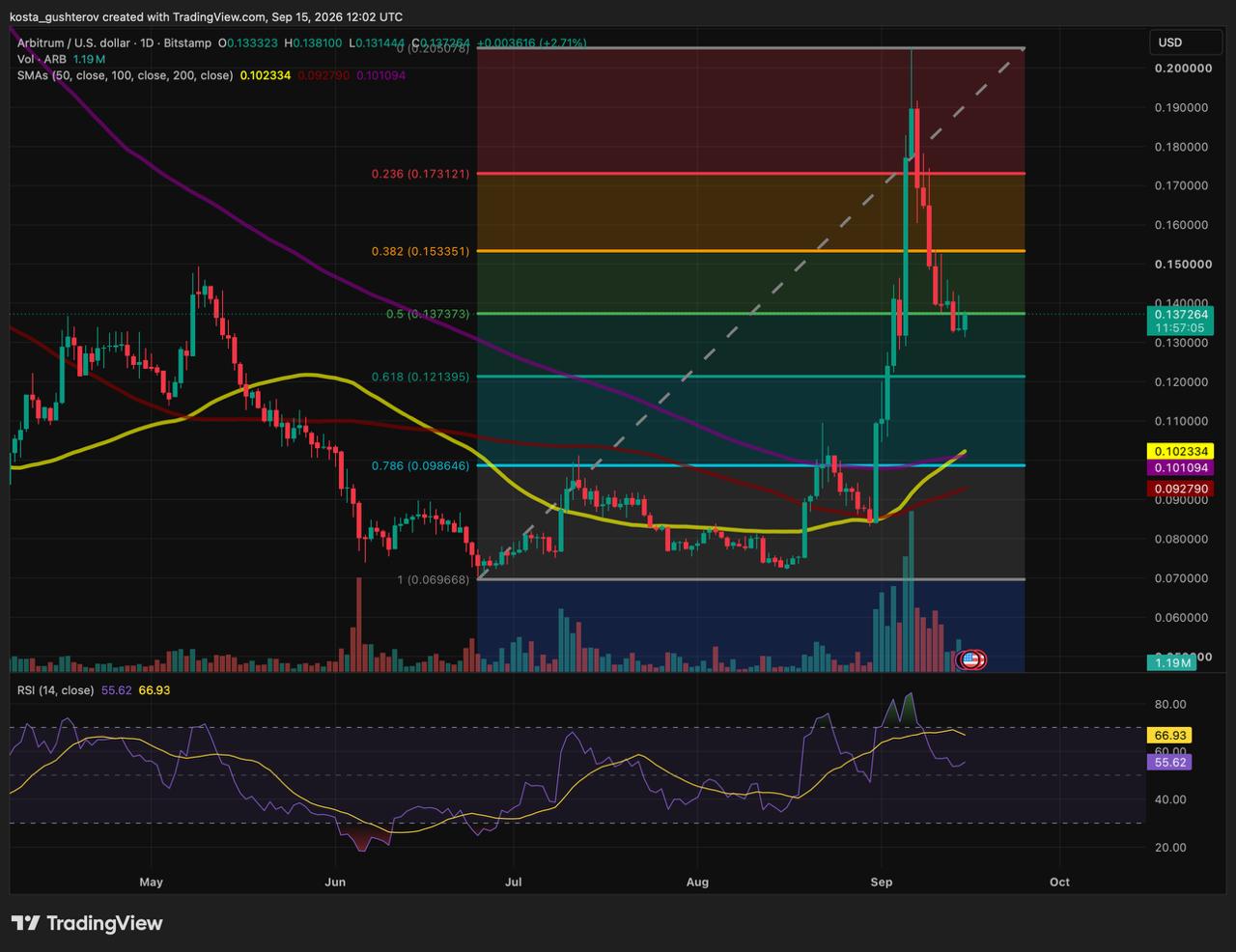
A Fibonacci retracement is a reference line drawn from a previous price swing. Traders use it to identify places where a pullback could pause or where a prior move may resume. It is a guide to possible market interest, not a prediction.
ARB first crossed $0.137 during the early-September rally and subsequently reached about $0.205. Its return to the midpoint is therefore the first important test of whether that advance created lasting support. An intraday reaction is not enough to confirm the retest; the daily close will provide the more useful signal.
Nova shows why launching chains is not enough
Robinhood Chain is the positive case for Arbitrum’s expansion model, while Nova shows how quickly a network can lose economic relevance. Nova’s TVL fell from roughly $20.4 million to about $359,000, while daily decentralized-exchange volume dropped below $60 before the move to a lower-footprint operating model.
The Nova migration does not invalidate the potential of dedicated chains but still clarifies what needs to be measured: not how many chains launch, but whether they still attract users and produce fees after initial incentives or promotional periods end.
What could prevent ARB from reaching the target?
Standard Chartered’s forecast depends on assumptions covering market growth, institutional adoption and ARB’s token economics. Each could develop differently from the bank’s projections.
- Tokenization grows more slowly than forecast.
- Financial firms choose competing blockchain networks.
- New chains fail to produce lasting revenue.
- Revenue remains disconnected from ARB demand.
The first checkpoint is $0.50, not $10
The more revealing test will come well before 2030. If ARB approaches Standard Chartered’s $0.50 target while Robinhood-derived fees remain elevated, the price and business evidence would be moving together. A rally without durable revenue would suggest speculation is running ahead of adoption, while continued fee growth without stronger ARB demand would show that the token’s value-accrual problem remains unresolved.
This article is provided for informational purposes only and does not constitute financial or investment advice. Standard Chartered’s ARB forecasts are analyst projections, not guarantees of future performance.



Kosta has reported on cryptocurrency markets and blockchain infrastructure since 2020, bringing over six years of hands-on experience in the crypto industry built through daily tracking of markets, trends, and emerging blockchain developments. Specializing in Bitcoin on-chain analysis, institutional ETF flows, and digital asset price action, his work at Coindoo has been cited by other news agencies and consistently covers market developments with a focus on data-driven reporting across Bitcoin, Ethereum, Solana, and XRP. Over the years, Kosta has contributed to multiple crypto media outlets in different regions, authoring over 6,000 articles across the sector. His reporting spans cryptocurrency markets and the broader fintech industry, tracking not only price action but also the technological and regulatory forces shaping the ecosystem. To support his analysis, Kosta actively leverages on-chain data and metrics from leading platforms such as Santiment, Glassnode, and CryptoQuant, enabling deeper, evidence-based market insights. He believes in the power of transparency and the data that underpins the blockchain ecosystem. His academic background in Marketing Management from Denmark further complements his analytical approach, adding a strong understanding of communication strategy and content positioning to his work.