Zcash Price Faces First Test After 285% Rally: Can It Hold?
Zcash is holding above its first major retracement level after a 285% advance. A daily close above the area would strengthen the case that buyers may be building more durable support.
Key Takeaways
- Buyers defended the $1,070 Fibonacci level.
- Daily RSI cooled while remaining positive.
- ZCSH reported more than $70M in inflows.
- NU7 vote and Fed decision arrive next.
Zcash retreats after climbing 285%
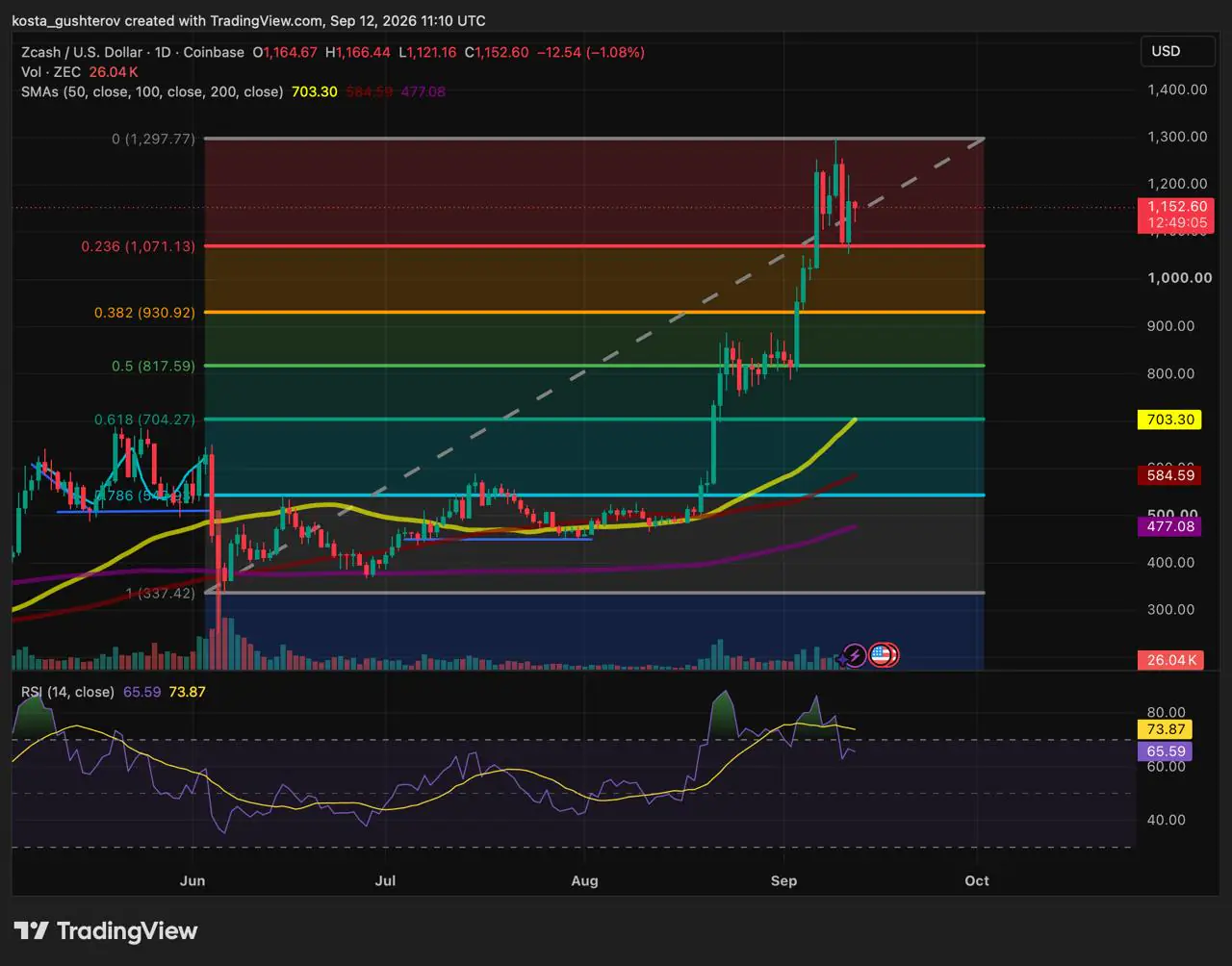
Zcash has pulled back from a rally that carried the token from a June low near $337 to a September peak close to $1,297. ZEC traded near $1,150 at the time of writing on September 12, roughly 11% below that high.
The decline came after ZEC broke above $1,000, a move examined in our previous Zcash price analysis. With that threshold now behind the market, attention has shifted to $1,070 – the 23.6% Fibonacci retracement of the June-to-September advance and ZEC’s first clear support reference during the pullback.
Buyers have defended $1,070 for now
ZEC tested the $1,070 area during its decline from $1,297, and buyers returned the price above $1,100. For now, that recovery leaves the higher-low structure intact, but an intraday rebound is not confirmation.
A close above the level, followed by further trading above it, would strengthen the case that support is forming. A daily close beneath $1,070 could bring the next retracement near $930 into focus; a brief wick below it would matter less if buyers recovered the level before the session ends.
Momentum has cooled from its recent extreme
The 14-day Relative Strength Index has fallen to 65 from overbought readings during the strongest part of the rally, while its moving average remains higher at 73.8. That shows momentum has cooled after ZEC approached $1,300, but RSI remains above 50, keeping the daily trend constructive rather than confirming that the correction is over.
ZEC also remains well above its major moving averages. The 50-day simple moving average stands near $703, while the 100- and 200-day averages sit around $584 and $477.
The nearest major moving average sits roughly $450 below the current price. That leaves a wide area without comparable daily trend support between $1,070 and the 50-day average near $700, making the Fibonacci levels more useful markers during a further pullback.
Levels to watch if $1,070 fails to hold
- $1,070: 23.6% retracement and immediate support.
- $930: 38.2% retracement and the next level below $1,000.
- $817: Midpoint of the measured advance, close to early-September consolidation.
- $704: 61.8% retracement, almost aligned with the 50-day average.
A daily close below $1,070 would weaken the immediate setup and could bring $930 back into focus. It would not erase the entire advance from June, since ZEC would still trade well above its longer moving averages.
Those levels show how quickly the technical picture could change if the first retracement gives way. The bullish alternative requires buyers to reclaim the most recent supply area rather than merely prevent a deeper decline.
On the upside, ZEC would first need to reclaim the $1,200-$1,220 range, where sellers recently appeared. A sustained move through that zone could bring the $1,297 peak back into focus.
A $100 million ZCSH creation was not $100 million of spot buying
A September 8 SEC filing confirmed that DCG International Investments exchanged 85,705.33 ZEC for approximately $100 million of shares in The Zcash ETF, which trades under the ticker ZCSH.
The transaction values the contributed ZEC at roughly $1,167 per token, close to ZEC’s current trading area. It is useful transaction context, not evidence of a $100 million spot-market purchase: DCG, an affiliate of Grayscale and the fund, received ZCSH shares through an authorized participant in exchange for tokens it already held.
In its accompanying press release, Grayscale said ZCSH had recorded more than $70 million of cumulative inflows in its first two weeks, excluding DCG’s $100 million contribution. The product’s assets under management had exceeded $500 million, while options began trading on NYSE Arca on September 8.
Those figures should not be treated as interchangeable. Net inflows are a better measure of new investor demand, while assets under management also reflect the value of ZEC held by the fund. The affiliate transaction increased the fund’s scale, but it did not create matching spot-market demand.
The price effect depends on how authorized participants source the ZEC used to create new shares. Cash inflows can add to spot demand when participants need to buy tokens in the market, but they may have little immediate effect when creations are funded with existing inventory or contributed tokens, as in DCG’s transaction.

The NU7 vote matters, but it will not change the network immediately
The fund data matters most if it is followed by continued outside demand. The next catalysts will test that demand from two different directions: Zcash governance first, then macro policy.
The NU7 community poll closes on September 14 at 19:00 UTC. The poll will not alter the network by itself, but it can show whether the community supports the direction of the next upgrade. Proposals include cutting block time from 75 seconds to 25 seconds, changing ZEC’s issuance schedule and setting a timetable to retire older Sprout transactions.
Once the NU7 poll closes, attention will shift from a Zcash-specific event to the broader market. The Federal Reserve meets on September 15-16, with its statement, projections and press conference due on September 16.
Markets raised their expectations for an interest-rate increase after the latest US inflation report. No one can know in advance how ZEC or the wider crypto market will react, or how much of the expected decision is already reflected in prices. Traders will need to watch the Fed’s projections and comments on later meetings, alongside the immediate market response, rather than treating the rate decision alone as a clear directional signal.
After such a rapid advance, a broader risk-off move could make ZEC more sensitive to selling pressure, even if the NU7 outlook remains unchanged.
The pullback is testing the quality of ZEC demand
ZEC’s rally has created two different types of demand to assess. ZCSH’s non-affiliate inflows point to outside investor interest, while DCG’s $100 million token-for-shares transaction increased fund assets without creating equivalent spot buying. The distinction matters more now that the price has begun to retrace: a large AUM figure alone does not show how much independent demand is prepared to absorb selling pressure.
The $1,070 area is therefore more than a Fibonacci line. It is the first point at which the market can test whether demand built during the rally is strong enough to support ZEC through both a network-governance vote and a potentially volatile Fed decision. If it holds, that would improve the case that the rally is developing a base; if it fails, the market may need to find that demand at lower levels instead.
This article is provided for informational purposes only and does not constitute financial or investment advice.



Alexander Zdravkov is a market analyst and crypto journalist with interests in economics, broader financial markets and digital assets. His journey into crypto began more than four years ago, driven by a fascination with the rapid evolution of blockchain technology and the transformative potential of decentralized finance. He began analyzing market cycles and identifying emerging trends before they reach the mainstream. He holds a degree in International Relations - a background that helped shape his broader perspective on global economics, geopolitics, and the interconnected nature of modern financial markets. Whether covering the latest developments in the crypto sector or exploring broader macroeconomic themes, Alexander focuses on giving readers context rather than simply repeating headlines. During his career, he has authored more than 5,000 articles covering cryptocurrencies, traditional finance, and global market developments. His work spans everything from Bitcoin and altcoins to macroeconomic trends influencing risk assets worldwide.