US Crypto Investors Face a $955 Retirement Wake-Up Call

A retirement report shows how little room many U.S. workers have for financial setbacks. That context matters when crypto is presented as a route to faster wealth creation.
Key Takeaways
- The $955 median includes zero-balance workers.
- The report uses a December 2022 data snapshot.
- High-return crypto pitches can exploit financial pressure.
- Long-term goals require clear loss limits.
- AI trading tools add execution and permission risks.
What the $955 retirement median actually measures
A 2026 report from the National Institute on Retirement Security found median retirement savings of $955 across the U.S. workforce. The calculation includes employed people with no retirement savings, and its reference month is December 2022.
The report also found a $40,000 median balance among workers with positive defined-contribution savings. The gap between those figures points to a basic problem: many workers have no savings plan balance to build on, while others are contributing through an employer plan.
Access is part of the story. NIRS found that many workers still lack employer-sponsored retirement plans, with lower-income workers, Hispanic workers, and workers with less education facing lower sponsorship and participation rates. Housing costs and student debt compete with retirement contributions for the same household income.
These figures describe a national pattern. A person’s own retirement position depends on factors such as age, income, pension rights, Social Security, housing costs, debt, and the amount of time left before withdrawals begin.
Financial pressure changes the appeal of crypto returns
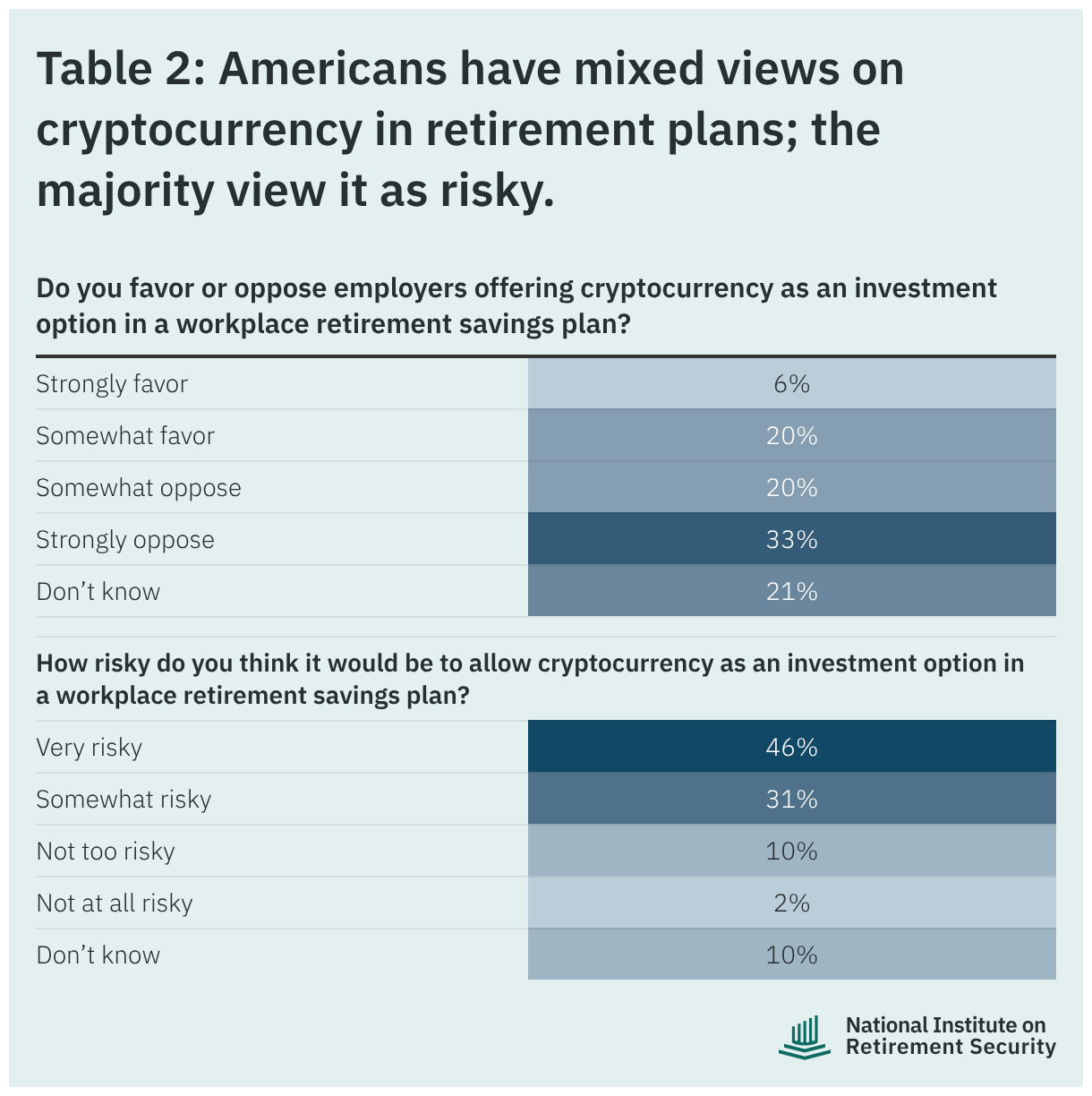
The NIRS research does not track crypto ownership or prove why people buy digital assets. It does show the financial pressure facing households with limited savings. That pressure can make a large past Bitcoin gain, a double-digit yield, or a promise of automated trading feel more relevant than a slow and uncertain savings plan.
Crypto promotion often focuses on rapid wealth creation. In a market built around price volatility, new token launches, staking rewards, and trading strategies, those messages can appeal to people who feel they have fallen behind financially.
The risk comes from treating a speculative position as money that must produce a specific result. A token can lose value quickly. A lending product can have counterparty exposure. Staked assets can involve lockups, validator risks, or smart-contract vulnerabilities. Assets held on an exchange depend on that platform’s custody and withdrawal processes.
The SEC’s investor alert on crypto asset securities highlights market volatility, platform failures, withdrawal restrictions, hacking, and the potential loss of assets held through an intermediary. Those risks matter more when the money may be needed for a future housing cost, emergency, or retirement expense.
Long-term money needs a clear risk test
Retirement preparation involves more than an account balance. NIRS found that Social Security supplies 52% of retirement income for the typical older American. Retirement plans, including pensions and defined-contribution accounts, provide about one-fifth on average. Earnings, housing costs, and debt can still shape the budget after someone stops full-time work.
That wider picture gives crypto investors a useful test. Before buying an asset or joining a yield product, ask what job the money is meant to do. Capital set aside for a long-term goal needs a time horizon, a loss limit, and a clear understanding of when it may be needed.
A volatile crypto position can sit alongside a broader financial plan. It becomes far more dangerous when an investor needs a price target, a yield payment, or a trading strategy to close a savings shortfall.

What AI-managed crypto tools add to the risk
AI can research a market, suggest a trade, calculate an order size, rebalance a portfolio, or place transactions under preset rules. Each function adds a new decision about data quality, account permissions, and the amount of capital exposed.
Coindoo previously examined the growing market for AI-managed crypto portfolios in the U.S.. The important question is not whether a tool carries an AI label. Investors need to know what the tool can access and what it can do with that access.
For example, an agent with read-only access can analyse account data without placing trades. A system connected to a dedicated account can trade only the funds assigned to it. A broader connection may have access to margin, derivatives, or a much larger share of an investor’s assets.
The SEC, FINRA, and NASAA have warned investors about AI-related schemes that promote unrealistic or guaranteed returns. Investors should verify the provider, read the terms, check trading permissions, and understand how access can be revoked before connecting any automated tool to a crypto account.
Six checks before crypto becomes part of a long-term goal
- Keep emergency money outside volatile crypto assets.
- Identify the future expense this money may cover.
- Set a loss limit before entering a position.
- Check custody, liquidity, fees, and withdrawal terms.
- Review whether staking, lending, or leverage is involved.
- Limit an AI tool’s capital and trading permissions.
Investors with complex retirement, tax, debt, or estate-planning circumstances may need individual advice from a qualified professional. A national savings figure cannot replace that work.
The NIRS study offers a useful view of retirement access and savings across groups of U.S. workers. It cannot establish a suitable crypto allocation, identify a retirement date, or measure whether a particular household can absorb a large market loss.
Its central value for crypto readers lies elsewhere. It shows how many people approach investing with limited financial slack. That is the moment when risk controls, independent research, and realistic expectations become most important.
This article is provided for informational purposes only and does not constitute investment, financial, or retirement-planning advice.



Kosta has reported on cryptocurrency markets and blockchain infrastructure since 2020, bringing over six years of hands-on experience in the crypto industry built through daily tracking of markets, trends, and emerging blockchain developments. Specializing in Bitcoin on-chain analysis, institutional ETF flows, and digital asset price action, his work at Coindoo has been cited by other news agencies and consistently covers market developments with a focus on data-driven reporting across Bitcoin, Ethereum, Solana, and XRP. Over the years, Kosta has contributed to multiple crypto media outlets in different regions, authoring over 6,000 articles across the sector. His reporting spans cryptocurrency markets and the broader fintech industry, tracking not only price action but also the technological and regulatory forces shaping the ecosystem. To support his analysis, Kosta actively leverages on-chain data and metrics from leading platforms such as Santiment, Glassnode, and CryptoQuant, enabling deeper, evidence-based market insights. He believes in the power of transparency and the data that underpins the blockchain ecosystem. His academic background in Marketing Management from Denmark further complements his analytical approach, adding a strong understanding of communication strategy and content positioning to his work.