Trump’s WLFI Price Sinks 45% as USD1 Loses Its Peg

Trump family-backed World Liberty Financial's WLFI token fell to $0.0158 and its USD1 stablecoin slipped to 94 cents on Binance on Saturday, both before Justin Sun urged delistings.
Key takeaways
- Analysts flagged a $20M reserve ETH sale Friday.
- Liquidations drove the first drop only.
- USD1 slipped equally against USDT and USDC.
- Sun is suing World Liberty over frozen tokens.
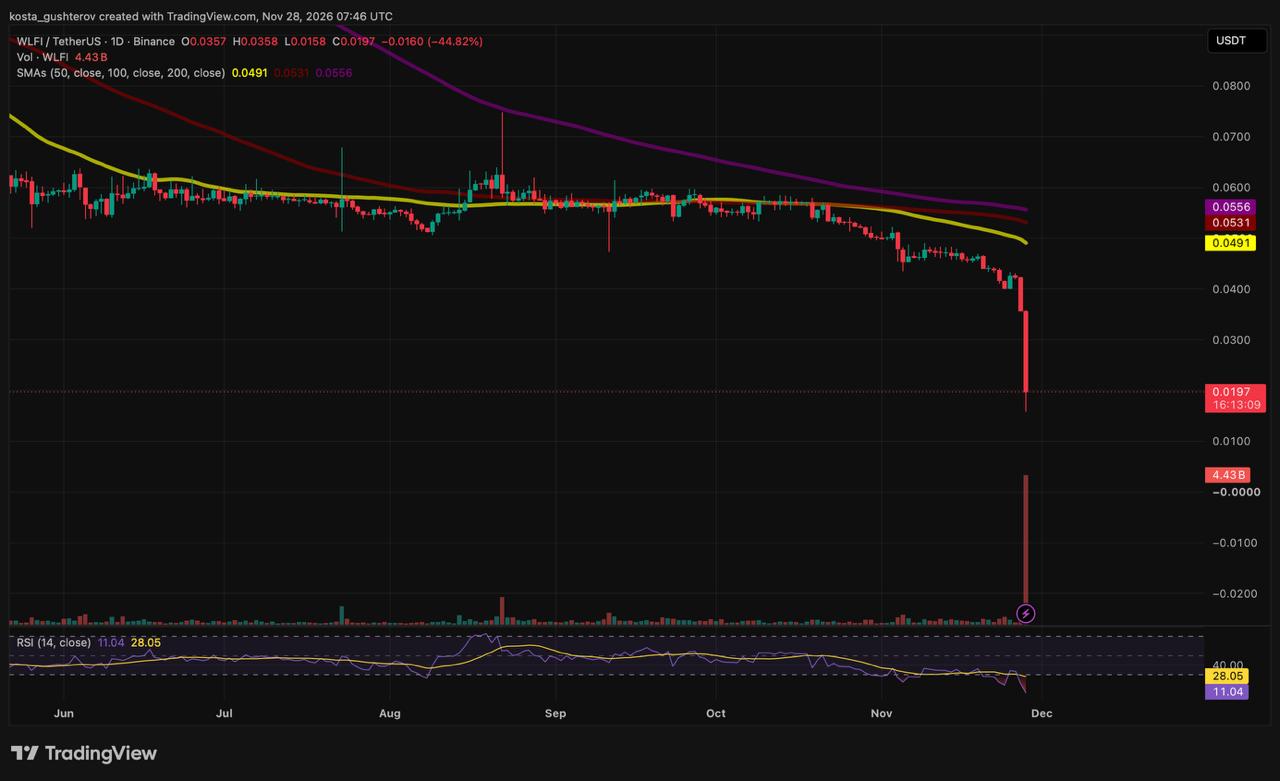
WLFI went into Saturday already weak. The token had been sliding since mid-October out of the roughly $0.055–$0.060 range it held through September, and it opened the day at $0.0357, below its 50-, 100- and 200-day moving averages.
Late on Friday, on-chain analysts EmberCN and Lookonchain flagged a wallet they linked to a World Liberty reserve selling about $20 million of ether. EmberCN counted 12,121 ETH swapped for 17.58 million USDC and 2.48 million USD1 and put the realized loss near $19 million, while Lookonchain recorded a slightly different mix of ETH and mETH. WLFI held near $0.035 for several hours after the sale, so the sale alone does not explain when the break came.
How Saturday unfolded
Nov. 28, UTC. Binance data unless noted.
WLFI opens the minute at $0.0350, and spot and the perpetual start falling together.
Spot touches $0.0211 as the liquidation burst ends.
LBank suspends WLFI deposits and withdrawals.
WLFI spot reaches the day’s low.
USD1 bottoms against USDT, with the USDC pair following a minute later.
Sun calls on exchanges to delist WLFI and USD1.
WLFI trades at $0.0197, down 44.82% on the day, while USD1 is back near 0.989.
Leverage explains the first drop, not the low
Liquidation tracker AlertaChart counted at least $10.4 million of positions forcibly closed on Binance’s WLFI/USDT perpetual in the first 15 minutes, almost all of them longs. The figure is a floor: Binance’s public liquidation feed shows no more than one order per contract each second, so simultaneous liquidations go partly uncounted.
Binance data cannot show where the selling began. The perpetual crossed $0.0340 just 58 milliseconds ahead of spot, too close to say one market led the other. Nor was the move confined to Binance: The Defiant measured a drop of roughly 25% in the hour to 05:00 UTC on Coinbase and OKX, while bitcoin barely moved.
The low came more than an hour after the liquidation burst ended, about 25% beneath the level where it stopped. Open interest on Binance’s perpetual, counted in WLFI tokens so a falling price does not shrink it on paper, shows positions draining throughout. It went from 3.98 billion tokens at 04:30 to 2.59 billion ten minutes later, 1.94 billion at the low and 1.25 billion by 07:45, a 69% reduction.
Open interest cannot separate the two causes. Traders leaving voluntarily shrink it just as liquidations do, and no public count of forced closures covers the slide to the low. By 07:46 UTC, WLFI’s rebound had stayed below the level where the liquidation burst ended, and the daily 14-period RSI stood at 11, far below any reading since June.
USD1’s discount showed up on both of its pairs
World Liberty’s dollar token fell to 0.9400 USDT and 0.9389 USDC on Binance. A problem with either quote coin would have opened a gap between the two pairs. Instead the discount was almost identical, which places the selling in USD1 itself. On CoinMarketCap’s cross-exchange price, the move was shallower: USD1 first drifted to about 99.6 cents, then bottomed near 95 cents.
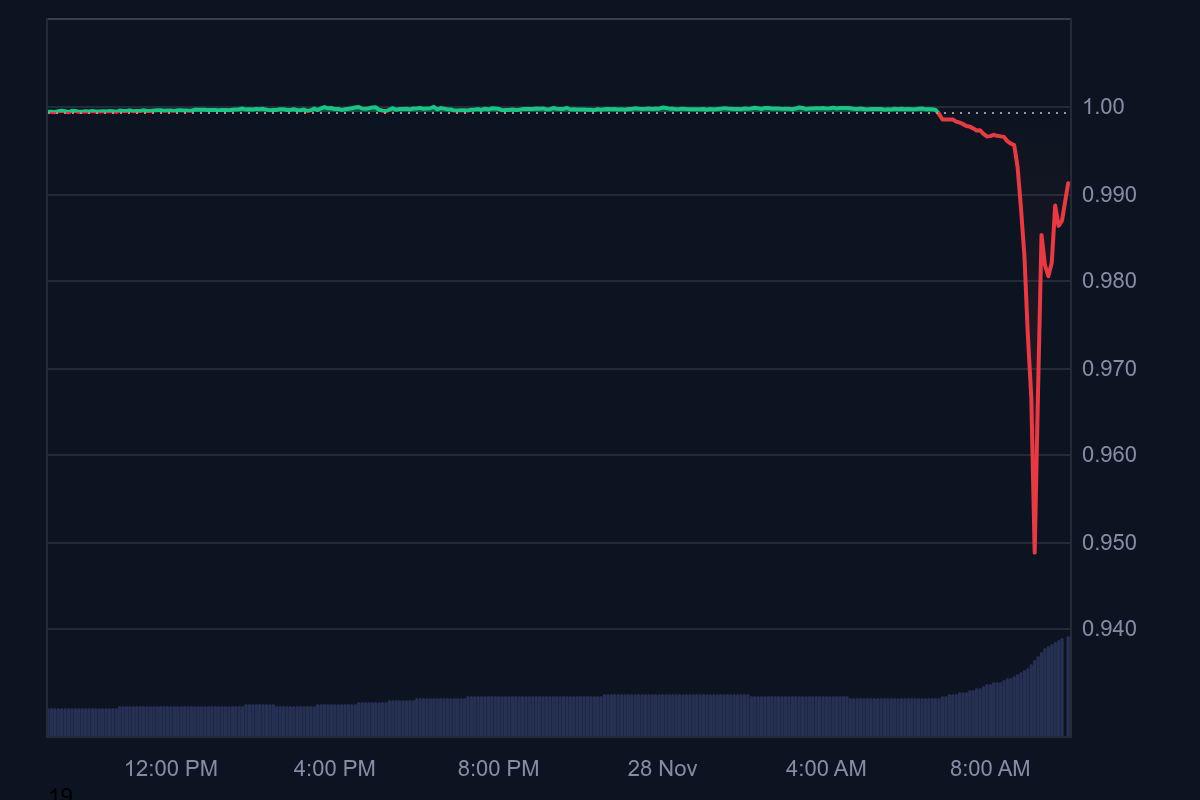
The redemption rules explain why such a gap can open. World Liberty’s documentation says eligible BitGo customers can redeem USD1 directly for dollars. Everyone else can only sell on the market, so closing a discount depends on the smaller group with redemption access buying it.
World Liberty’s own borrowing is tied to the same token. Its lending markets run on Dolomite, a protocol co-founded by World Liberty adviser Corey Caplan, and in April the project used 5 billion WLFI as collateral to borrow about $75 million there. At Saturday’s low, 5 billion WLFI was worth about $79 million. World Liberty dismissed liquidation concerns as “FUD” when the position drew scrutiny in April, and Coindoo could not confirm how much of that borrowing was still open on Saturday.
Sun’s delisting call comes from an opposing litigant
Sun’s English post, embedded below, accuses the venture of investor fraud and ties Saturday’s move to insider circular lending and unauthorized insider selling. He directed his call at regulators and courts as well as exchanges, and posted a Chinese version alongside it. The allegations remain unverified.
Today’s WLFI episode is just another rerun of insider circular lending to cash out, unauthorized insider selling, the illegal freezing of investor assets, and investor fraud. I call on major exchanges, regulators, judicial authorities, and the courts to take prompt action against WLFI and USD1, including but not limited to issuing warning lists, immediate delisting, restricting deposits, and requiring disclosure of where the illicit funds have gone. Related team members have already been mass-deleting social media and communications in an attempt to cover up their crimes. Action cannot wait.
— H.E. Justin Sun 👨🚀 🌞 (@justinsuntron) November 28, 2026
Sun has a direct stake in the dispute. By his own account, he was one of World Liberty’s earliest large backers, agreeing in November 2024 to buy $30 million of WLFI and later raising his total to $45 million. World Liberty blacklisted one of his wallets in September 2025 after he moved tokens. In April he sued the company, alleging he was misled into investing and that his tokens were unlawfully frozen. World Liberty said its sale terms disclosed its power to freeze tokens and filed a defamation suit in May, and it has since alleged in court that Sun shorted WLFI.
This is also not the first time an exchange associated with Sun has dropped these tokens. In June, HTX suspended its WLFI and USD1 pairs and delisted USD1, converting balances to USDT, after World Liberty froze HTX-linked addresses on sanctions-compliance grounds.
What World Liberty has not answered
World Liberty had not publicly addressed the reserve sale or Sun’s new allegations at the time of writing. Four questions are still open: who sold first when WLFI broke at 04:22 UTC, whether BitGo redemptions processed normally while USD1 traded below $1, how much of the Dolomite borrowing was outstanding at the low, and why LBank halted WLFI transfers without giving a reason.
Market data: Binance spot, perpetual and open-interest feeds; daily figures from TradingView’s Binance WLFI/USDT chart at 07:46 UTC; USD1 cross-exchange price from CoinMarketCap.



Kosta has reported on cryptocurrency markets and blockchain infrastructure since 2020, bringing over six years of hands-on experience in the crypto industry built through daily tracking of markets, trends, and emerging blockchain developments. Specializing in Bitcoin on-chain analysis, institutional ETF flows, and digital asset price action, his work at Coindoo has been cited by other news agencies and consistently covers market developments with a focus on data-driven reporting across Bitcoin, Ethereum, Solana, and XRP. Over the years, Kosta has contributed to multiple crypto media outlets in different regions, authoring over 6,000 articles across the sector. His reporting spans cryptocurrency markets and the broader fintech industry, tracking not only price action but also the technological and regulatory forces shaping the ecosystem. To support his analysis, Kosta actively leverages on-chain data and metrics from leading platforms such as Santiment, Glassnode, and CryptoQuant, enabling deeper, evidence-based market insights. He believes in the power of transparency and the data that underpins the blockchain ecosystem. His academic background in Marketing Management from Denmark further complements his analytical approach, adding a strong understanding of communication strategy and content positioning to his work.