Trump’s Filing Shows Strategy, Coinbase Buys and Miner Sales
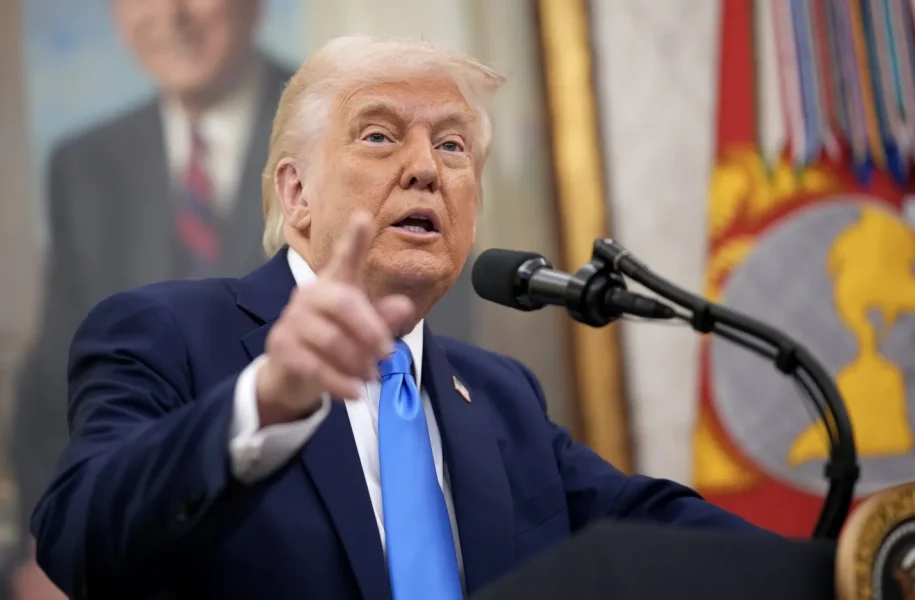
US President Donald Trump’s latest financial transaction report lists purchases of Strategy and Coinbase shares alongside sales of MARA Holdings and CleanSpark.
The largest crypto-linked entry was a July 27 Strategy purchase valued between $50,001 and $100,000. Yet the six relevant trades appear within a filing containing 1,156 transactions across stocks, bonds and other securities. They should not be read in isolation as a wholesale move into or out of crypto equities.
Source note: The 37-page OGE Form 278-T was received by the Office of Government Ethics on September 14 and certified on September 18. The transactions covered below occurred in July.
What changed in July
Shares purchased
Strategy – July 27
$50,001–$100,000
Strategy – July 24
$1,001–$15,000
Coinbase – July 24
$1,001–$15,000
Shares sold
MARA Holdings – July 29
$15,001–$50,000
CleanSpark – July 29
$15,001–$50,000
The report also lists a Strategy sale on July 8 valued between $1,001 and $15,000. Its two later purchases therefore followed an earlier reduction in the same stock.
The value of the two Strategy purchases was more than $51,000 and no more than $115,000. That is a gross disclosed range, not the size of the account’s current Strategy position. The filing provides no share counts, execution prices or closing balances.
How to read the disclosure without overstating it
An OGE Form 278-T records qualifying securities transactions above $1,000 involving the filer, the filer’s spouse or a dependent child. Each transaction is placed inside a value band rather than reported as an exact amount.
- The owner is not identified. Individual entries do not say which covered person held the shares.
- The decision-maker is not identified. The form does not show whether Trump, a family member or an investment manager selected the trade.
- The remaining position is not reported. The MARA and CleanSpark sales could have closed those holdings or reduced larger positions.
Because those details are missing, the accurate statement is that Trump’s disclosure lists the transactions—not that Trump personally placed each order.
Four stocks represent three different crypto exposures
The companies do not provide interchangeable bets on Bitcoin.
Strategy: Bitcoin held on a corporate balance sheet
Strategy describes itself as a Bitcoin treasury company. Its common stock gives investors indirect exposure to a business holding a large Bitcoin reserve, but shareholders cannot redeem MSTR shares for the company’s BTC.
The stock also responds to financing costs, share issuance, preferred securities and the premium or discount investors assign to the company’s Bitcoin holdings. Coindoo’s earlier examination of how Bitcoin prices affect Strategy’s treasury position explains why MSTR should not be treated as equivalent to Bitcoin itself.
Coinbase: activity across the crypto market
Coinbase operates a platform for trading, custody and other crypto services. Its business can benefit from higher transaction volumes and customer activity even when the prices of individual digital assets move in different directions.
MARA and CleanSpark: the economics of producing Bitcoin
MARA and CleanSpark retain substantial Bitcoin-mining operations. Their results depend on Bitcoin’s price, but also on electricity costs, mining difficulty, equipment efficiency and the amount of BTC their facilities produce.
The reported accounts therefore bought exposure to a Bitcoin treasury company and a crypto platform while selling shares in two mining businesses. That does not reveal whether their overall sensitivity to Bitcoin rose or fell, because the disclosure does not show the size of the positions that remained.
These equity trades are separate from Trump’s direct crypto interests
The periodic report should not be confused with Trump’s annual financial disclosure. Coindoo’s earlier review of Trump’s disclosed cryptocurrency holdings and income covered digital assets, wallets and revenue connected with crypto businesses. The new Form 278-T instead records transactions in publicly traded securities.
A Strategy share purchase is not a Bitcoin purchase, just as selling shares in a miner is not the same as selling BTC. The distinction determines what the document can support and what would require additional evidence.

The document shows direction, not intent
The public record confirms that Strategy and Coinbase shares were purchased while MARA and CleanSpark shares were sold. It does not establish whether the trades formed a coordinated crypto strategy, resulted from ordinary portfolio rebalancing or were chosen by an outside manager.
It also does not show whether the mining positions were closed or how much crypto-linked equity remained afterward. The filing establishes the allocation changes. The reasoning behind them remains outside the public record.
This article is provided for informational purposes only and does not constitute financial or investment advice. Public financial disclosures use value ranges and may not identify who directed individual transactions.



Kosta has reported on cryptocurrency markets and blockchain infrastructure since 2020, bringing over six years of hands-on experience in the crypto industry built through daily tracking of markets, trends, and emerging blockchain developments. Specializing in Bitcoin on-chain analysis, institutional ETF flows, and digital asset price action, his work at Coindoo has been cited by other news agencies and consistently covers market developments with a focus on data-driven reporting across Bitcoin, Ethereum, Solana, and XRP. Over the years, Kosta has contributed to multiple crypto media outlets in different regions, authoring over 6,000 articles across the sector. His reporting spans cryptocurrency markets and the broader fintech industry, tracking not only price action but also the technological and regulatory forces shaping the ecosystem. To support his analysis, Kosta actively leverages on-chain data and metrics from leading platforms such as Santiment, Glassnode, and CryptoQuant, enabling deeper, evidence-based market insights. He believes in the power of transparency and the data that underpins the blockchain ecosystem. His academic background in Marketing Management from Denmark further complements his analytical approach, adding a strong understanding of communication strategy and content positioning to his work.