Trump’s Crypto Meeting: Who Is in the Room and Why

A token can be sold without having a clear route through the rest of the financial system but it buyer may still face unanswered questions about custody, trading venues, ownership records and settlement.
That practical gap appears to be behind a White House meeting reportedly scheduled for the afternoon of August 19, 2026. According to CoinDesk, President Donald Trump is expected to meet SEC Chair Paul Atkins, CFTC Chair Michael Selig and executives connected with Coinbase, Ripple, Gemini, Polymarket, Kalshi, Nasdaq, NYSE, CME Group and DTCC at the Eisenhower Executive Office Building.
The White House had not published an agenda or confirmed the list of participants at the time of writing, so the details remain based on that report.
The reported group brings together companies involved at nearly every stage of a transaction, from customer access and trading to custody, clearing and settlement. While tokenization may be part of the discussion, the more difficult question is how tokenized assets can operate within financial systems that already carry defined legal and regulatory responsibilities.
Why the reported mix of participants matters
| Reported participants | Part of the transaction | Question still to be resolved |
|---|---|---|
| Coinbase, Ripple and Gemini | Customer access, custody and token distribution | Which rules apply when a customer holds or transfers the asset? |
| Nasdaq, NYSE and CME Group | Trading venues and derivatives infrastructure | Where may the product trade, and under which market rules? |
| Polymarket and Kalshi | Event-contract platforms | Where does the line sit between a regulated contract and a securities product? |
| DTCC | Clearing, settlement and depository services | How is ownership recorded and a completed trade settled? |
DTCC’s reported presence is particularly significant because tokenized securities still require legally recognised ownership records and a defined settlement process. These are central post-trade functions that cannot be handled solely through a wallet interface or smart contract.
There is also some overlap with the CFTC’s existing work. Its Innovation Advisory Committee roster includes several of the companies named in the report. The roster does not confirm their attendance at the White House meeting, but it indicates that many of the same infrastructure questions are already being considered by the regulator.
Congress has left a seam between the agencies
The CLARITY Act was meant to address wider questions of crypto-market structure and agency jurisdiction. Its delay leaves regulators to work through narrower pieces of the problem. As we reported when the Senate left for recess, the bill lost its August path.
That matters because a federal agency can clarify an existing rule or propose an exemption, while Congress is the body that can write a durable division of responsibilities into law. Product classification, intermediary oversight and secondary trading remain connected questions.
The SEC has issued an interpretation, not a complete trading framework
In March, the SEC and CFTC issued a joint interpretation on crypto assets. It set out categories including digital commodities, digital collectibles, digital tools, payment stablecoins and digital securities.
Atkins has also described a potential package called Regulation Crypto. His March remarks floated a startup exemption, a larger fundraising exemption and an investment-contract safe harbour. Those ideas are useful signposts, but an issuer cannot rely on a speech. A formal proposal needs published text, a release number and a comment deadline.
That distinction has immediate consequences. A project might receive a route to sell a token, yet still lack a settled answer on how the token can trade on a regulated venue or move through established custody and clearing arrangements.
The CFTC is examining the infrastructure around the product
The CFTC’s Innovation Advisory Committee can make recommendations; it cannot create a binding market rule. Its role is nevertheless relevant because the agency’s Innovation Task Force is working with the committee on crypto assets and blockchain technology, prediction markets and coordination with the SEC’s Crypto Task Force.
That puts event contracts, crypto products and tokenization in the same policy conversation. It does not settle their treatment. Firms still need written rules that identify the responsible intermediary, the applicable venue requirements and the regulator with authority over each activity.

A token still has to meet the clearing system
The existing securities system is already beginning to confront that question. In April, the SEC published a NYSE rule filing covering securities in tokenized form. Separately, the SEC has considered changes to DTC operational arrangements that govern securities’ eligibility for DTC services.
These filings show where a White House discussion becomes concrete. A blockchain record has to work alongside recognised ownership records, transfer controls, custody arrangements and settlement finality. Each responsibility needs a named institution and a legal basis.
That is the part of tokenization that determines whether a product can move beyond a limited pilot. A token that cannot enter a compliant trading and settlement route may still exist onchain, but it will not operate like a conventional security in the US financial system.
The evidence that would move this beyond a meeting
Traders should watch for documents rather than broad promises.
- A White House readout confirming who attended and which issues were discussed.
- An SEC release containing the full Regulation Crypto text, its file number and public-comment deadline.
- A CFTC agenda or meeting record identifying the questions assigned to its advisory committee.
- A pilot involving an issuer, a regulated venue and post-trade infrastructure such as DTCC.
Those records would answer the practical question raised by the reported meeting: whether a tokenized security can carry a documented issuer, a legal trading route and a workable settlement process. Until they appear, the gathering signals policy coordination rather than a change in what issuers, exchanges or investors may do.
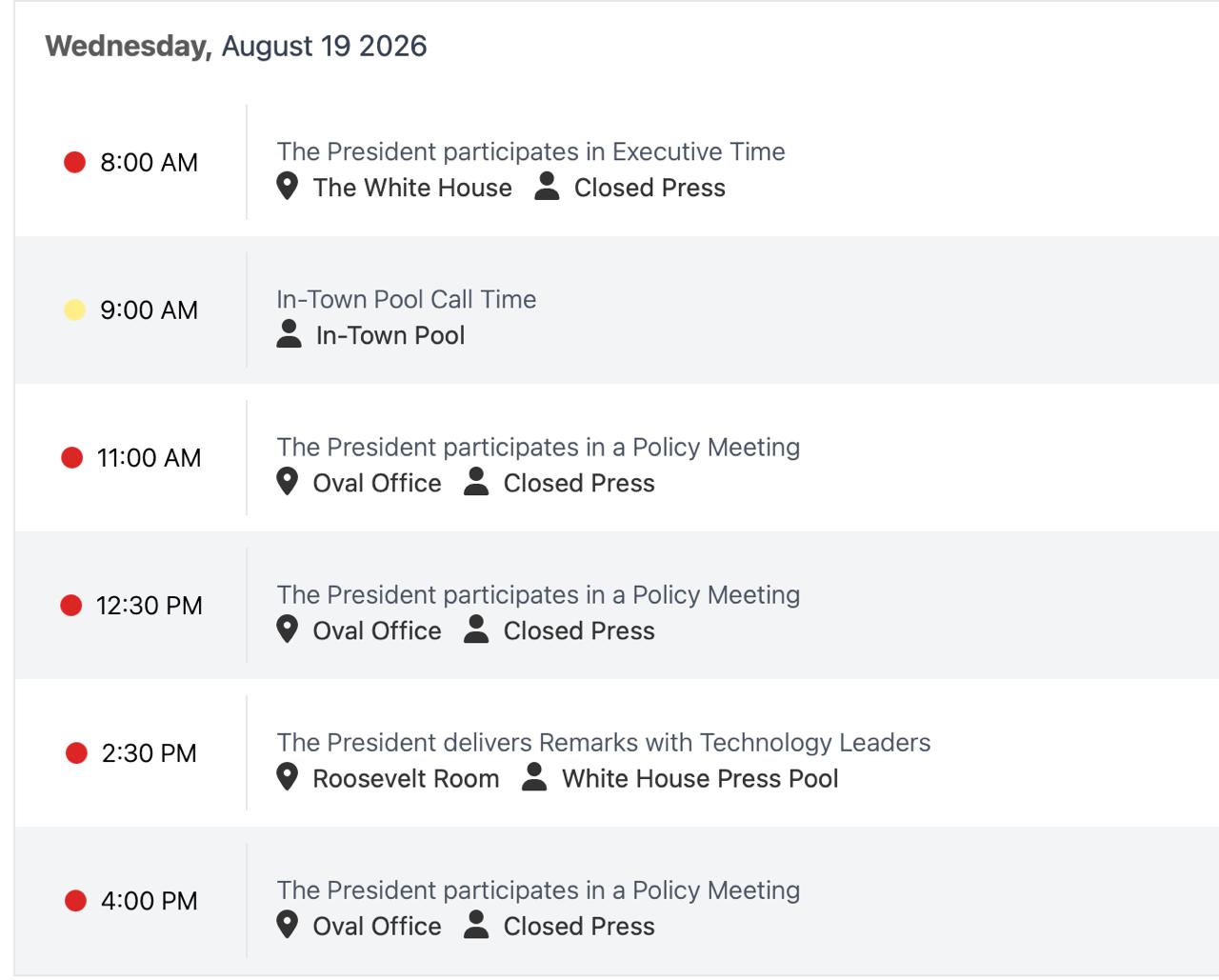
- UPDATE August 19 – 14:20 UTC: According to the President’s official schedule, Trump is set to deliver remarks with technology leaders at 2:30 p.m. EDT (6:30 p.m. UTC) in the Roosevelt Room. The event will be covered by the White House press pool.



Alex is Editor-in-Chief of Coindoo and co-founder of Millennial Media Group, with nearly a decade of experience covering financial markets - crypto first, then everything else. It started in 2016 with Bitcoin. Like most people at the time, he didn't fully understand it - so he kept digging. Blockchain, tokenomics, the projects, the cycles. That curiosity never stopped, and eventually pulled him into traditional markets too: equities, commodities, macro. Not because he left crypto behind, but because you can't properly understand one without the other. What drives him is straightforward: he wants to know why something is happening, not just that it's happening. Most market coverage stops at the headline - price up, price down, here's a chart. Alex finds that kind of reporting actively unhelpful. If you walk away from an article without understanding the mechanism behind the move, what did you actually learn? He holds a degree in Tourism from New Bulgarian University - not the most obvious path into financial markets, but markets have a way of pulling in people who are simply too curious to stay out. He has authored over 200 in-depth analyses and more than 10,000 articles across crypto and traditional finance. He still thinks every day in markets teaches him something new. That's probably why he hasn't stopped.