Solana’s RWA and Payments Growth Has a Concentration Problem

Solana is gaining ground in tokenized assets and automated payments, but its tokenized-stock trading and validator infrastructure remain concentrated among a small number of providers and locations.
Key Takeaways
- Solana handled 32% of RWA spot volume.
- It held 12% of outstanding RWA value.
- One issuer and one venue dominate volume.
- x402 leadership needs organic-use confirmation.
- Two cities held 54.7% of leader slots.
Solana’s RWA lead is in trading, not holdings
Solana processed $14.7 billion of the $46 billion in onchain real-world asset spot volume recorded during the 12 months through August 18, according to an Allium report. That gave the network 32% of dollar volume and 47% of transaction count across the 24 chains studied.
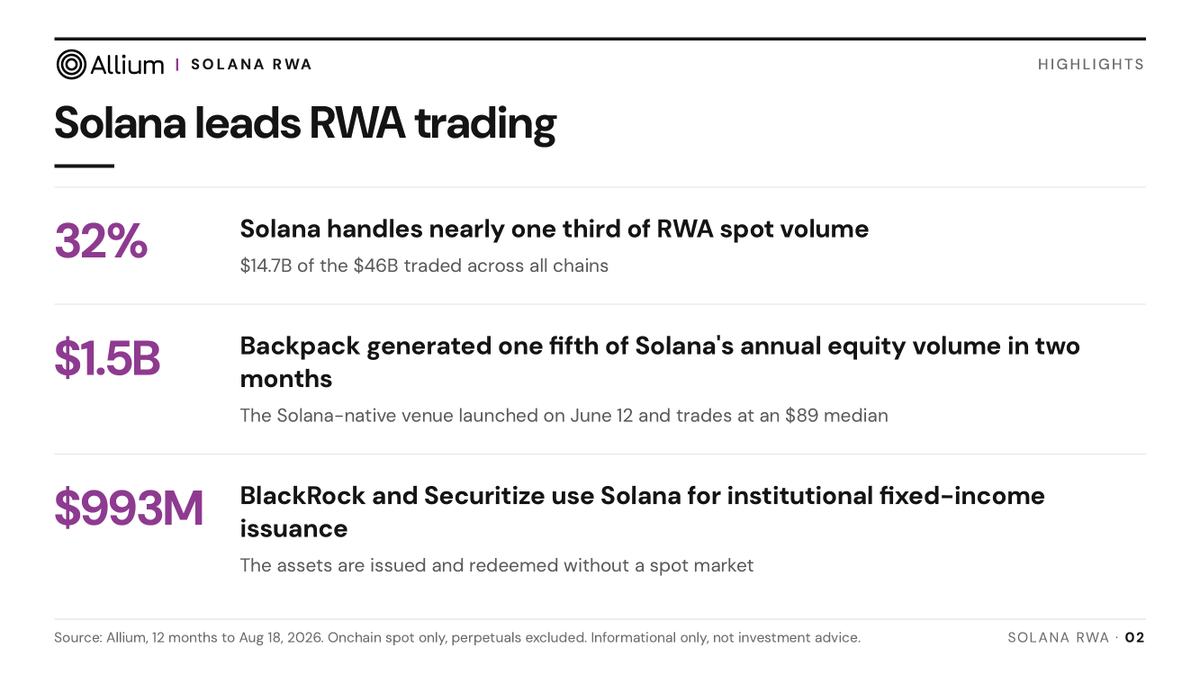
Solana held only 12% of the outstanding RWA value measured by Allium. Its larger trading share therefore reflected turnover rather than the amount of tokenized assets on the network.
Allium attributed that gap partly to frequent, relatively small transactions. The median RWA trade on Solana was $29, compared with $70 across other networks. Its 374,000 traders completed an average of 114 trades each, versus 63 elsewhere.
Tokenized equities generated $8.2 billion of Solana’s annual RWA volume. Allium found that 63% of those trades occurred outside U.S. exchange hours, showing that much of the demand appeared when traditional markets were closed.
The annual figures also show concentration within individual asset classes. Solana processed $5.4 billion, or 74%, of the fixed-income volume measured across chains, yet almost all of its share came from two private-credit issuers. In the private-fund category, one reinsurance product generated 52% of the onchain volume measured by Allium.
Why 32% and 9.1% tell different stories
A separate Token Terminal dataset put Solana’s tokenized-stock DEX volume at $807.3 million over the latest 30 days. That represented 9.1% of the $8.8 billion recorded across six chains.
Solana accounted for $807.3M, or 9.1%, of tokenized stock DEX volume over the past 30d
Within Solana, the leaders were:
Reference stock: ETF ($165.3M)
Asset: SPYx ($145.4M)
Issuer: xStocks ($490.7M)
Venue: Raydium CLMM ($560.4M) pic.twitter.com/KfPr0x4S6j— Token Terminal 📊 (@tokenterminal) September 9, 2026
The figure does not conflict with Allium’s 32% share. Allium covered six RWA classes over a year, including equities, fixed income, private funds and commodities. Token Terminal measured only tokenized stocks traded through decentralized exchanges during one month.
Figures use different reporting windows, ranging from 30 days to the 12 months through August 18, 2026.
One issuer and one venue carry most tokenized-stock volume
Within Solana, xStocks generated $490.7 million, or 60.8%, of the 30-day tokenized-stock DEX volume. Raydium’s concentrated-liquidity pools handled $560.4 million, equivalent to 69.4% of the total.
Those percentages cannot be added together. xStocks is an issuer, whereas Raydium is a trading venue. Each dominates a different layer of the same market.
A change to xStocks listings, redemption terms or incentives could reduce the products available to trade. On Raydium, a contract incident or the departure of major liquidity providers could thin liquidity and widen spreads.
The figures point to commercial concentration rather than a consensus failure. Volume could fall or migrate quickly following a major change at either xStocks or Raydium.
x402 opens another use case for Solana
Beyond tokenized stocks, Solana is competing to settle payments for APIs and other online services through x402.
x402 is an open protocol that allows an API or digital service to request a stablecoin payment within an HTTP request. A person, application or software agent can pay for data, computing resources or other online services without completing a conventional checkout process.
Solana ranked first in x402 transaction count and volume for a second consecutive week, according to an Artemis chart shared by Solana.
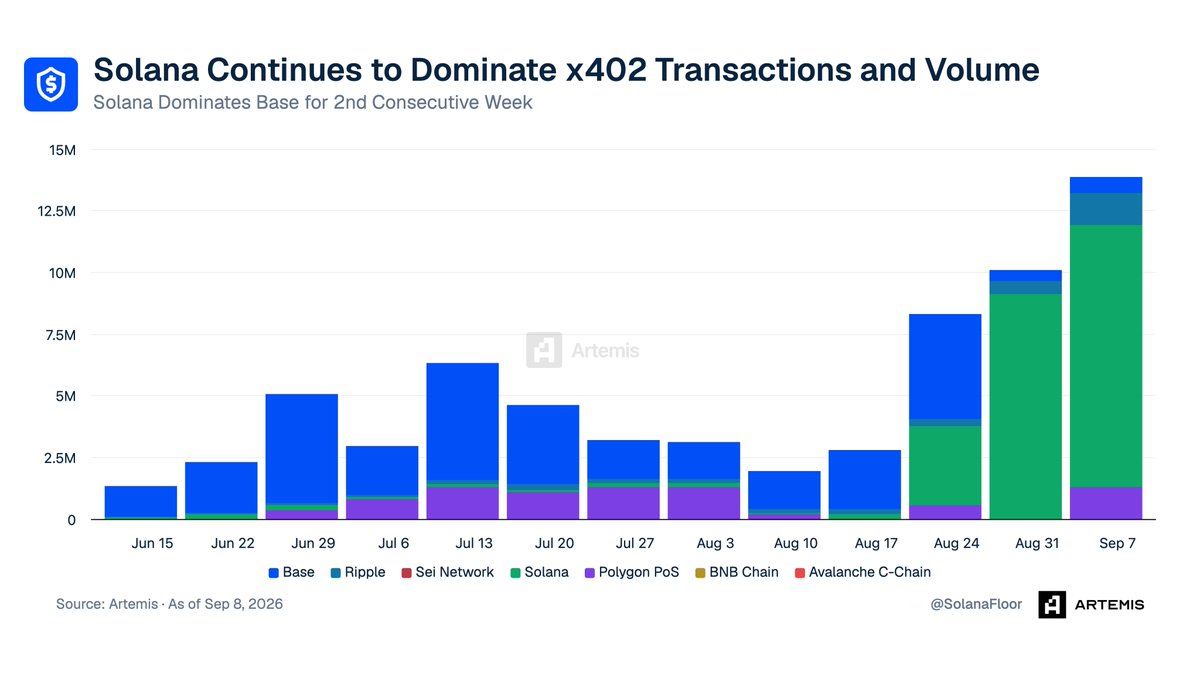
Because x402 payments settle in stablecoins, they do not represent direct purchases of SOL. Their connection to the native token is limited mainly to the blockspace and transaction fees they use.
Raw transaction counts need additional scrutiny. In January 2026, Artemis estimated that 86% of Solana’s historical x402 payments were gamed or non-economic under its revised methodology. Earlier figures had been inflated by memecoin transfers and attempts to climb activity rankings.
That estimate concerned earlier data. The September ranking should therefore be read as a current lead, not proof of an established commercial market.
Two cities carry more than half of leader slots
A separate concentration appears in the validator infrastructure processing those transactions.
A Glassnode post on X placed 35.3% of Solana’s leader slots in Frankfurt and 19.4% in Amsterdam during epoch 1030. Together, the two cities accounted for approximately 54.7%.
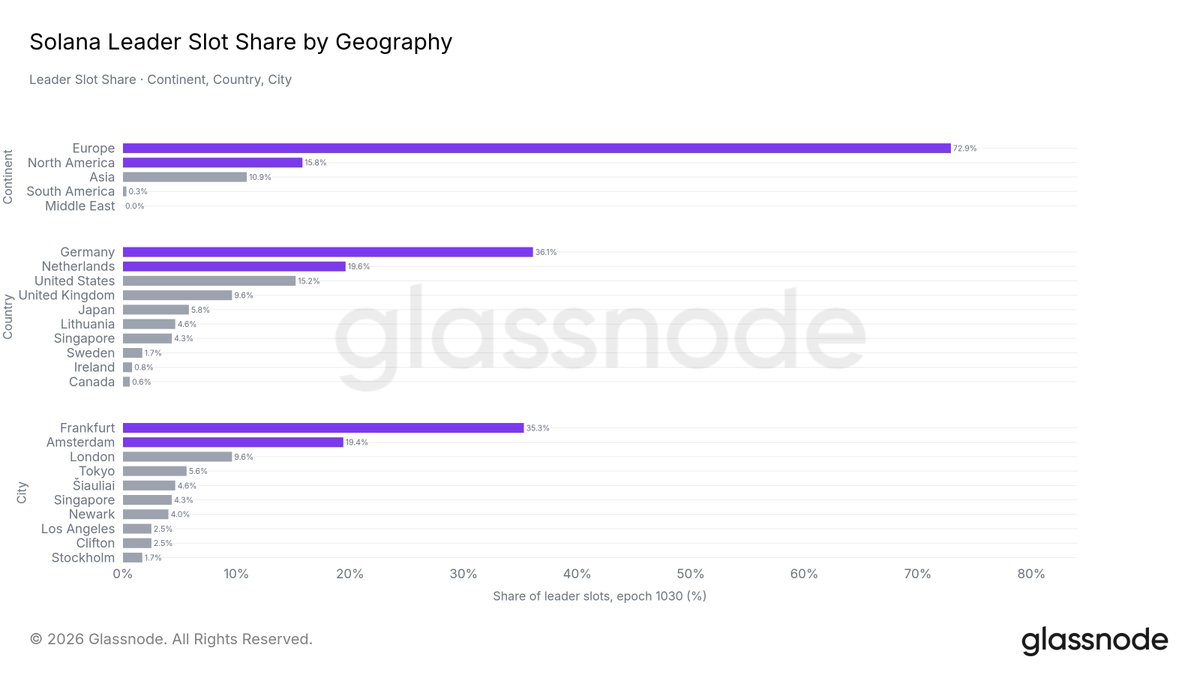
Glassnode also reported that 310 of 675 validators were located in those cities, representing 46% of the validator count and 53% of active stake. Europe accounted for 72.9% of leader slots in the same snapshot.
Leader-slot share measures where scheduled block-production opportunities are located, not who controls the validators. Independent operators can use infrastructure in the same city, so the figures do not prove common ownership. They do reveal correlated exposure to connectivity failures, hosting disruptions and regional regulatory action.
The distribution can change between epochs as validators move, leave the network or receive different amounts of delegated stake. The figures describe the September 8 snapshot rather than a permanent allocation of block production.
Performance incentives help explain the clustering
Frankfurt and Amsterdam are major connectivity hubs, making them attractive to validators and latency-sensitive traders. Physical proximity reduces the time required to send transactions to the current block producer, which can improve execution for market makers, arbitrage systems and liquidation bots.
Competition for lower latency can therefore encourage operators to use the same well-connected infrastructure.
Maintaining a low-latency setup also has a cost. Validators must cover hosting, connectivity and hardware expenses, so changes to validator rewards can shape which operators can justify operating in major connectivity hubs. Coindoo previously examined how record Solana fees coincided with proposed reductions in validator rewards. The current geography data do not show whether those proposals contributed to the Frankfurt-Amsterdam cluster.
READ MORE:

LAPTOP Coin May Burn 30% – But Who Decides?
The metrics that would show wider distribution
For tokenized stocks, the risk would decline if competing issuers and venues gained volume without shrinking the overall market. A falling xStocks or Raydium share caused only by lower trading would not represent greater adoption.
For x402, recurring buyers, qualified sellers and continued payment value would provide stronger evidence than another weekly transaction record. Those measures would help separate payments for useful services from testing, farming and leaderboard competition.
At the infrastructure layer, the clearest improvement would be growth in stake and leader-slot share outside Frankfurt and Amsterdam. Lower concentration caused by expansion elsewhere would strengthen the network; a lower share caused by validators leaving would not.
This article is for informational purposes only and does not constitute financial advice.



Alex is Editor-in-Chief of Coindoo and co-founder of Millennial Media Group, with nearly a decade of experience covering financial markets - crypto first, then everything else. It started in 2016 with Bitcoin. Like most people at the time, he didn't fully understand it - so he kept digging. Blockchain, tokenomics, the projects, the cycles. That curiosity never stopped, and eventually pulled him into traditional markets too: equities, commodities, macro. Not because he left crypto behind, but because you can't properly understand one without the other. What drives him is straightforward: he wants to know why something is happening, not just that it's happening. Most market coverage stops at the headline - price up, price down, here's a chart. Alex finds that kind of reporting actively unhelpful. If you walk away from an article without understanding the mechanism behind the move, what did you actually learn? He holds a degree in Tourism from New Bulgarian University - not the most obvious path into financial markets, but markets have a way of pulling in people who are simply too curious to stay out. He has authored over 200 in-depth analyses and more than 10,000 articles across crypto and traditional finance. He still thinks every day in markets teaches him something new. That's probably why he hasn't stopped.