MSTR’s Institutional Momentum Story Has a Footnote Nobody Is Talking About

Phong Le, President and CEO of Strategy, posted 13F data showing 13 of the top 15 institutional shareholders of MSTR added to their positions in Q1 2026, with combined holdings increasing 27%.
- 13 of top 15 institutional shareholders added to MSTR positions in Q1 2026.
- Combined holdings up 27%, measured in share quantity at fixed 5/15/26 price.
- Defiance ETFs entered fresh at $511M: new entrant, not an existing holder adding.
- Capital International added $1,921M; UBS added $35M: same cohort, different conviction.
The 13-of-15 figure includes Defiance ETFs, which held no MSTR at the end of 2025 and entered with $511M in a single quarter, making it a new institutional entrant rather than an existing holder adding conviction, a meaningful distinction the framing does not draw. Remove Defiance and the cohort is 12 existing holders adding, one holding flat, and one reducing. That still represents the majority of the top 15 adding deliberately to an existing position, which is the stronger claim and the more accurate one.
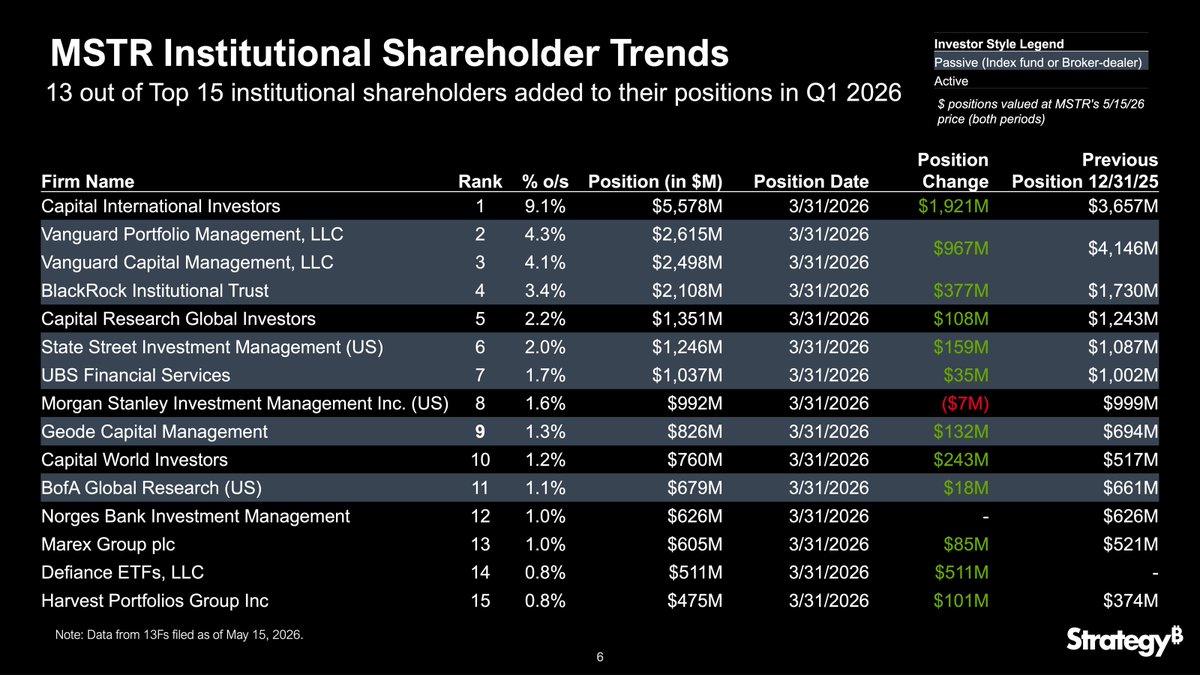
The two firms that did not add tell different stories. Morgan Stanley reduced its position by $7M from $999M to $992M, a 0.7% reduction that is effectively flat. Norges Bank Investment Management held unchanged at $626M with no position change recorded.
Capital International’s $1,921M addition and UBS’s $35M addition are both counted as a single vote of confidence in the same cohort, but a 52.5% increase in share quantity from the largest holder is a structurally different statement than a 3.5% increase from a firm already above $1 billion. The range of conviction inside the 13 additions spans from a firm doubling its position to a firm making a token addition. The aggregate 27% figure blends both into a single number.

What the 27% Measures and What It Does Not
The 27% combined holdings increase measures share quantity growth at a fixed price rather than dollar value appreciation, which means the institutional commitment story it tells is about deliberate accumulation of shares, not about the market valuing those shares higher. Both periods are valued at MSTR’s May 15, 2026 price, which isolates the share count change from price movement. The 13 firms that added chose to hold more shares of MSTR between December 31, 2025 and March 31, 2026. That is the precise claim the data supports.
The investor style legend distinguishes passive holders, index funds and broker-dealers, from active managers. Analytically, passive holders add to MSTR positions when index weights shift or client demand increases, not necessarily through deliberate Bitcoin treasury conviction. If a meaningful portion of the 27% share quantity growth reflects index rebalancing by Vanguard and similar passive vehicles rather than active allocation decisions, the figure overstates the degree of deliberate institutional endorsement it is being used to represent.
If Q2 2026 13F filings show the same pattern of additions without a new entrant inflating the count and with active managers leading the share quantity growth, the institutional accumulation thesis will have a second consecutive quarter of evidence behind it. If the Q2 data shows passive rebalancing accounting for most of the additions while active managers reduce or hold flat, the Q1 pattern will look more like index mechanics than conviction.
The information provided in this article is for educational purposes only and does not constitute financial, investment, or trading advice. Coindoo.com does not endorse or recommend any specific investment strategy or cryptocurrency. Always conduct your own research and consult with a licensed financial advisor before making any investment decisions.



Kosta has reported on cryptocurrency markets and blockchain infrastructure since 2020, bringing over six years of hands-on experience in the crypto industry built through daily tracking of markets, trends, and emerging blockchain developments. Specializing in Bitcoin on-chain analysis, institutional ETF flows, and digital asset price action, his work at Coindoo has been cited by other news agencies and consistently covers market developments with a focus on data-driven reporting across Bitcoin, Ethereum, Solana, and XRP. Over the years, Kosta has contributed to multiple crypto media outlets in different regions, authoring over 6,000 articles across the sector. His reporting spans cryptocurrency markets and the broader fintech industry, tracking not only price action but also the technological and regulatory forces shaping the ecosystem. To support his analysis, Kosta actively leverages on-chain data and metrics from leading platforms such as Santiment, Glassnode, and CryptoQuant, enabling deeper, evidence-based market insights. He believes in the power of transparency and the data that underpins the blockchain ecosystem. His academic background in Marketing Management from Denmark further complements his analytical approach, adding a strong understanding of communication strategy and content positioning to his work.