How to Buy MON and Use the Monad Ecosystem in 2026
Monad spent most of the past year defined by its testnet, one of the most closely watched in crypto, but that chapter is effectively closed. The network’s public mainnet went live on November 24, 2025, and MON launched as a real asset on the same day. The token now trades on Coinbase, OKX, Bybit and other major exchanges, and the airdrop that drove so much of the testnet activity was claimed and distributed back in late 2025.
What does a Monad guide need to cover now? Faucet farming is over. What people need now is the practical stuff: how to get MON, move it onto the network, stake it, and figure out which of the hundreds of live apps are actually worth opening.
Set Up a Wallet for Monad
Monad is fully EVM compatible, so any standard EVM wallet works. You’re not locked into one. MetaMask, Phantom, Backpack, OKX Wallet, Rabby – use whatever you already have open.
Whichever wallet you choose, make sure you are connected to Monad Mainnet before moving real funds. Monad also runs a separate developer testnet, and tokens on it have no value, so confirm you are on the main network.
How to Get MON in 2026
MON is a real token now. You buy it like any other crypto, not from a faucet. Two routes work: buy on an exchange and withdraw to Monad, or bridge in assets you hold elsewhere. Most people take the first.
Buy MON on an exchange and withdraw to Monad
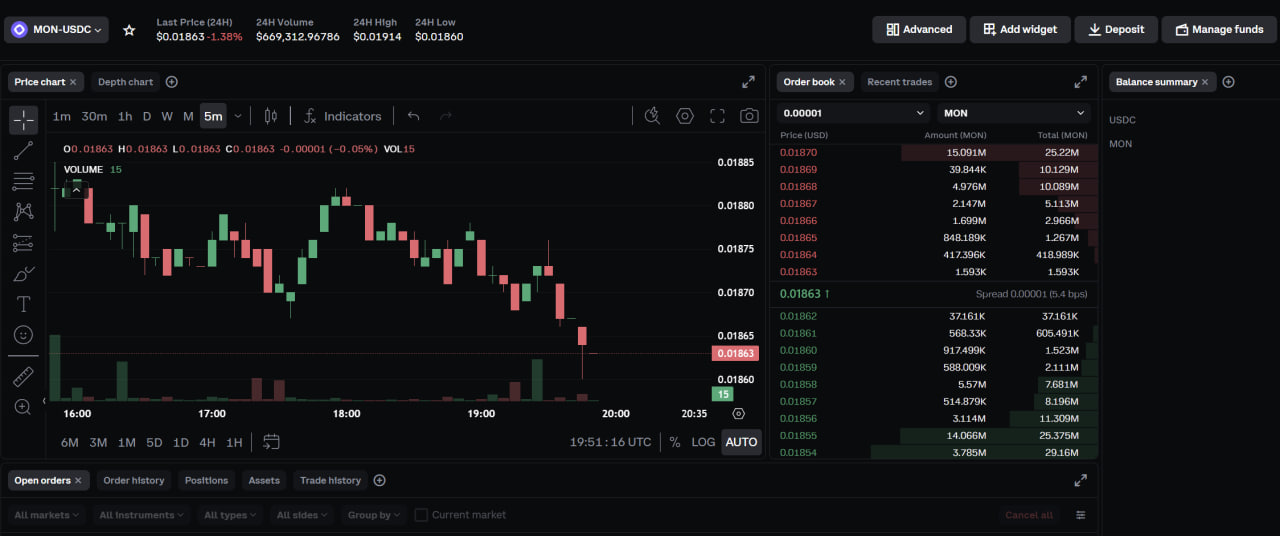
MON is listed on several major exchanges, including Coinbase, OKX, Bybit and Kraken, so you can buy it with stablecoins, another crypto, or in many cases a direct fiat purchase.
- Open an account and add funds. Sign in to your exchange of choice and deposit fiat or crypto if you have not already. Buying MON works like any other pair on the platform.
- Buy MON. Search for the MON trading pair, enter the amount you want, and confirm the order. A market order fills immediately at the current price; a limit order lets you set the price you are willing to pay.
- Withdraw to your Monad address. Go to the withdrawal screen, paste your wallet’s Monad address, and select Monad as the network. This is the step people get wrong. The network dropdown often defaults to Ethereum, and if you send MON over the wrong network it can be gone for good. Several exchanges now support direct withdrawal to the Monad network, which lets you skip bridging entirely and avoids congestion on bridge routes.
- Confirm and wait for arrival. Approve the withdrawal and any security checks. Given Monad’s sub-second finality, the tokens should appear in your wallet shortly after the exchange processes the request.
Send a small test amount the first time. If it arrives, send the rest.
Bridge to Monad
If you already hold assets on Ethereum or another chain and would rather move them across than buy fresh, you can bridge instead. Use the official Monad bridge or a supported third-party bridge to move funds onto the network, then swap into MON on a Monad DEX such as those covered later in this guide. Worth knowing: around launch the official bridge was patchy, and a lot of people routed through Jumper Exchange instead. If the official one stalls, that’s the usual fallback.
How to Stake MON
Staking is one of the main reasons to hold MON beyond trading it. By staking, you help secure the network and earn rewards in return. On Monad you can stake in two broad ways: delegate directly to a validator, or use a liquid staking protocol that gives you a tradable token representing your staked position.
Direct staking
The straightforward route is delegating your MON to a validator, who runs the infrastructure that secures the chain. You keep your tokens, the validator runs the hardware, and you collect a share of what it earns.
- Connect your wallet to a staking interface and make sure you are on Monad Mainnet.
- Choose a validator and enter the amount of MON you want to stake.
- Confirm the transaction in your wallet to delegate your stake.
- Earn and manage rewards over time, and unstake when you decide to, subject to any unbonding period the network applies.
Liquid staking
Liquid staking has become the more popular option on Monad because it keeps your capital usable. Instead of locking MON away, you receive a liquid staking token in return that you can trade, lend, or use as collateral across DeFi while it continues to earn staking rewards in the background.
Liquid staking carries the usual smart-contract risk that direct delegation does not, so weigh the added flexibility against that before choosing.
How to swap tokens on Monad
Swapping is the most common first action once you hold MON. The example below uses Monorail, which routes your trade across Monad’s DEXs for the best price, but the flow is similar on Kuru or any other DEX.
- Connect your wallet. Open the app and connect your wallet, confirming you are on Monad Mainnet.
- Choose your tokens. Select the token you are swapping from and the one you want to receive, for example MON to USDC.
- Enter the amount and review. Type the amount, then check the quoted rate, price impact and any fees before continuing.
- Confirm the swap. Approve the transaction in your wallet. Thanks to Monad’s sub-second finality, the swapped tokens arrive almost immediately.
Exploring the Monad Ecosystem
With the network in production, hundreds of applications now run on Monad. The selection below covers the most useful starting points across each category. For the full, current catalogue, the official Monad App Hub is the definitive reference.
Trading and DEXs
- Kuru is a trading hub and on-chain order book DEX, one of Monad’s flagship venues.
- Monorail is an aggregator that routes trades across Monad’s DEXs to find the best price.
- Uniswap, PancakeSwap, Curve and Sushiswap all run natively on Monad for familiar swapping.
- Perpl, Bean Exchange, Monday Trade and LeverUp cover perpetuals and leveraged trading.
Lending and yield
- Curvance lets users build leveraged positions from interest-bearing assets in a single transaction.
- Morpho, Euler, Gearbox, TownSquare and Neverland round out the lending market.
Liquid staking
See the staking section above for the main protocols.
Launchpads
- Nad.fun is a leading launchpad for tokens and memecoins, with built-in trading and prediction features.
- Flap, Token Mill and Printr are other active launch venues.
NFTs and collectibles
- OpenSea supports Monad collections through its familiar marketplace.
- PlayKami is a gamified collectibles marketplace built on Monad.
Games, social and prediction markets
- Lumiterra is an AI-powered open-world game.
- Kizzy is a social-media betting platform, and Levr offers leveraged sports betting.
- Farcaster brings onchain social to Monad.
What is Monad?
Monad is a high-performance Layer 1 blockchain that is fully compatible with the Ethereum Virtual Machine while pushing scalability and throughput well beyond most existing networks. Because it is EVM compatible at the bytecode level, developers can deploy their existing Ethereum applications on Monad without rewriting them.
The network was built to address the limitations that constrain chains like Ethereum, combining high transaction throughput, low latency and very low fees. Those are the qualities that matter most for decentralized finance, from DEXs and lending protocols to yield strategies, and they are central to why Monad drew so much attention in the run-up to its launch.
The numbers: up to 10,000 transactions per second, blocks around 0.4 seconds, finality near 0.8. It reaches that performance through a combination of parallel execution, which processes many transactions at once rather than one after another, and a custom consensus mechanism called MonadBFT. The result is centralized-exchange-level speed while keeping full compatibility with the Ethereum tooling developers already use.
What is Monad Testnet?
The Monad testnet was the public proving ground for the network before mainnet, and it remains live today as a developer sandbox. Its public version launched in February 2025 and quickly became one of the most active testnets in crypto, letting developers and users experiment with transactions, smart contracts and dApps in a risk-free environment without putting real funds at stake.
Its role has changed since mainnet went live. Rather than a staging area ahead of launch, the testnet now serves as a space for teams to test new code and for the protocol itself to trial upgrades before they reach production. It was reset from genesis in December 2025 and continues to receive network upgrades, such as MONAD_NINE in early 2026, which keep it aligned with the live chain.
Tokens on the testnet are obtained from faucets and have no value, since they exist purely for testing. This is the one place where Monad faucets still matter, as a tool for builders rather than a route to real MON.
Monad’s Investors and Funding
Monad’s rise has been backed by serious capital. Across its venture rounds the project raised roughly $244 million, led by some of the most prominent names in crypto investing and reflecting strong confidence in its potential as a fast, scalable Layer 1.
Major funding rounds:
- February 2023: a $19 million seed round led by Dragonfly Capital, with Shima Capital, Lemniscap, Placeholder Ventures and Finality Capital Partners participating.
- April 2024: a $225 million round led by Paradigm, with support from Electric Capital, Greenoaks Capital and Coinbase Ventures, valuing the project at around $3 billion.
- May 2024: a strategic round with investment from OKX Ventures, with the amount undisclosed.
The venture money wasn’t the whole story. Ahead of mainnet, Monad also raised straight from the public. In November 2025 it held a token sale on Coinbase’s token sales platform, the first ever hosted there, selling MON at $0.025 per token. The sale raised around $269 million from more than 85,000 participants, well above its initial target.
Monad has also drawn backing from notable angel investors, including Naval Ravikant, Eric Wall, Rune Christensen and punk6529, further reinforcing its credibility.
FAQ
Who is behind the Monad blockchain?
Monad was built by Monad Labs, founded in 2022 by Keone Hon (CEO), James Hunsaker (CTO) and Eunice Giarta (COO). The team’s background is in low-latency programming and distributed systems, much of it from high-frequency trading, which shaped Monad’s focus on speed and parallel processing.
Where can I buy MON, and is it a live token?
Yes. MON launched as a tradable token when Monad’s mainnet went live on November 24, 2025. It is available on major exchanges including Coinbase, OKX, Bybit and Kraken, and you can withdraw it directly to the Monad network or bridge assets in and swap for it on a Monad DEX.
Did the Monad airdrop already happen?
It did. The MON airdrop was distributed to early users ahead of mainnet, with the claim window open from October 14 to November 3, 2025. It is no longer possible to claim, so any current activity on Monad is about using the live network rather than farming a future drop.
How does Monad compare to Ethereum?
Monad positions itself as a high-performance alternative to Ethereum, aiming for far faster transaction processing as a pure Layer 1 rather than relying on Layer 2 networks. Where Ethereum pursues scale largely through rollups and other off-chain layers, Monad keeps everything on a single chain and achieves its throughput through parallel execution and its MonadBFT consensus, while remaining fully compatible with Ethereum’s tooling.
How does Monad differ from Solana?
Both chains target high throughput, but they take different routes. Solana uses Proof of History alongside Proof of Stake and has faced ongoing debate about validator hardware demands and decentralization. Monad runs a single EVM-compatible chain that validates transactions directly, using parallel execution and pipelined consensus to reach high speeds while staying compatible with the existing Ethereum ecosystem.
When do locked MON tokens start unlocking?
A significant portion of MON’s supply remains locked under a cliff-vesting schedule, with the first major unlock expected around November 2026, one year after launch. This is one of the main dynamics investors are watching, since new supply entering circulation can affect the market.
Conclusion
Getting started with Monad in 2026 is straightforward: buy MON on a major exchange, move it onto the network with a wallet of your choice, put it to work through staking, and start poking around the apps that catch your eye.
The months ahead are worth watching. The first major token unlock arrives around November 2026, bringing fresh supply into circulation, and Monad’s development arm has signaled a possible open-market buyback of MON in the meantime. Both will shape how the network develops as real usage becomes the measure of its progress.
For now, the practical path is simple: get some MON, choose a wallet, and start interacting with the apps that interest you. The ecosystem is still young and evolving quickly, so the best way to understand it is to use it.
Last update: 27.06.2026
This article is for informational purposes only and does not constitute financial advice. Consult a professional before making investment decisions.



Kosta has reported on cryptocurrency markets and blockchain infrastructure since 2020, bringing over six years of hands-on experience in the crypto industry built through daily tracking of markets, trends, and emerging blockchain developments. Specializing in Bitcoin on-chain analysis, institutional ETF flows, and digital asset price action, his work at Coindoo has been cited by other news agencies and consistently covers market developments with a focus on data-driven reporting across Bitcoin, Ethereum, Solana, and XRP. Over the years, Kosta has contributed to multiple crypto media outlets in different regions, authoring over 6,000 articles across the sector. His reporting spans cryptocurrency markets and the broader fintech industry, tracking not only price action but also the technological and regulatory forces shaping the ecosystem. To support his analysis, Kosta actively leverages on-chain data and metrics from leading platforms such as Santiment, Glassnode, and CryptoQuant, enabling deeper, evidence-based market insights. He believes in the power of transparency and the data that underpins the blockchain ecosystem. His academic background in Marketing Management from Denmark further complements his analytical approach, adding a strong understanding of communication strategy and content positioning to his work.