Bitcoin Outlook: Whale Losses Mount, Volatility Risks Increase

Bitcoin’s slide has deepened, but the debate now stretches beyond price action. After falling more than 40% from its peak, the world’s largest cryptocurrency is facing mounting questions about its long-term role in global markets.
Key Takeaways
- Bitcoin has dropped over 40% from its peak, raising questions about its long-term narrative.
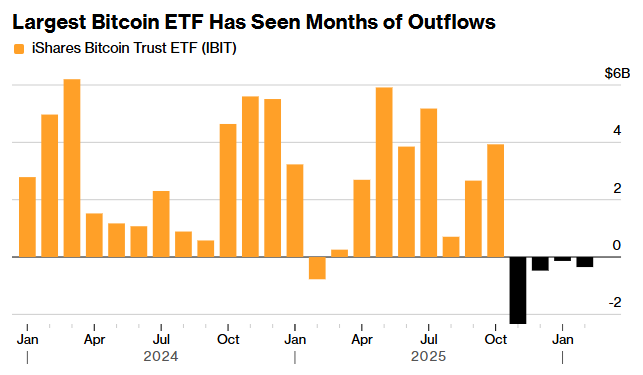
- The largest Bitcoin ETF has seen sustained outflows, signaling weaker institutional demand.
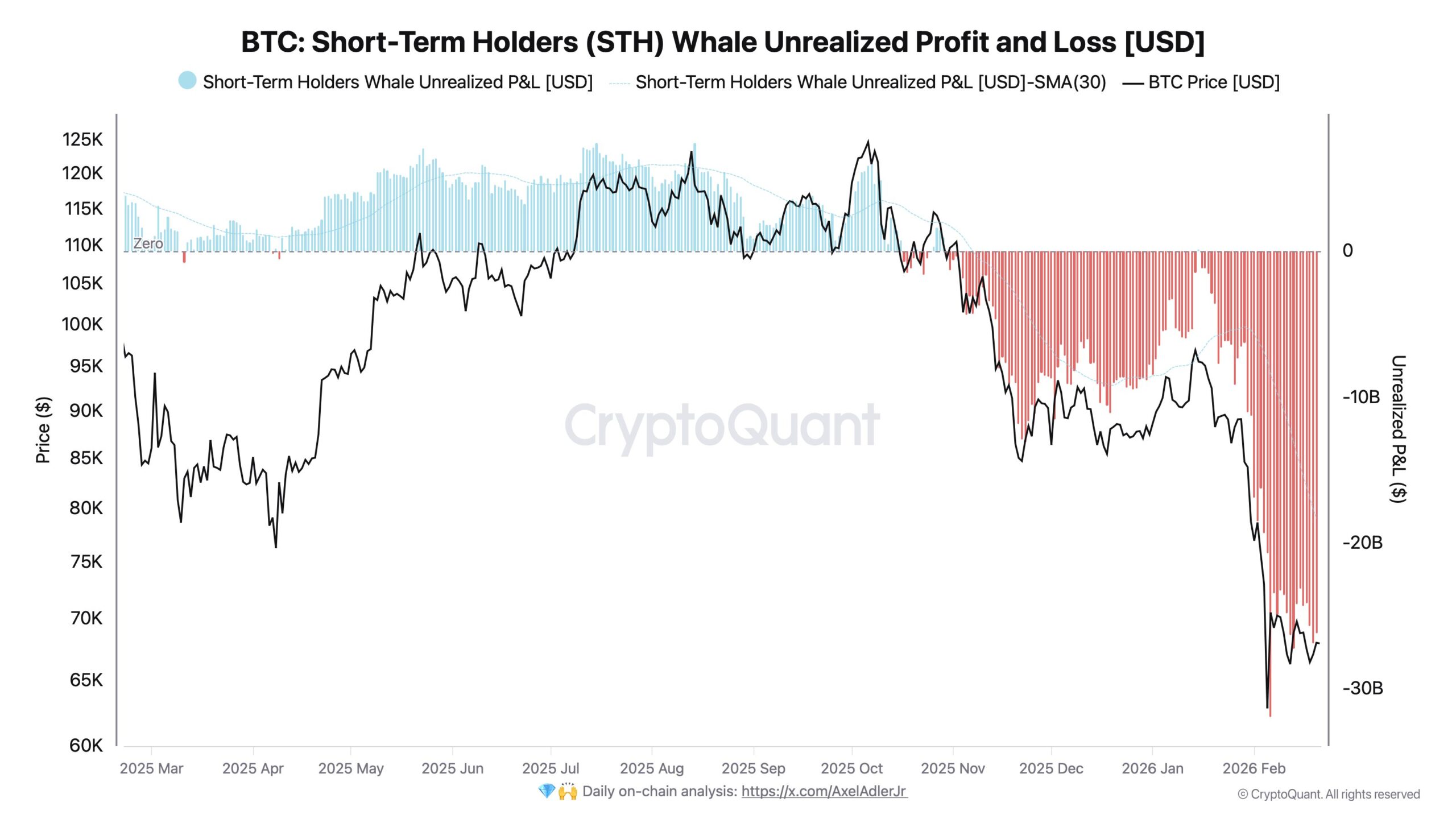
- Short-term whales are holding roughly $26 billion in unrealized losses, increasing volatility risk.
- Rising competition from gold and stablecoin use cases is pressuring Bitcoin’s “digital gold” thesis.
The recent drawdown has coincided with a noticeable cooling in demand. Once propelled by powerful narratives around scarcity and “digital gold,” Bitcoin is now competing on multiple fronts. Gold has regained favor as a macro hedge, stablecoins are increasingly dominating payments use cases, and tokenization as well as prediction markets are drawing speculative capital elsewhere.
ETF Outflows Signal Cooling Institutional Appetite
The pressure is also visible in exchange-traded fund flows. The largest Bitcoin ETF, BlackRock’s iShares Bitcoin Trust (IBIT), has recorded months of persistent outflows, underscoring softer institutional appetite. What was once viewed as a structural tailwind from Wall Street is now offering less immediate support as investors rotate toward traditional safe havens and high-growth AI-linked equities.
The “digital gold” thesis appears under strain at a time when precious metals are rallying. Analysts note that unlike equities or commodities, Bitcoin lacks cash flows or industrial demand to anchor valuations during prolonged downturns, leaving sentiment as the dominant driver.
Short-Term Whales Sitting on Billions in Losses
On-chain data reveals additional fragility beneath the surface. Unrealized losses held by short-term holder (STH) whales – wallets that accumulated Bitcoin within the past six months – have climbed to roughly $26 billion.
The most acute stress point occurred on February 6, when Bitcoin briefly dipped below $60,000. At that moment, unrealized losses for these newer large holders surged to approximately $32 billion, marking one of the highest stress readings of the year.

Market observers warn that elevated paper losses among late-cycle entrants can amplify volatility. When large holders sit deeply underwater, renewed price swings often trigger emotionally driven selling, creating feedback loops that intensify downside pressure.
Narrative Shift or Structural Reset?
Bitcoin remains the most established crypto asset and has endured multiple boom-and-bust cycles. However, its core story – rising prices fueled by expanding adoption – is facing renewed scrutiny.
With ETFs seeing outflows, short-term whales under water, and alternative crypto use cases attracting capital, the market is increasingly asking whether Bitcoin can redefine its utility or whether its dominance will gradually erode.
For now, the asset stands at a crossroads: either reclaim its narrative strength or adapt to a digital-asset landscape that is no longer revolving around a single coin.
The information provided in this article is for educational purposes only and does not constitute financial, investment, or trading advice. Coindoo.com does not endorse or recommend any specific investment strategy or cryptocurrency. Always conduct your own research and consult with a licensed financial advisor before making any investment decisions.




Alexander Zdravkov is a market analyst and crypto journalist with interests in economics, broader financial markets and digital assets. His journey into crypto began more than four years ago, driven by a fascination with the rapid evolution of blockchain technology and the transformative potential of decentralized finance. He began analyzing market cycles and identifying emerging trends before they reach the mainstream. He holds a degree in International Relations - a background that helped shape his broader perspective on global economics, geopolitics, and the interconnected nature of modern financial markets. Whether covering the latest developments in the crypto sector or exploring broader macroeconomic themes, Alexander focuses on giving readers context rather than simply repeating headlines. During his career, he has authored more than 10,000 articles covering cryptocurrencies, traditional finance, and global market developments. His work spans everything from Bitcoin and altcoins to macroeconomic trends influencing risk assets worldwide.